
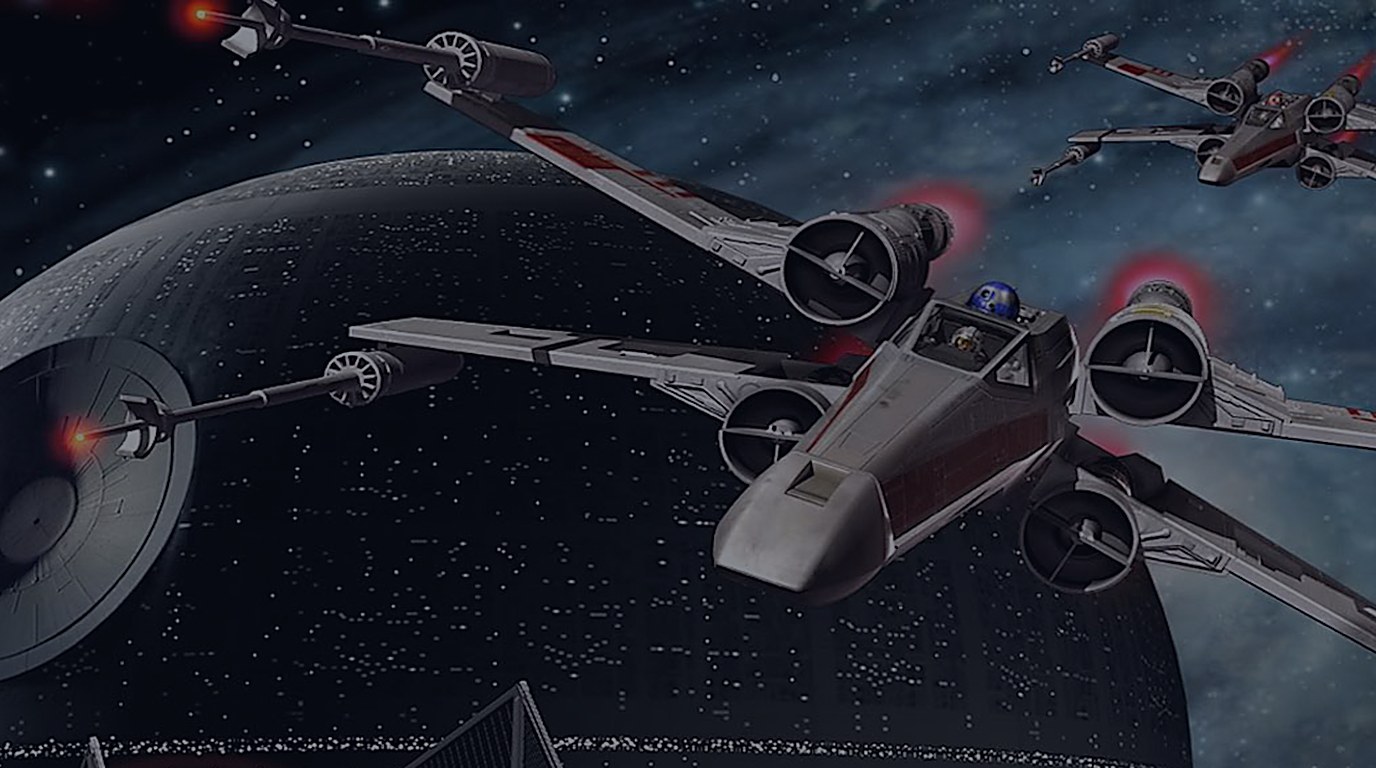
There’s a moment in the Battle of Hoth where your X-wing pulls up off the snow and the camera swings wide — and in a headset, that swing is your neck, not a cutscene. I’ve lost count of how many times I flew Rogue Leader flat on a GameCube, but the first time I flew it with my head actually inside the cockpit, the AT-ATs didn’t feel like a render. They felt like they were down there, and I was up here, and the snow was between us.
That feeling is the whole argument for Rogue Leader in VR. Factor 5 built one of the best-looking games the GameCube ever shipped, a 60fps arcade space-combat showcase with a chase cam welded to your ship’s tail and an optional cockpit view. It was never a VR game — Nintendo and LucasArts never shipped a headset mode, and they never will. What we have instead is the long tail of GameCube emulation doing what emulator communities do best: dragging a beloved flat game into stereoscopic 3D with head tracking, and then, in the last few weeks, something even more interesting.
Rogue Leader VR routes: DolphinXR emulation vs RedTwoVR recompilation
There is no official VR mode. There never was. What exists is a small stack of community routes, and right now the honest picture is two of them.
The one you can actually count on is DolphinXR — iChris4’s maintained fork of the Dolphin GameCube emulator with OpenXR bolted on. This isn’t the old abandoned Carl Kenner Dolphin VR build that produced most of the Rift-era footage you’ll find on YouTube; it’s a living project that rebases on current Dolphin development and adds per-eye stereo rendering, 6DOF head tracking, life-size scale, a 3D HUD, free look, and a “Shader Hunter” for per-shader overrides. Crucially, its v0.5 release shipped a patch written specifically for this game. A maintainer fixed a Rogue Leader rendering defect because people are playing it in VR.
RedTwoVR is a fork of Red Two, the static recompilation that turns the GameCube binary into native PC code — and it adds an OpenXR layer plus a stereo render path straight into the game’s own graphics backend. Structurally that’s the better ceiling: no emulator interpreter, no shader pipeline to fight, just the game running native with two eyes. The catch is brutal honesty — it landed one day before I wrote this, with no gameplay footage and no reception yet. It’s real, it’s verified to exist, and it is not yet a proven way to play.
Both routes demand the same thing the law requires anyway: your own ripped copy of the GameCube USA disc, revision 0. Nothing copyrighted ships with any of these projects.
Hoth in stereo: Rogue Leader VR head tracking and cockpit presence
I expected a tech demo — a floating window with depth. What I got instead was a cockpit I could lean into. The head tracking is the whole experience: you crane to watch a TIE bank past your canopy, you look down the trench as the camera drifts, you turn your head to find the next target instead of waiting for the ship to swing. The 3D HUD sits in space in front of you rather than painted on glass. It reads like a seat, not a screen.
Controls are plain gamepad, and that’s the right call for the genre. Your guns fire along the ship’s nose; the reticle is the X-wing, not your hands. There’s no free-aim to map to a wand, so motion controllers would add nothing the ship doesn’t already do. You fly with a stick, you look with your head, and the split between “what the vehicle does” and “what I’m watching” is exactly the fantasy the flat game was always reaching for.
Comfort sits at moderate intensity — the dogfight roll and pitch are real and the game uses them hard, but there’s no artificial locomotion or snap-turning to fight.
The presence is the win. Snow, distance, the sheer scale of the Star Destroyers — these are things the flat game told you about with framing, and VR just hands them to you spatially. The trench run, flown head-tracked with the surface filling your peripheral vision, is the moment the whole effort pays for itself.
Rogue Leader VR setup: USA disc image, OpenXR runtime, and the VR Wide Terrain Culling patch
Both routes start with the same thing: your own USA copy of the game, dumped as a disc image (GSWE64 rev 0). DolphinXR asks for its v0.5 build and an active OpenXR runtime, plus one non-obvious step — opening the game’s Properties and enabling the VR Wide Terrain Culling patch. That patch is what stops the Death Star surface from tearing when you turn your head, and it is the clearest sign the game is being actively played in VR rather than merely booting. RedTwoVR skips the emulator layer entirely because it is a native recompilation, but at one day old it has no setup guide beyond the upstream README. Either way you are flying with a gamepad: the ship’s nose is the crosshair, so there is no free-aim reticle for motion controllers to drive.
For all the setup, the cockpit presence is real — this is the Star Wars fantasy the flat game only ever gestured at, and it genuinely lands in VR. The price is an emulator you configure yourself and a disc you have to own and rip. The native recomp is the more exciting ceiling, but it’s a day old and unproven — install DolphinXR, not RedTwoVR, if you actually want to fly tonight.