
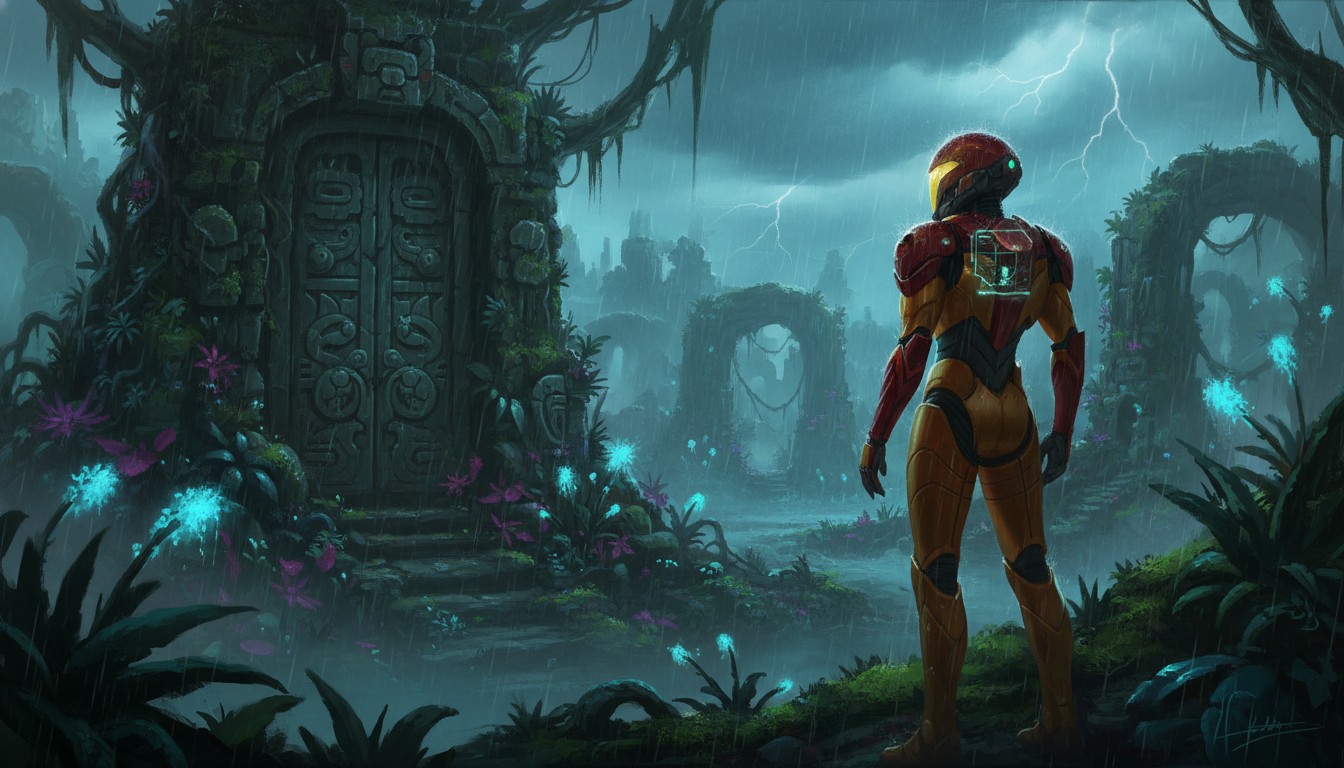
The first time you raise the scan visor and the world dissolves into a wireframe grid that wraps across your entire field of view, you stop thinking about the emulator. You stop thinking about the GameCube, or 2002, or the fact that you’re wearing a headset to play a game that predates consumer VR by over a decade. You’re just Samus Aran, standing in the rain on Tallon IV, staring at an alien door mechanism and wondering what the hell it wants from you.
That’s the Dolphin VR version of Metroid Prime, and it’s one of the most convincing arguments that a flat first-person game can become something genuinely spatial without a single line of official VR code.
What This Actually Is
Dolphin VR is a fork of the open-source Dolphin emulator. It takes GameCube and Wii games and adds stereoscopic 3D rendering plus full six-degrees-of-freedom head tracking. It is not an official VR product. Nintendo had nothing to do with it. The base emulator’s legal and technical foundations are solid, but this is community-driven experimentation — a wrapper around an existing game that fakes VR well enough to make you forget, for stretches at a time, that it’s faking anything at all.
For Metroid Prime specifically, the fit is almost unnaturally good. Retro Studios built the game as a first-person adventure where you inhabit a suit. There’s no third-person camera to break. The HUD is diegetic — a helmet display you see from inside Samus’s visor. The world is built for slow, deliberate exploration rather than twitch reflexes. All of that maps to VR with embarrassingly little friction.
The Primed mod changes the equation further. Built on top of Dolphin VR ReduX (and its continuation as Dolphin XR), Primed adds motion-tracked arm cannon aiming — your controller becomes Samus’s arm, independently tracked from your head. You physically aim at targets. You raise your hand to scan. The gap between “emulator trick” and “actual VR game” narrows considerably when you’re pointing a weapon with your real hand instead of steering it with your gaze.
How It Plays
Movement stays on a gamepad. Walking, jumping, morph ball, weapon switching — all of that stays under your thumbs. Your head handles the camera. Look up, and the view tilts up. Lean sideways, and you peer around a corner. But now your right hand aims the arm cannon independently. You can track a target while looking elsewhere. You can snap between enemies with a flick of the wrist. The decoupling between where you’re looking and where you’re shooting transforms combat from a gaze-locked exercise into something that feels like native VR aiming — because it is.
The visor system is the star, and Primed makes it shine harder. Combat visor, scan visor, thermal visor, x-ray visor — each one slaps a full-screen filter across your vision. On a television, these are cool effects. In a headset, they feel like hardware toggles inside an actual helmet. Scanning objects now means physically pointing at them with your controller, raising your arm to interrogate the environment. It feels less like a menu selection and more like an act of observation — because you’re literally reaching out and looking. The thermal visor, with its grainy monochrome heat signatures and warping interference, is genuinely unsettling in close quarters. The x-ray visor’s skeletal reveal of enemies you thought were solid hits harder when the distortion fills your peripheral vision.
Stereoscopic 3D gives the environments volume you can’t get on a flat screen. The Chozo ruins have actual depth. The magma pools in Magmoor Caverns feel like pits rather than painted backdrops. When you drop into the morph ball and roll through tight tunnels, the sense of enclosure is far more immediate — which is either thrilling or suffocating, depending on your claustrophobia threshold.
The Problems Nobody Hides
Let’s be blunt about the comfort. Metroid Prime was not designed for VR. It has artificial locomotion everywhere — smooth strafing, jumping, falling, elevator rides, and the morph ball’s rapid rolling. The camera bobbles. Cutscenes wrench control away without warning. The morph ball’s tunnel-vision sprint can wreck a sensitive stomach in under a minute. Primed gives you real aim, but real aim doesn’t fix real motion sickness. Players with established VR legs report hour-long sessions without issue. Players without them report quitting after the first save room. This is highly variable in the extreme, and there’s no comfort menu to bail you out. The bittersweet truth: the controls are finally right, but your stomach is still the gatekeeper.
Graphically, the emulator needs help. Metroid Prime aggressively culls objects outside the original camera’s field of view, which means that in VR — where you can turn your head independently of the game camera — walls, enemies, and entire room sections can vanish from your peripheral vision. Fixing this requires applying AR culling codes, a manual step that sits somewhere between “mild inconvenience” and “debugging nightmare” depending on your tolerance for hex values. Even with codes applied, occasional texture pop-in, HUD scaling issues, and scan visor resolution drops remind you that you’re looking at an emulated GameCube game through a hacked renderer.
The HUD is another hangover from flat-screen design. The helmet overlay — health, radar, ammo, danger warnings — was built for a 4:3 television viewed from a couch. In a headset, some elements feel too large, others too small, and the persistent border framing can feel claustrophobic. It’s readable, but it’s not elegant.
Performance depends heavily on your hardware. Dolphin emulation already stresses a CPU in certain areas — the rain-soaked intro, dense rooms with multiple enemies — and rendering the scene twice for stereo 3D adds overhead. Primed’s motion control layer adds its own processing on top. The game is playable on mid-range hardware if you accept some dropped frames in demanding sequences, but you’ll need a solid PC to maintain consistent comfort framerates throughout.
The Experience, Honestly Assessed
Despite all of that, this is still Metroid Prime in a headset with motion-tracked aim, and that combination is hard to dismiss. The isolation that defines the game — the silence of abandoned ruins, the environmental storytelling told through scan data, the gradual unlocking of a hostile alien world — gains presence when you’re inside it rather than watching it. Tallon IV stops being a level and starts feeling like a place you got dropped into. And now you can reach into that place, point your arm cannon at what’s trying to kill you, and feel the connection between your real hand and Samus’s weapon in a way that thumbstick aiming never provided.
The game’s structure helps. Metroid Prime is slow. It rewards looking around. It doesn’t rush you with timed sequences or relentless enemy waves. That pace is a gift in VR, where sensory overload is the enemy. You can stand on a platform and just watch the rain. You can scan every piece of lore without feeling like you’re burning time. The game wants you to inhabit the space, and VR makes that literal.
Who Should Bother
This is for Metroid fans who own a PCVR headset and don’t mind technical setup. It’s for emulator enthusiasts who already know their way around Dolphin’s menus. It’s for players with established VR tolerance who want a substantial, atmospheric adventure rather than another wave shooter. If you’ve got the stomach for it and the patience to configure culling codes, the payoff — especially with Primed’s motion controls — is one of the most memorable ways to experience a canonical game.
If you’re new to VR, sensitive to smooth locomotion, or expect plug-and-play polish, skip it. Dolphin VR is not a consumer product. There is no support hotline. The fork is stable but quiet, and while it works, it makes no apologies for being a hack.
For everyone else, there’s something remarkable about standing inside a twenty-year-old game and discovering it feels like it was always meant to be seen this way. The visor clicks down. The rain streaks across your helmet. You raise your arm cannon toward the sound of something screaming in the ruins, and for a moment, the emulator disappears entirely.