
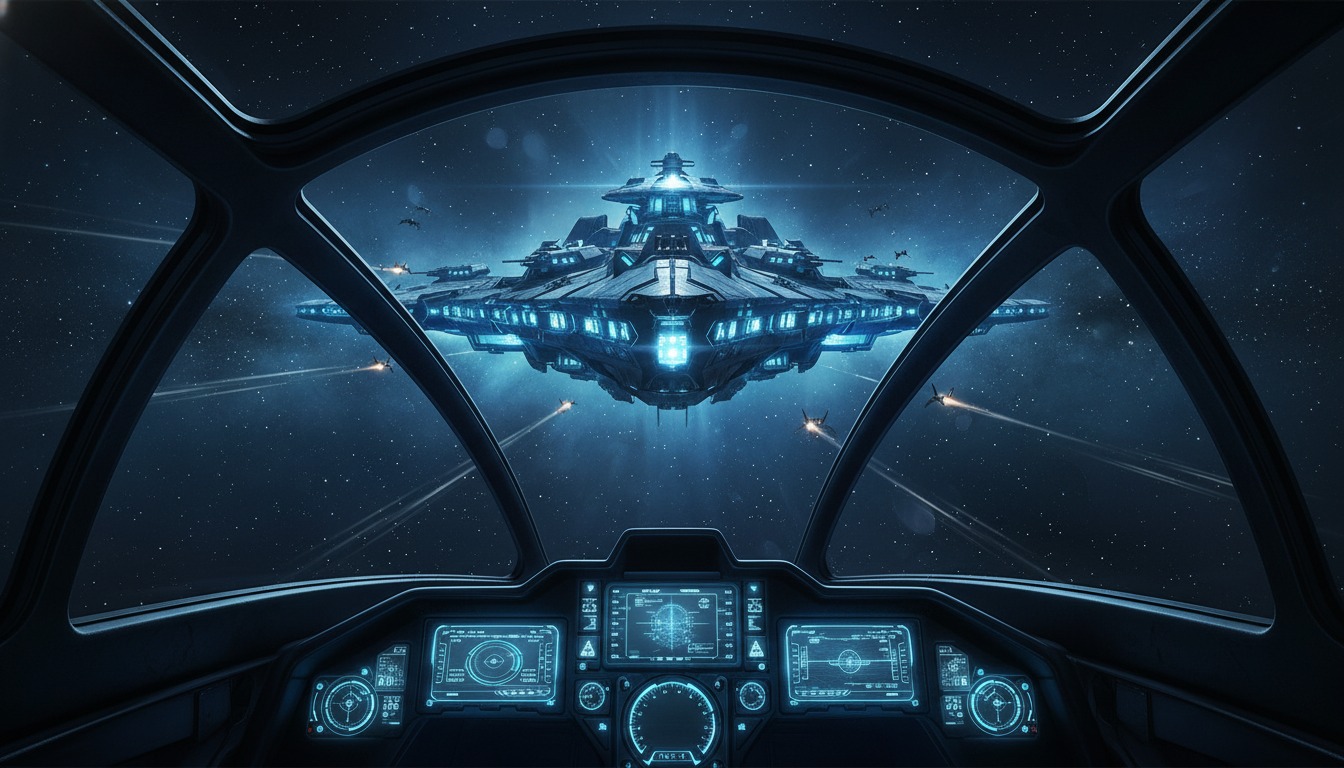
The first time you drop out of hyperspace and an Imperial Star Destroyer fills your entire field of view, you understand why Motive Studios built this game in first-person. In VR, that moment isn’t impressive — it’s physical. Your head actually tilts back. The cockpit glass frames the threat like a viewport into someone else’s nightmare. For about fifteen seconds, Star Wars: Squadrons makes good on every childhood fantasy of sitting in an X-Wing.
Whether it keeps that promise depends heavily on what you’re expecting, what hardware you’re running, and how much you care about multiplayer.
Squadrons is an official hybrid: one build, one purchase, VR toggled from the menu. On PC it supports PCVR headsets via SteamVR or native Oculus SDK. On PlayStation it launched day-one for PSVR. There is no hand presence, no motion controller support, and no VR-ified interactions. You sit in a chair, you look around with your head, and you fly with a gamepad, keyboard and mouse, or a HOTAS setup. That design choice is defensible — a flight stick offers the resistance and precision that waggling motion controllers can’t replicate — but it also means this is cockpit tourism, not full-body VR.
The campaign runs roughly ten hours and bounces between the New Republic’s Vanguard Squadron and the Empire’s Titan Squadron, set in the limbo between Return of the Jedi and The Force Awakens. The story won’t rewrite Star Wars canon, but the mission design has genuine highlights: threading through debris fields, bombing capital ships, drifting around asteroids in a chase that feels plucked from the films. The cast of new characters is stronger than it needed to be, and the hangar sequences between missions let you soak in the atmosphere.
But the campaign is also clearly a tutorial with cutscenes attached. Most missions rotate through the same objectives — eliminate fighters, defend a ship, escape the blast radius — and the difficulty curve can feel either punishing or patronizing depending on your familiarity with energy management and drifting mechanics. In VR, the cutscenes are particularly jarring: they play in a floating letterbox window, breaking the cockpit illusion every time the story wants to show you something dramatic happening outside your ship. It’s the kind of compromise that makes sense for a hybrid build, but it stings every time.
Where Squadrons originally shone was multiplayer. The 5v5 dogfighting and fleet battles are mechanically excellent, with genuine depth in loadout customization, subsystem targeting, and team coordination. In VR, head tracking gives you a real advantage for spotting threats and tracking targets through canopy frames — especially in the open-cockpit Rebel ships. The TIE Fighter’s restricted viewport is claustrophobic by design, and that design choice actually lands harder in VR than on a flat screen.
The problem is that the multiplayer is functionally dead. Lobbies are sparse, matchmaking is slow, and the community has dwindled to a handful of dedicated players. There is no cross-generation support for PSVR2, no ongoing content updates, and no reason to expect a revival. If you’re buying this now, buy it for the campaign and the solo fleet battles against AI. Do not buy it for the multiplayer experience that existed in 2020.
Technically, the PCVR version is where things get complicated. The game has a well-documented history of stuttering, frame drops, and crashes — even on hardware that should handle it comfortably. Reports consistently describe choppy performance that doesn’t correlate cleanly with GPU power, suggesting the VR path was optimized around PSVR’s 60Hz baseline and never properly tuned for PC’s variable refresh rates. Launching VR from fullscreen mode can crash the game. The Steam version has historically performed worse than the EA App version. HDR handling can cause eye strain in headsets that don’t support it. Getting a smooth session often requires borderless window mode, lowered settings, resolution scaling below 100%, and patience.
On PSVR, the tradeoff is different: the performance is more stable because the target is fixed, but the resolution is softer, distant objects blur, and the TIE Fighter cockpits render darker than their PC counterparts. It’s still the same thrilling core experience, just at lower fidelity.
Comfort is a genuine concern. Space combat involves constant banking, rolling, and acceleration changes that no comfort setting can fully neutralize. The cockpit frame helps ground you, and experienced VR users often adapt after a few sessions, but this is not a starter VR experience. If you’re prone to motion sickness, Squadrons will test you.
The controls are a bright spot. A HOTAS setup is the definitive way to play — the Thrustmaster T.16000M and similar sticks map beautifully and add a physical authenticity that completes the fantasy. Gamepad works well and is perfectly viable for the campaign. Keyboard and mouse is supported but feels out of place in VR. The energy management system — shunting power between engines, lasers, and shields — is genuinely engaging and adds tactical texture to every engagement.
So who is this for? If you’re a Star Wars fan who already owns a VR headset and ideally a flight stick, the campaign alone justifies the price during a sale. The cockpit presence is that good. The scale of the ships, the detail in the instrument panels, the way enemy fighters whip past your canopy — these moments are hard to replicate in any other VR title.
If you’re looking for a polished, modern VR space sim with active multiplayer, full motion controls, and reliable performance, this isn’t it. The technical debt, the dead online scene, and the absence of any ongoing support make Squadrons feel like a time capsule — a genuinely good game that was left behind.
It’s worth opening, but you should know what you’re looking at before you climb into the cockpit.