
Westworld Awakening in VR: A Host Wakes Up, and It Gets Uncomfortable Fast
The first thing that happens in Westworld Awakening is that you are brutally murdered in an old west farmhouse. The second thing that happens is worse: you wake up again, because you’re a Host, and the people running the park need you to keep performing.
Survios — the studio behind Raw Data and Creed: Rise to Glory — partnered with HBO to turn the Westworld premise into a narrative VR horror experience, and the fit is obvious. The show is about consciousness, control, and being trapped in a loop. VR is uniquely good at making you feel trapped. Put the two together and you get a game whose best moments are less about jump scares and more about the slow realization that you are disposable.
What This Actually Is
Westworld Awakening is a single-player, PCVR-only narrative adventure set during the early events of Westworld Season 2. You play Kate, a Host who gains self-awareness and has to sneak through the Delos facility while another Host named Hank hunts her down. It launched on August 20, 2019, for SteamVR, Oculus Rift, and HTC Vive, with a simultaneous VR arcade release.
There is no flatscreen version. There is no Quest version. There is no UEVR profile or VorpX injection to hunt down — the game is already native VR with full motion controls. That makes the setup dead simple, but it also means the addressable audience is narrow: you need a PCVR headset and a tolerance for short, linear horror.
How It Plays
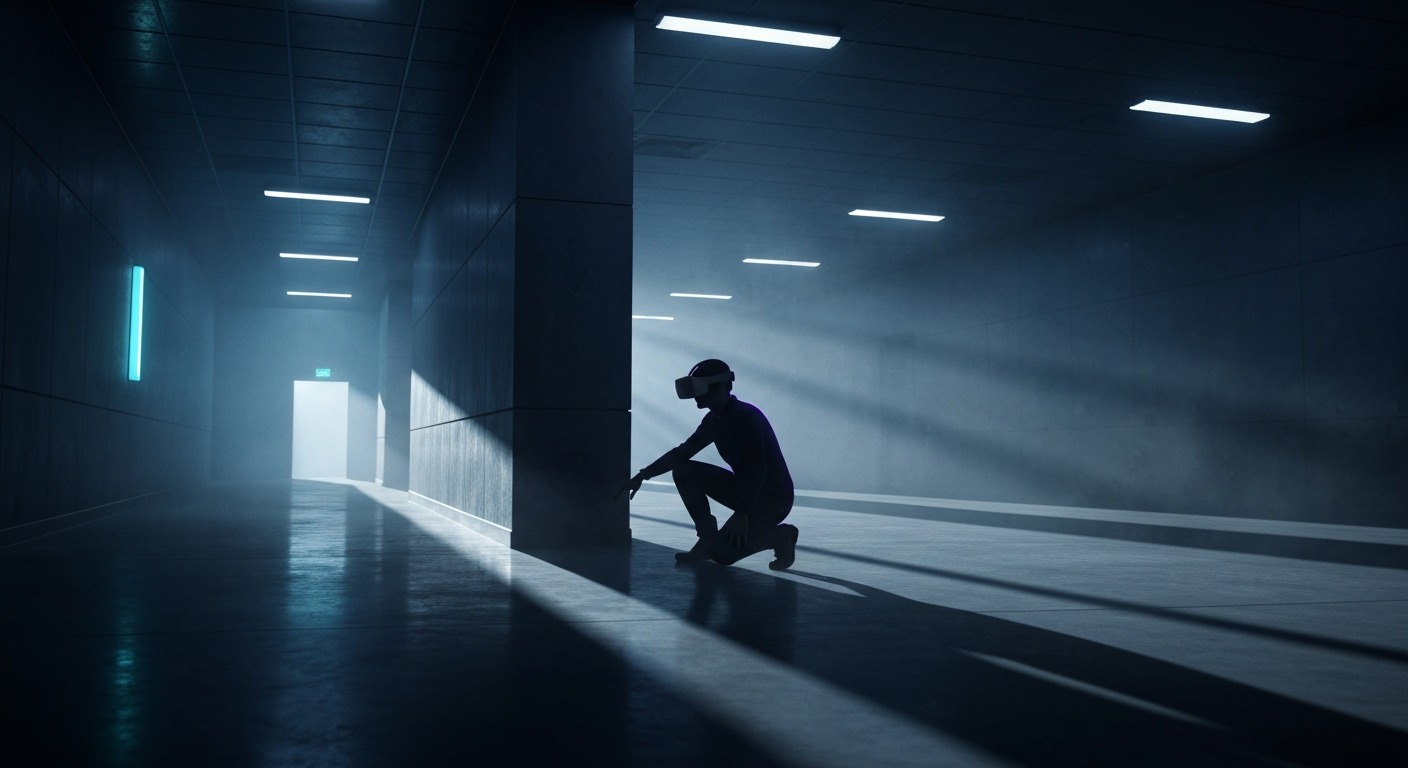
The pacing is deliberately slow. This is not a shooter. Most of the game is spent crouching behind cubicle walls, hiding under tables, shimmying through vents, and timing button presses so you don’t draw Hank’s attention. The AI is a little predictable — Hank struggles to check under objects, so you can game the stealth once you learn his patterns — but the tension holds because the sound design and environmental storytelling keep you off-balance.
The puzzles follow a simple loop: scan something, trace where it leads, find a key, unlock a door, repeat. It’s Alien: Isolation stripped down to its essentials, except the alien is a fellow Host who talks to you while he hunts you. The best puzzles involve manipulating other Hosts’ behavior, which ties neatly into the self-awareness theme. I wish the game had gone deeper with that mechanic, because every time it lets you rewrite another Host it becomes more than just a horror exercise.
Movement is stealth-oriented, so comfort is gentler than a smooth-locomotion shooter, but the first-person horror framing still makes it a moderate-intensity experience. If you’re sensitive to being chased in VR, the crouch-and-sprint sections will get to you regardless of comfort settings.
What It Does Well
The atmosphere is the star. The Delos facility feels sterile and threatening in exactly the right way, and the game is unafraid to make you feel small, watched, and used. The opening chapter — where you’re still inside the park’s scripted narrative and a “hero” character leers at you — is genuinely skin-crawling in a way that only works because you’re wearing a headset.
The license isn’t just window dressing. The themes of loops, memory, and awakening map directly onto the mechanics. You’re not playing a Westworld-themed escape room; you’re experiencing the show’s premise from the inside. That gives the game’s short runtime more impact than its length suggests.
Performance is reasonable on mid-range hardware from its era. As a 2019 PCVR title built around tight interiors rather than open environments, it runs well enough that you don’t have to think about frame timing while you’re trying not to get caught.
What Holds It Back
Length is the clearest limitation. My first playthrough clocked in around three hours, and while the developers suggested four to six hours for completionists hunting secrets, that’s still a single-evening experience. For a narrative game with little replay value, that’s a tough value proposition at full price.
The stealth mechanics also wear thin. Once you realize the AI doesn’t check under tables consistently, the horror becomes a puzzle of patience rather than genuine fear. The game wants you to feel hunted, but after the second chapter the hunting starts to feel choreographed.
And then there’s the platform lock, which is more a reach problem than a quality problem. No Quest release, no standalone version, no console port — so if you’re a Quest-only VR owner, this game may as well not exist. That’s a real shame, because this is exactly the kind of short, polished, atmosphere-first experience that deserves a wider audience. It would be great to see Survios bring it to more platforms eventually. But a narrow footprint doesn’t make the three hours that are here any less effective.
The Verdict
Westworld Awakening is a strong A-tier VR experience: a memorable, atmospheric few hours that uses its license intelligently and delivers real tension. It’s short, the stealth AI gets predictable, and the PCVR-only footprint keeps it from the audience it deserves — but what’s here is a tight, polished slice of Westworld that’s well worth an evening in the headset. If you already have a Rift, Vive, or Index and want a self-contained horror narrative, it’s worth the evening. Just know exactly what you’re buying: one night in the park, not a season.