
The Horror They Promised, The Horror We Got: Sevastopol in VR
For a decade, VR players dreamed of standing inside Alien: Isolation. The E3 demo haunted us. A community modder finally finished what Creative Assembly abandoned.
There’s a moment when you realize you’ve made a terrible mistake.
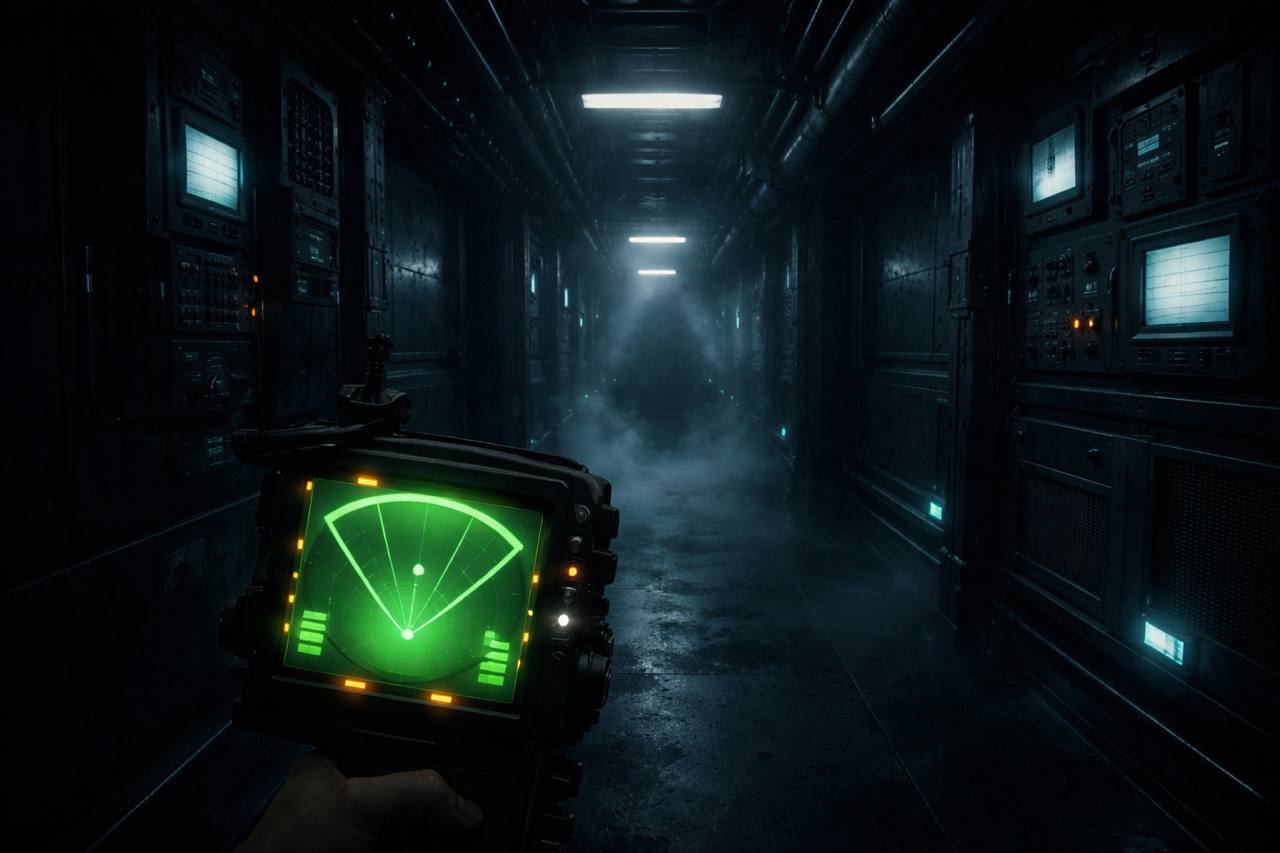
You’re crouched in a corridor, the flickering lights casting shadows that might be nothing. The motion tracker in your left hand shows a blip. Not moving. Yet. Your actual head turns slowly, trying to keep the corridor visible while checking the tracker. The physicality of that gesture—looking down at a device you’re holding, not pressing a button to see a UI overlay—changes everything.
Then the vent above you rattles.
You don’t think about frame rates or input mappings. You think about survival.
This is Alien: Isolation in VR. Not a polished commercial release. Not an official port. A promise made at E3 2014, abandoned by its publisher, then resurrected years later by modders who refused to let it die.
The Promise That Got Away
In June 2014, Oculus demonstrated Alien: Isolation at E3 using the DK2 development kit. The demonstration was electric. Journalists wrote about physically cowering from the Xenomorph, about feeling present in Sevastopol Station in a way that flat-screen gaming couldn’t replicate. It was, by all accounts, one of the most compelling VR experiences anyone had seen.
Then nothing.
Creative Assembly confirmed via social media that the VR implementation was “just a prototype” with “no full game in development.” The flat version of Alien: Isolation released that October to critical acclaim, winning awards for its atmosphere, AI, and faithfulness to Ridley Scott’s original film. But the VR demo became a ghost story told in enthusiast forums—proof of what could have been.
For years, the only way to experience Sevastopol in VR was to track down old DK2 hardware and wrestle with abandoned software configurations. The dream of standing inside Creative Assembly’s masterpiece faded into frustration.
What the Modders Built
The community refused to let it go.
The first major breakthrough came from Nibre, who created MotherVR—a mod that activated the dormant VR code buried in the game’s files. It wasn’t elegant at first. It required an Xbox controller or keyboard and mouse. It was designed for seated play. The camera animations could black out your view, the comfort settings were necessary rather than optional, and the whole thing felt like what it was: an alpha modification that proved the concept could work.
But it worked. And it was terrifying.
In 2018, MotherVR added motion controller support—Oculus Touch and Vive wands could now control the game. The implementation was a mapping of VR controller inputs to gamepad functions, not true hand tracking. You could aim with your controller, but your in-game hands didn’t move the way your real hands moved. It was better than nothing. It wasn’t the dream.
Then in 2025, the dream arrived.
A modder named JayP released GRAND-MotherVR, built on MotherVR’s foundation but fundamentally transformed. True six-degrees-of-freedom motion controls. Hand models that track your movements. Body presence—arms, hands, the physicality of occupying Amanda Ripley’s space. The mod doesn’t just enable VR; it reimagines how the game plays in it.
This is the version that matters now. Not the alpha that proved it was possible. The overhaul that made it feel native.
What It Actually Feels Like
The first thing you notice isn’t the Xenomorph. It’s Sevastopol itself.
Creative Assembly’s art direction has aged remarkably well—the CRT monitors, the analogue buttons, the lived-in industrial design that references the 1979 film’s production design without simply copying it. In VR, that attention to detail surrounds you. You’re not watching a screen that shows you a space station. You’re standing inside it.
The scale hits differently. Lockers aren’t just hiding spots on a HUD—they’re physical spaces you squeeze into. Corridors stretch longer. Ceilings press lower. The environmental storytelling that made the flat version compelling becomes immersive in a way that screenshots can’t capture.
And then there’s the motion tracker.
In flat gaming, it’s a clever UI element that you toggle to see enemy positions. In VR with motion controls, it’s an object you hold. You look down at it. You angle it toward doors, toward vents, toward the darkness where something might be waiting. The flashlight gesture—holding your right hand near your head and pressing a button—grounds you in Amanda’s equipment in a way that button mappings never achieved.
The Xenomorph, already one of gaming’s most sophisticated AI adversaries, becomes genuinely unpredictable when you’re physically present in its hunting grounds. The creature doesn’t follow scripted paths—it responds to sound, to sight, to the patterns it learns from your behavior. In VR, those moments when you freeze aren’t roleplay. They’re instinct.
The GRAND-MotherVR improvements make this playable in a way the original mod wasn’t. Terminals that were frustrating to navigate are now accessible. Text that was blurry is readable. The graphics overhaul—disabled LOD rendering, proper anti-aliasing, fixed shadows—transforms a 2014 game into something that looks surprisingly modern inside a headset.
Limitations and Caveats
This is still a community mod, not a commercial product.
The installation process requires multiple steps and some comfort with file management. It’s not “subscribe on Steam Workshop and play.” The GRAND-MotherVR project explicitly calls itself a test build, with known issues documented on its site. Occasional camera quirks after certain animations. Controls that aren’t fully configurable yet. Some weapon angles that don’t fire correctly. The original game’s scripted sequences—particularly those that take camera control away from the player—can still break immersion in ways that commercial VR ports have solved years ago.
Performance depends heavily on your hardware. The original game runs well on modest systems; VR rendering effectively doubles that load. The mod includes options for supersampling and various quality settings, but finding the right balance takes experimentation. Players with older headsets or mid-range PCs may need to compromise on visual fidelity to maintain the frame rates VR requires.
Comfort remains a consideration. Alien: Isolation was designed as a seated experience with a controller. Even with standing support added, this is not room-scale VR. You can’t physically walk around Sevastopol. The mod supports smooth and snap rotation, but the game’s design—particularly its more cinematic moments—assumes a fixed player perspective. Motion sickness is possible, though the mod’s comfort options help.
Finally, the mod requires the Steam version of Alien: Isolation. Epic and GOG versions aren’t supported yet. If you own the game on another platform, you’d need to repurchase it to play in VR.
The Gap Between Promise and Delivery
What’s remarkable about the VR experience of Alien: Isolation isn’t just that it works. It’s that it took the community a decade to finish something that the developer showed working in 2014.
The E3 demo wasn’t smoke and mirrors. The code was there, buried in the game files. Creative Assembly built a VR implementation that journalists played and praised. Sega chose not to release it. The reasons are likely complicated—certification costs, support infrastructure, uncertain market size for VR in 2014—but the result was a generation of VR enthusiasts wondering what could have been.
MotherVR proved it was possible. GRAND-MotherVR made it feel complete.
The difference matters. The original MotherVR release was playable, but it felt like what it was: a mod that activated dormant features and mapped controller inputs to VR hardware. GRAND-MotherVR is something else—a genuine reimagining of how the game should work when you’re standing inside it. True motion controls. Hand presence. Visual fidelity that matches modern expectations. The mod treats VR not as a technical problem to solve, but as an experience design challenge.
That distinction is why this matters now in a way it didn’t before. The horror of Alien: Isolation was always about proximity—the Xenomorph’s presence in your space, the sounds of its movement, the knowledge that it could be anywhere. VR amplifies that proximity. Motion controls and hand tracking complete it. What was once an excellent survival horror game becomes something closer to a haunting.
The Verdict
Tier: A
Alien: Isolation is one of the finest survival horror games ever made. The MotherVR foundation and the GRAND-MotherVR overhaul together transform it into one of the most compelling VR experiences available—full stop.
This isn’t “good for a mod.” This is “if you own VR hardware and can tolerate horror, you should experience this.”
The caveats are real: the installation process requires effort, the mod is still in active development with documented bugs, and the game’s design wasn’t built for VR’s physical freedom. But the core experience—Sevastopol Station, the Xenomorph’s AI, the motion tracker, the atmosphere—translates to VR with stunning effectiveness.
The motion controls matter more than they might seem. Holding the tracker, angling it toward threats, seeing your hands reach for terminals and weapons—that physicality isn’t a gimmick. It’s what VR promised when Oculus showed that E3 demo in 2014. It took eleven years and two modders working in their spare time to deliver it.
The game itself earns an A on its own merits—brilliant AI, immaculate art direction, sound design that teaches you to fear silence. The VR implementation earns a B+ on technical grounds—impressive for a community project, but not the seamless polish of a native AAA VR release. Combined, they produce an experience that ranks among VR’s essential offerings.
Not perfect. Not frictionless. But essential.
Quick Reference
Platform: Steam version of Alien: Isolation required (GOG and Epic not yet supported)
Headset Compatibility: SteamVR or Meta/Oculus Link compatible headset required
Installation: MotherVR installed as prerequisite, then GRAND-MotherVR added via single DLL. Requires file management comfort. Not Steam Workshop.
Performance Expectations:
- Modest hardware runs base game, VR rendering demands significantly more
- Mid-range systems should handle experience well with balanced settings
- High-end systems can use supersampling and full graphical options
Comfort Warning: Horror game with intense moments. Seated experience, not room-scale. Motion sickness possible despite comfort options.
Where to Find It:
- MotherVR releases on GitHub
- GRAND-MotherVR via the Flat2VR Discord community
- Installation guides available through the GRAND-MotherVR website and YouTube tutorials
Last updated: March 2026