
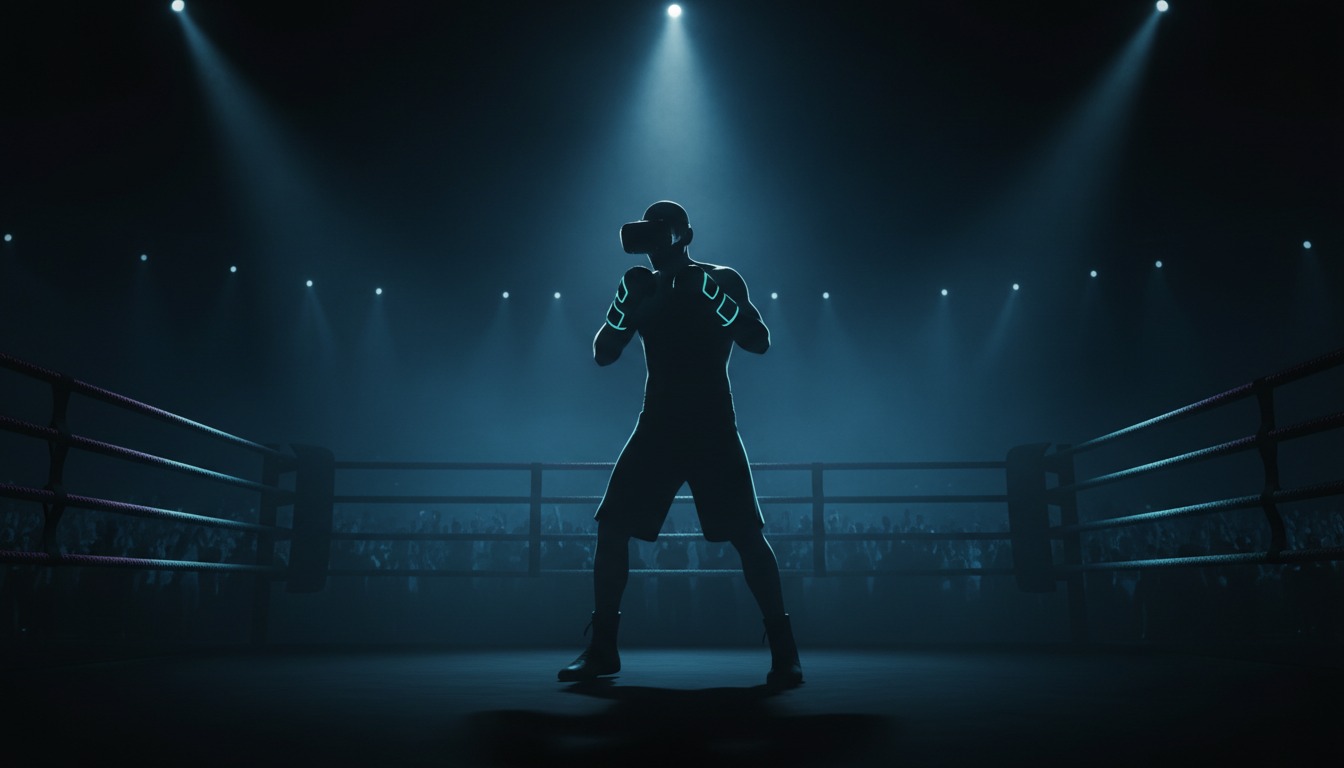
The first time you land a clean hook in Creed: Rise to Glory, you realize this is not a button-mashing boxing game. Your actual shoulder rotates. Your fist travels through real space. Your heart rate jumps. Survios didn’t build a boxing simulator so much as a boxing occupation — a game that demands your body show up to work.
Released in September 2018 for PSVR, Oculus Rift, and HTC Vive, Creed is a native VR title through and through. There is no flat-screen version, no gamepad fallback that makes sense, no way to experience this sitting on a couch with a controller in your lap. You stand, you punch, you sweat. The design assumes motion controls, a playspace, and a willingness to treat your headset like gym equipment.
The Phantom in the Room
The centerpiece is the Phantom Melee system, and it is the single smartest thing Survios did to make VR boxing playable at scale. Here’s the problem with real boxing in virtual reality: human arms tire. Fast. If your game faithfully translates every slowed, exhausted swing into a weak in-game punch, fights collapse into awkward slap-boxing after two minutes. Survios solved this by inserting “phantom” hits — when your real punches slow down from fatigue, the game interpolates stronger strikes to maintain combo flow and cinematic momentum. Your avatar keeps fighting even when your biceps are begging for mercy.
It is a necessary compromise, and an elegant one. Without it, Creed would be unplayable in longer bouts. But the compromise cuts both ways. Fights never feel fully “real” because the game is always helping you across the finish line. Land ten phantom hooks in a row and some of the satisfaction drains away. You are not quite as accountable for your exhaustion as a pure simulation would demand. The system keeps the game fun; it also keeps it from ever feeling like a true boxing simulator.
The Career, The Gym, The Grind
Career mode follows Adonis Creed through a structure that will feel familiar to anyone who has seen a Rocky film: the underdog gym, the montage training, the escalating rivals, the championship belt waiting at the end. The training mini-games — speed bag, heavy bag, skipping rope, mitt work with Rocky himself — are where Creed shines brightest. Hitting a heavy bag in VR with motion controllers feels substantially better than any flat-screen boxing game has managed. The rhythm of it, the physical feedback loop of your own movement, sells the fantasy in a way that button presses never could.
But the career structure surrounding those mini-games is thin. Fights blur together. Opponent AI follows predictable patterns, and the roster lacks the personality or visual variety to make each bout feel distinct. The narrative beats land because the Creed license carries weight — the music, the gym aesthetics, the voice performances — not because the storytelling does anything unexpected. You fight, you train, you fight again. After a few hours, the loop starts to feel like actual gym attendance: rewarding, repetitive, and occasionally a slog.
Multiplayer: The Empty Ring
PvP multiplayer exists, and when you find a match, it works. Two human players swinging at each other in VR produces chaotic, hilarious, genuinely competitive moments. But the mode always felt like an afterthought. Matchmaking was slow even at launch, and without a robust ranking system or meaningful progression, most players drifted back to the campaign. It is a nice feature to have, not a reason to buy the game.
Controls and Comfort
Punching, blocking, and dodging all map naturally to motion controllers. Raise your gloves to guard. Lean to slip a jab. Throw body shots by aiming low. The tracking holds up well on PSVR Move controllers and PC VR setups, though the limited tracking volume of the Move wands can occasionally lose a glove mid-combo. The bigger comfort issue is physical, not virtual. Creed will exhaust you. There is no locomotion to cause motion sickness — you are confined to a ring — but standing and throwing punches for thirty minutes is a genuine workout. If you approach this like a traditional video game, you will be humbled. If you approach it like cardio equipment with a license attached, you will get exactly what you paid for.
The Quest port, which arrived on the Oculus Quest launch day in May 2019 as a cross-buy release and one of the headset’s bundled ready-to-play demos, makes the same trade in a different direction. Going wireless is arguably the best way to experience Creed: you are ducking, weaving, and spinning without a cable brushing your shoulder or threatening to clothesline you mid-combo. But the Snapdragon 835 build pays for that portability. Lighting is flatter, effects are dialed back, and the overall look is drabber than the PC or PS4 versions. Character models still hold up where it matters — you spend most of the fight staring at an opponent from arm’s length — but the port was one of the rougher Quest translations at launch. Inside-out tracking can lose a fast glove during a flurry, more often than on PC, and load times are noticeably longer. Cross-buy softens the blow if you already own the Rift version, but the Quest edition is the version you buy for the freedom of no wires, not for visual fidelity.
Visually, the game runs comfortably on mid-range hardware and PS4 Pro. Character models hold up in close-up, which matters when you are staring at an opponent’s gloves from inches away. Crowds and arenas are functional but unremarkable. This is not a game that pushes VR rendering to its limits; it spends its budget on animation fidelity and physical interaction instead.
Who Should Step Into the Ring
Creed: Rise to Glory is best suited for fitness-minded VR owners who want their headset sessions to count as exercise. Boxing enthusiasts will appreciate the mechanics more than the simulation depth. Creed and Rocky fans get a licensed product that actually respects its source material, which is rarer than it should be.
You should skip this if you want deep strategy, narrative complexity, or a game you can play for hours without feeling it in your shoulders the next morning. It is not a casual experience, and it makes no apologies for that.
Creed: Rise to Glory commits to a single idea — boxing in VR should feel like boxing — and delivers on it well enough to justify the purchase. The Phantom Melee system keeps fights flowing at the cost of simulation purity. The career mode entertains but does not surprise. And the sheer physical demand of it all means you will remember the workout long after you forget the plot. It is one of the most active experiences available in VR, and for the right player, that is recommendation enough.