
Best VR Haptic Vests for PCVR (2026): Setup, Game Support & Picks
Best VR haptic vests for PCVR in 2026 — bHaptics TactSuit Pro/Air, Woojer Vest 4, and OWO Skin. Compare setup, Quest 3 via PCVR, game support, comfort, and tradeoffs before you buy.
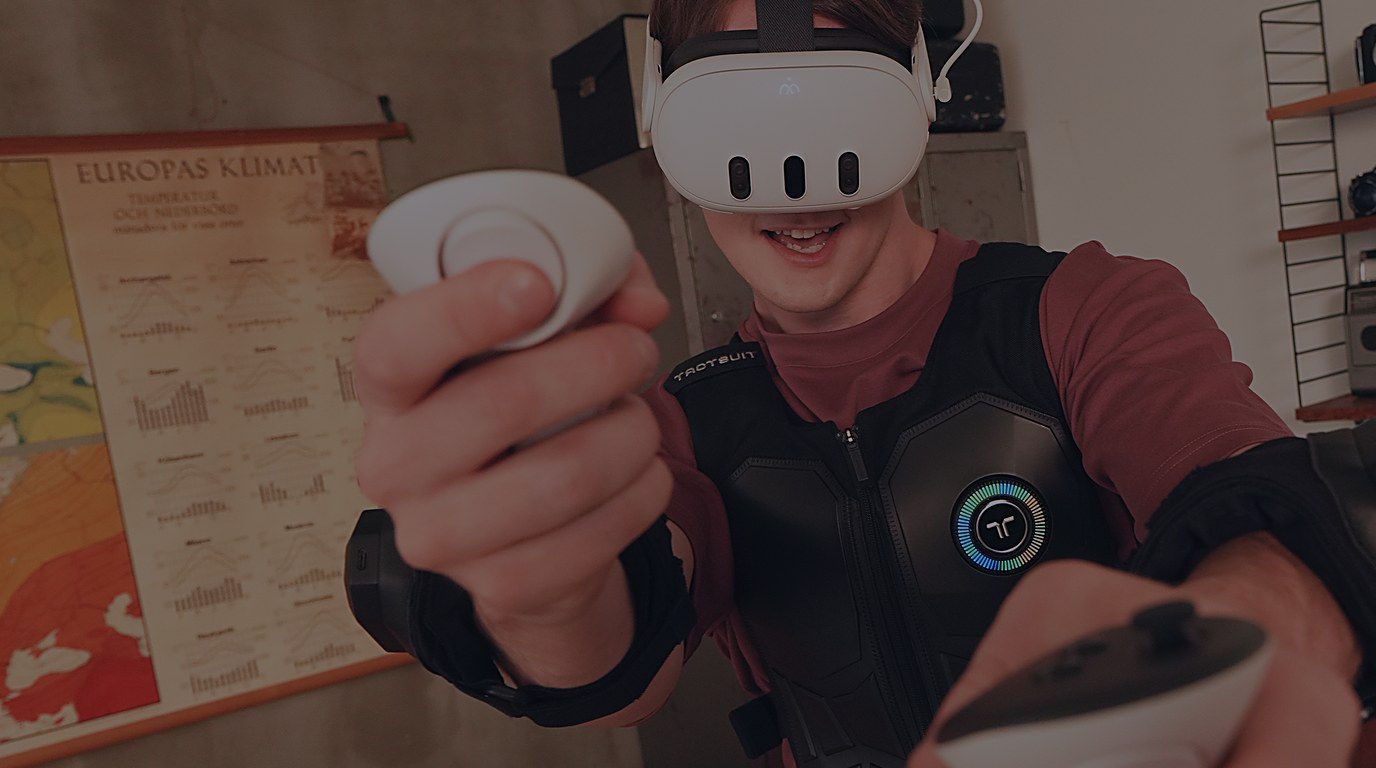
A haptic vest is the one VR upgrade that makes you physically flinch before your brain catches up — and in 2026 the category has quietly split into three things that share a name but feel nothing alike. I’ve watched enough owners unbox one, fire it up, and wonder why it mostly just rumbles to know the confusion is the product’s fault, not yours. These aren’t plug-and-play VR peripherals. They’re three different technologies wearing the same word, and picking wrong means spending $500 on a thing that does the opposite of what you pictured.
This guide is for someone standing at the shelf, not someone who already owns one. I’ll tell you what each vest actually does to your torso, how it gets signal from your PC, which games fire real directional feedback versus which ones just buzz, and where the money is and isn’t worth it.
Best VR Haptic Vests for PCVR: Quick Picks (2026)
If you want the short answer before the details, start here. Prices and lineup details below reflect sources cited in this guide (checked 2026-11-08); verify current official pricing, availability, and game support before buying.
| Pick | Best for | How it works on PCVR | Main caveat | Approx. price |
|---|---|---|---|---|
| bHaptics TactSuit Air | Value pick for directional positional feedback | PC-side bHaptics software; Bluetooth/USB BT dongle; Quest 3 most reliable via PCVR | Native/mod support varies by game; 16 motors | ~$269 |
| bHaptics TactSuit Pro | Most graded positional feedback in the current bHaptics vest lineup covered here | Same bHaptics PCVR ecosystem | Heavier, warmer in long sessions, pricier | $529–$565 |
| Woojer Vest 4 | Zero setup and “works with any audio” | Takes PC audio (3.5mm/USB/Bluetooth) | No directional game events; whole-body rumble can feel muddy | From ~€508 in Europe |
| OWO Skin | Muscle-stimulation sensations, not vibration | Vendor integration, mod, sim, or supported experience paths | Fit, calibration, gel-pad care, and safety/contraindication checks matter | $569 US delivered / regional pricing varies |
Three types of haptic feedback
Every VR haptic vest throws actuators against your torso, but the actuators are not the same and neither is the work required to make them meaningful.
Vibration motors (bHaptics). An array of small ERM/LRA motors, each mapped to a body zone — front, back, shoulders. A hit on your left flank feels different from one on your right. That positional signal only appears in titles with native integration or a community mod written for that specific game. Everything else falls back to a whole-torso audio rumble.
Audio transducers (Woojer). Large low-frequency oscillators driven by an audio signal. There is no per-game integration and no position. Your chest, back, and sides all thump together on any sound your PC makes. It works with everything and tells you nothing about where the hit came from.
Electrical muscle stimulation (OWO). Electrodes on the skin deliver controlled electrical stimulation for localized, involuntary muscle response — a punch that tightens a muscle, not a motor that vibrates it. This needs vendor-authored sensation profiles per title, and it carries a comfort and safety profile the other two don’t.
A vest that “supports 300 games” and a vest that “works with any game” are not in the same competition, and the audio vest isn’t really competing at all — it’s a different product with a different job.
How a vest connects on PCVR (and the Quest 3 question)
No mainstream PCVR runtime treats a vest as a standard device. SteamVR and OpenVR expose a haptic API for controllers; vests are driven out-of-band by each vendor’s own software. Expect a vendor app and a Bluetooth link, not a “add device” popup in SteamVR. If a listing implies “works with any SteamVR game,” that’s either the audio fallback or a mod, not platform-level passthrough.
For Quest 3 owners the practical path matters. bHaptics lists both its vests as Made for Meta and compatible with Quest headsets, and over a PC connection (Link, Air Link, or Virtual Desktop) the link is stable. On Quest standalone, the same hardware shows sporadic connection problems — the PCVR connection is the reliable one, so if you’re on a Quest, plan to run your vest through your PC, not the headset alone.
Woojer is simpler: it takes audio. A 3.5mm cable from your PC’s output is the most reliable path; USB and Bluetooth also work but have shown minimal delays, and wireless audio can drop out. OWO and bHaptics both ride Bluetooth, and for bHaptics a USB Bluetooth dongle is the recommended fix for latency and dropouts on PC.
Quest 3 + VR haptic vest: PCVR setup paths
If you searched this on a Quest 3, the short version is: treat the vest as a PCVR peripheral unless the vendor clearly documents stable standalone support for your exact setup.
- bHaptics (TactSuit Air/Pro): Run the PCVR game on your PC, stream it to Quest 3 with Virtual Desktop, Link, or Air Link, and let bHaptics Player run on the PC. bHaptics lists Quest compatibility, but standalone connections can be sporadic — the PC connection is the reliable path. A USB Bluetooth dongle on the PC is the recommended fix for latency/dropouts.
- Woojer Vest 4: Route PC audio to the vest (3.5mm is the simplest reliable option). It reacts to audio, not headset-native game events, so it works as a PC audio accessory in a Quest PCVR setup.
- OWO Skin: Check OWO’s current Quest/PC/PCVR support and integration path for the specific title before buying. Headset compatibility is not the same as per-game haptic support, and setup/calibration is more involved than a vibration vest.
Before you buy: confirm the exact game, runtime (SteamVR/OpenXR/PCVR streaming path), and vendor support status. “Works with Quest 3” does not automatically mean directional native haptics in every standalone or PCVR game.
bHaptics: TactSuit Pro and TactSuit Air
bHaptics is the reference line for positional vibration, and in 2026 the two vests worth comparing are the Pro and the Air.
TactSuit Pro — 32 vibration motors, about 1.9 kg. It carries a rotary intensity knob on the vest, rubber elements across the front, and shoulder snap buttons for sizing. In testing it produced the most differentiated, finely graduated feedback of the lineup. It sits in a $529–$565 price band.
TactSuit Air — 16 motors, about 1.1 kg, roughly $269. It drops the knob, the shoulder snaps, and the front rubber elements. The feedback is slightly less finely graduated and needed higher intensity to match the Pro, but at lower motor density it runs cooler — a real advantage over long sessions.
Battery on both: about 13 hours average, USB-C charging in roughly 5 hours. Heat builds slightly under the material after about an hour of intensive use on the Pro. For forearm recoil, bHaptics arm sleeves (TactSleeves, three haptic points each) extend feedback outward, but they have to be tightened firmly to transmit vibration and can press during long play. A Tactivisor face cover fits Quest 3, Quest 2, and Valve Index and makes the headset itself vibrate.
If you’re choosing between them, the Air is the smarter default unless you’ve already confirmed a title list you care about leans on the Pro’s extra points. The Pro is for someone who wants the most graded positional feedback and will actually play the natively supported games; the Air is for someone who wants the bHaptics ecosystem and directional hits without the weight, heat, or $529 entry.
One naming trap: “flagship” is contested. Marketing calls the Pro the flagship by recency and price, but the older 40-point X40 is still the motor-count champ in the product lore, and a 2026 roundup frames the Pro as sitting “in the middle of the lineup… fewer than the flagship X40.” bHaptics doesn’t publish a current X40 price, so don’t buy one blind.
Woojer Vest 4: the zero-setup option
Woojer takes the opposite philosophy. The Vest 4 carries six oscillators — two on the sides, two at chest level, two on the back — converting any audio signal into broad vibration. No game integration, no mods, no per-title setup. Plug it into your PC’s audio and every game, movie, and track thumps.
It weighs about 1.6 kg, lighter than either bHaptics and closer to a holster than a vest; the straps adjust in seconds but must be snug for uniform feedback. Frequency range is 1–250 Hz. The maker claims up to 10 hours of battery; measured use in intense gaming landed around 5. The vibration-ring areas get noticeably warm after about 15 minutes at high intensity, and at high volume the integrated headphone amp adds slight background noise — the vibration itself is audible.
Because it uses the entire audio track, ambient sound — rain, street noise — becomes constant low-level rumble that reads as annoying rather than immersive, and you can’t tell which game event caused a given thump. It sells for about €508 in Europe.
The Vest 4 is for someone who wants maximum compatibility with zero configuration and doesn’t care about position. It’s for the person who’d otherwise never bother with a peripheral that needs a mod for every game. It is not for anyone who bought a vest specifically to feel a shot come from the left.
OWO Skin: electrical stimulation, not vibration
OWO is the outlier, and it’s the one people misunderstand most. It’s a shirt with electrodes that deliver controlled electrical muscle stimulation — localized, involuntary muscle response rather than a motor buzzing against you. A hit doesn’t vibrate your chest; it tightens a muscle. That’s a different sensation and a different set of obligations.
OWO states 10 individually calibrated active muscle zones and a 165+ game count of its own. Integration runs through native direct integration, a mod path for additional PC and PCVR titles, SimHub telemetry for racing and sim, and Overwolf for selected PC experiences. Platform support is listed as Meta Quest 3, Quest 2, PC and PCVR, plus some console experiences — but headset compatibility is not the same as per-game support, and OWO publishes no per-title list.
The practical demands are real. OWO ships in nine sizes (2XS to 4XL) and requires direct body contact plus per-wearer calibration that can be saved across sessions; reusable gel pads need care and eventual replacement. Sharing it is harder than a bHaptics vest because sizing and calibration are personal. OWO itself directs buyers to official safety guidance and contraindications before use, and there’s no independent safety assessment — that’s a gap, not a green light. Pricing from the vendor in 2026: US $569 total ($499 plus $70 shipping), Eurozone €425 free shipping, UK £379, Canada C$689, Australia A$689.
OWO is for someone who wants sensation variety — impacts, rain, tightness — that no motor vest reproduces, and who is comfortable with the fit and safety routine. It is not for anyone who wants to hand the vest to a friend mid-session, or who balks at electrode calibration and gel-pad maintenance.
Game support: what actually fires directional feedback
This is where the three vendor game counts diverge, and you have to name which denominator you’re using or the number is meaningless.
bHaptics’ own site claims “more than 250 SteamVR and Oculus Quest titles provide native support,” naming Ghosts of Tabor, Breachers, Arizona Sunshine 2, Onward, and Pavlov. The manufacturer also states the count is now 348 titles “differing in native support and community mods,” with recent additions Replaced and Wrath: Aeon of Ruin VR shown at the VR Games Showcase in March 2026. A separate comparison cites 325+ compatible bHaptics games. Those are three different denominators — native only, native-plus-mods, and a competitor’s count — and they don’t line up, so treat any single count with suspicion and check the vendor’s current game list for the exact title and runtime.
bHaptics directional feedback has been verified in Arizona Sunshine 2 and Pavlov — hits from behind, side explosions, and magazine clicks were reproduced distinctly, and the directional information “can actually help to react faster.”
Woojer has no per-game matrix by design — it takes any audio source, so “support” is automatic and meaningless as a count. OWO claims 165+ games but publishes no per-title list, so no specific title is confirmed beyond the aggregate. If a title you love isn’t on the shortlist above, assume you’re in audio-fallback or mod territory until you confirm it.
For PCVR mod context where community haptic mods tend to live, the UEVR and REFramework guides cover the flat-to-VR injection scene that produces a lot of this support. Treat those as modding context, not proof of haptic support for a specific game.
Check before buying: game and mod compatibility
Before spending the money, verify the exact game you care about:
- Native integration vs. fallback vs. mod: Positional vests (bHaptics) usually need native integration or a game-specific mod/profile. Woojer reacts to audio in any game but can’t tell where an event came from. OWO support depends on vendor integration, mod, sim, or supported-experience paths.
- Runtime/headset path: Confirm PCVR vs. standalone, SteamVR/OpenXR, and whether you’re playing on PC or streaming to Quest 3 via Link/Air Link/Virtual Desktop.
- Official compatibility lists: Check the vendor’s current supported-games or integration page for your title, and note the date you checked. Don’t buy on a headline count alone.
- Mod claims: If a guide, forum post, or mod page claims haptic support, confirm the mod is current, matches your game version/runtime, and actually supports your vest model.
Comfort, battery, latency, and setup tradeoffs
| Factor | bHaptics TactSuit Air/Pro | Woojer Vest 4 | OWO Skin |
|---|---|---|---|
| Feel | Positional vibration motors; directional in supported games | Broad audio-driven thump; no position | Electrical muscle stimulation; localized muscle response |
| Setup | PC-side bHaptics software + Bluetooth/USB BT dongle recommended | Audio connection (3.5mm simplest/reliable; USB/BT possible) | Fit, direct skin contact, calibration, gel-pad care, vendor integration path |
| Quest 3 PCVR | Most reliable through PCVR (Virtual Desktop/Link/Air Link) | Works as PC audio accessory in PCVR setup | Verify current Quest/PCVR support and per-title integration |
| Comfort/heat | Pro can build slight heat after ~1 hour intensive use; Air runs cooler at lower density | Contact/ring areas can get warm after ~15 min at high intensity | Sizing/calibration personal; comfort depends on fit and tolerance |
| Battery/latency notes | ~13h average claimed; BT dongle helps latency/dropouts on PC | Up to 10h claimed, ~5h measured in intense use cited here; wired audio can avoid wireless dropouts | Battery/runtime and latency depend on current model/use; verify official specs |
| Best reason to buy | You’ll play supported games and want directional feedback | You want zero per-game setup with any audio | You want EMS-style sensations and accept the routine/safety checks |
Figures above reflect sources cited in this guide (checked 2026-11-08). Verify current official specs, pricing, availability, and compatibility before buying.
Who should not buy a haptic vest
Skip the whole category if any of these are true. You don’t play the natively supported titles and won’t — you’ll live in audio fallback, which a subwoofer-adjacent strap does more cheaply than a vest. You’re on Quest standalone only and won’t run PCVR — you’ll fight the flaky standalone link. You want a turnkey, no-config peripheral — bHaptics setup and OWO calibration will frustrate you, and Woojer will still just rumble. You have any condition OWO’s own safety guidance flags for electrical stimulation — read that contraindication page before anything else, because no independent medical assessment exists.
The pick
For PCVR in 2026, the vest you want depends entirely on which of the three questions you’re answering. Want real directional hits and you’ll actually play the supported games: bHaptics TactSuit Air at ~$269 is the value entry, TactSuit Pro at $529–$565 is the graded-feedback ceiling. Want everything to thump with zero setup and no mods: Woojer Vest 4 from €508 is the only honest “works with any game” answer, and you should know going in that it can’t tell left from right. Want muscle-tightening sensation variety and you’ll do the fit-and-safety routine: OWO Skin at $569 US delivered is its own category, not a competitor to the other two. Buy the one that matches the games you play and the setup you’ll tolerate — the rest of the shelf is just a more expensive way to buzz.