
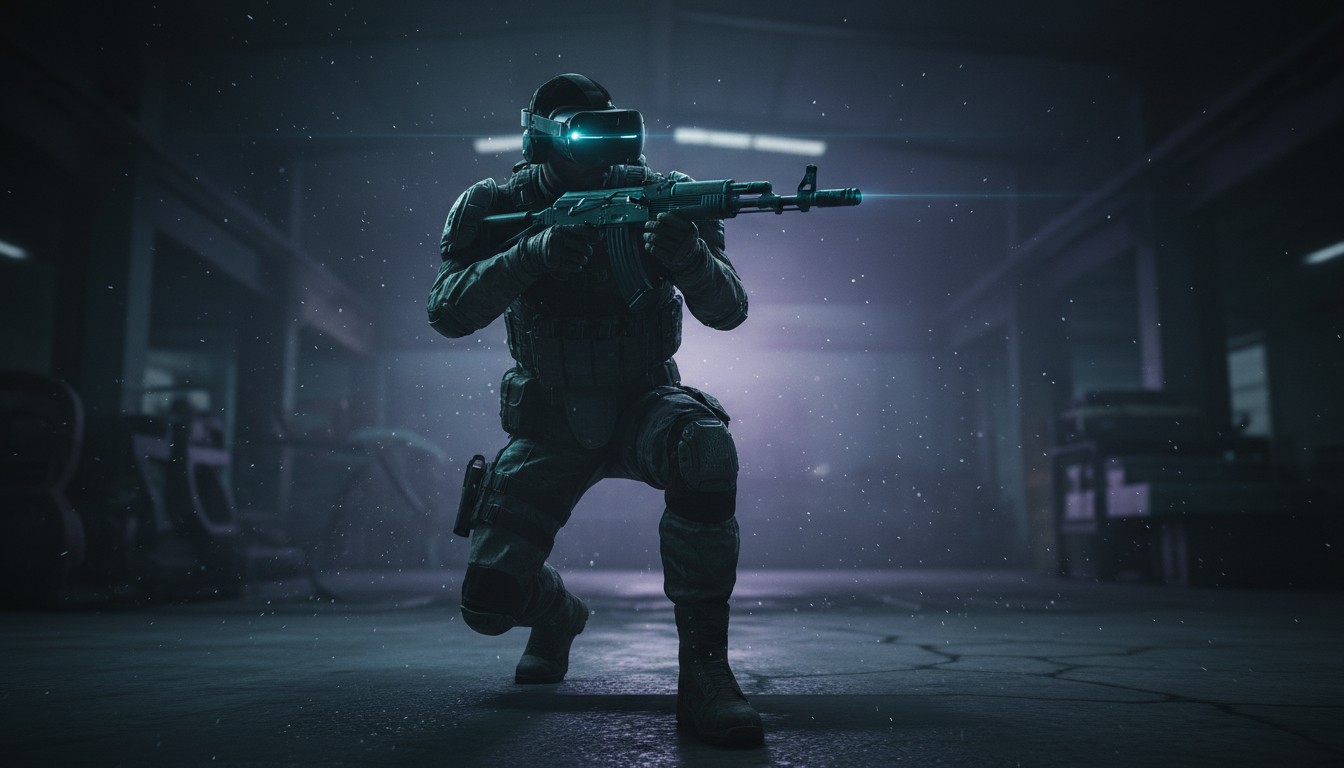
The first time you fumble a magazine change while someone peeks mid on Dust—sorry, Sand—you’ll understand exactly what Pavlov is. Your hands shake. You drop the mag. You die. And then you queue up again because that is the whole point.
Pavlov has been called “Counter-Strike in VR” since its 2017 Steam Early Access launch, and after eight years of iteration, the nickname still holds up. Vankrupt Games built a natively VR tactical shooter with over 65 interactable weapons, a full Search & Destroy economy system, and manual reloads that demand actual muscle memory. Grab a magazine from your chest, slap it into the well, rack the charging handle, and hope you didn’t fumble it under fire. There is no button-press abstraction. Your AK-47 won’t chamber itself.
The Gunplay Is Why You’re Here
Here’s the thing about Pavlov: the guns feel correct. Not flashy. Not cinematic. Correct. The M4’s initial pull is almost vertical and manageable. The LMGs shake hard unless you crouch. Shotguns load shell by shell, pump by pump. Empty an LMG and you’re in for a twelve-step procedure: open the top cover, swap the belt box, feed the belt, close the cover, rack the handle. In the middle of a firefight, that’s either a glorious ritual or a death sentence depending on your preparation.
The weapon handling isn’t just immersive—it’s mechanically expressive. You can two-hand a pistol for stability. You can flip a gun’s fire mode. You can misfeed a reload and waste a round by racking a slide that didn’t need racking. The game doesn’t forgive sloppiness, and that friction is the whole reason it works. In flat shooters, you press R and you’re back in the fight. In Pavlov, you earn every reload.
The haptics help sell it. On PSVR2, the Sense controller’s adaptive triggers give each weapon a distinct pull weight, and headset haptics punch you on headshots. Even without that hardware layer, the audio design is directional and punchy—gunfire carries weight, and you’ll hear footsteps behind you before you see them.
Modes, Maps, and the Mod Ecosystem
Search & Destroy is Pavlov’s signature: one life per round, two-minute timers, bomb plants and defuses with wire-cutting minigames. Terrorists need a four-digit code to arm; Counter-Terrorists need eight digits or wire cutters to defuse. It’s Counter-Strike translated into physical space, complete with an economy system that rewards kills and round wins with buy money. The tension of clutching a 1v3 while physically crouched behind a crate is something no flat shooter replicates.
Beyond S&D, there’s Team Deathmatch, Gun Game, Push, King of the Hill, a co-op Zombies mode, and Trouble in Terrorist Town—the social deduction mode that turns Pavlov into a murder party. Community modding extends this further: custom maps (including direct Counter-Strike ports), custom weapons, and entirely new game modes. Mods run on PCVR and Quest through Mod.io. They do not run on PSVR2—Vankrupt officially abandoned PSVR2 mod support in April 2024, citing platform pipeline issues. If mods matter to you, PSVR2 is the wrong place to be.
The mod ecosystem is Pavlov’s secret weapon. Community maps keep the game from going stale. Custom game modes like Infection and Parkour exist because players built them. But the engine upgrade to Unreal Engine 5.1 in 2023—switching from OpenVR to OpenXR—broke a significant chunk of older mods and shifted the mod pipeline from Steam Workshop to Mod.io. The transition was rough. Some beloved maps never made the jump. PCVR players who had curated mod collections found them partially obsolete overnight.
The Platform Split Is Everything
This is where Pavlov gets complicated. The game you get depends entirely on where you play it.
Quest (Pavlov Shack) is currently the healthiest version. The Meta Quest Store release in November 2023 replaced the free App Lab build with a $19.99 paid version. Population is active—reportedly thousands of concurrent players on weekends. Mods work. Lobbies fill. The visual fidelity takes a hit compared to PCVR, but the gunplay survives the transition intact. If you’re buying Pavlov today and you own a Quest 2, 3, or 3S, this is the default recommendation.
PCVR is the technically superior version with a shrinking population. Steam concurrents hover around 100–150 daily, down from a peak above 3,200 in 2021. Crossplay with PSVR2 helps populate lobbies, but the PC-native community has been vocal about feeling neglected. Recent Steam reviews sit at “Mostly Positive” (~71%) against a lifetime “Very Positive” (~89%). The complaints are consistent: perceived prioritization of Quest development, an engine upgrade that broke mods and caused instability, microtransactions added to a game already charging full price, and optimization that runs heavier than it should. A December 2024 update introduced a cosmetics system using purchased “Jared Coins”—for a paid Early Access title, that landed poorly.
The PCVR version is still the prettiest, the most moddable, and the most precise. But you’re buying into a community that feels like it’s shrinking, not growing. After seven years in Early Access, the December 2024 major update functionally served as a 1.0 milestone—though Vankrupt never formally announced leaving Early Access, and the lack of fanfare matched the mood.
PSVR2 launched as a day-one title in February 2023 and reviewed well. The Sense controllers and headset haptics are genuinely excellent here. Visuals are solid, framerate is stable, and the core shooting translates cleanly. But there’s no mod support, no community maps, and the player pool is entirely dependent on crossplay with PCVR. It’s a polished, limited version of a game that lives and dies on its community content.
The Verdict
Pavlov is the best VR-native tactical shooter on the market, full stop. Nothing else matches the combination of realistic weapon handling, competitive structure, and community extensibility. If you want to know what a “Counter-Strike in VR” fantasy actually feels like when executed properly, this is it.
But “best in category” and “easy recommendation” are not the same thing. The platform split is real, the PCVR population is concerning, and the post-2023 update turbulence—broken mods, added microtransactions, optimization complaints—has dented the game’s reputation among its most invested players.
Buy it on Quest if you want the active, hassle-free experience. Buy it on PCVR if you want the best visual fidelity and don’t mind hunting for populated lobbies. Buy it on PSVR2 if you want polished native gunplay and can live without mods. Skip it entirely if you’re looking for a single-player campaign—there isn’t one. Pavlov is a multiplayer game, and its value is determined by who you’re shooting at.
The guns still feel incredible. Whether you’ll find anyone to shoot them at depends on where you log in.