
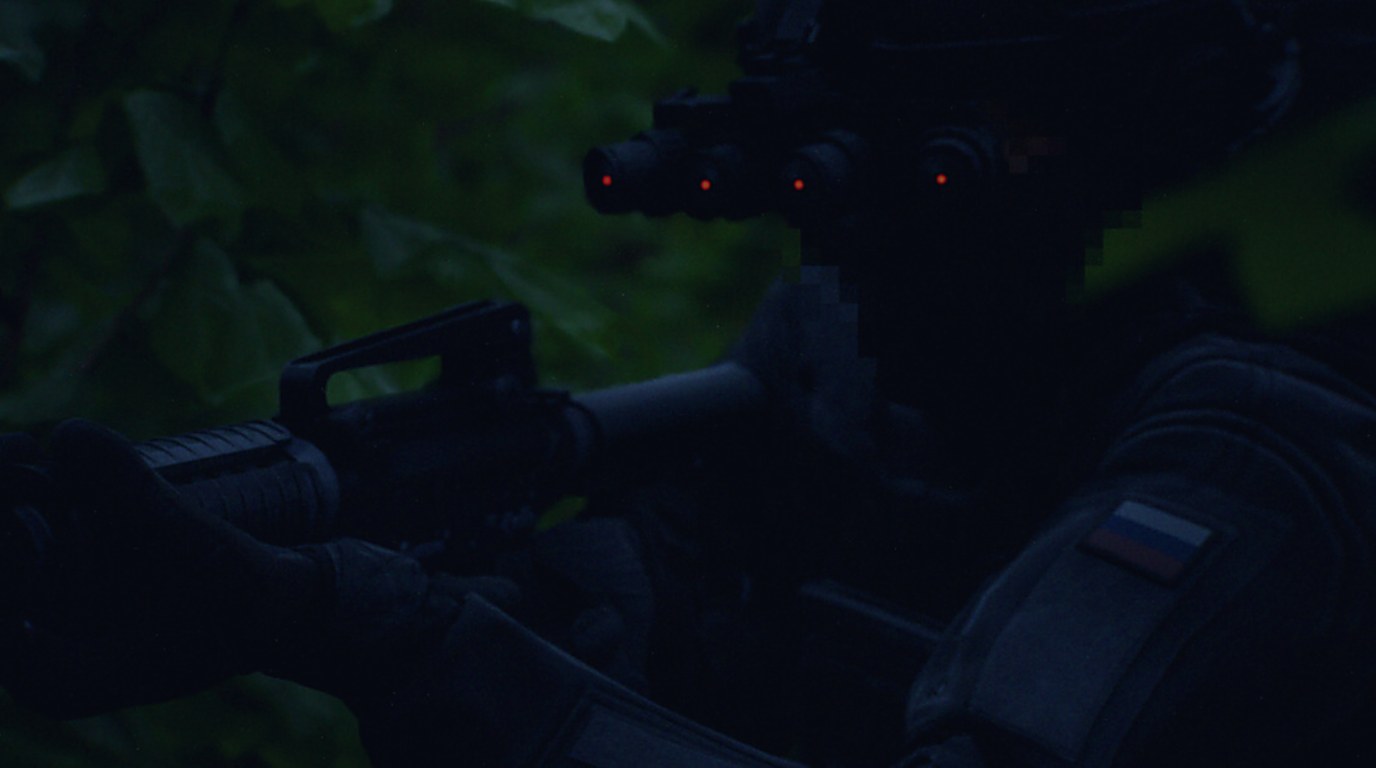
I spent a weekend with Bodycam running through UEVR, and the first thing that hit me wasn’t the gunplay — it was the weight of the camera. You know that chest-height, shoulder-braced viewpoint from every police-procedural clip you’ve ever watched? In VR, your hands are actually holding that camera. The lens distortion, the grain, the way the world jitters when you sprint — it stops being a filter and starts being a point of view.
Flat Bodycam is a gimmick with a deathmatch bolted to it. A lot of people bounced off it for exactly that reason: thin maps, a small weapon pool, and a “photoreal” look that mostly meant an expensive post-processing stack. But the thing that made it go viral on social video in 2024 — the body-worn camera identity — is precisely the thing VR was built to deliver. When the headset is on, Bodycam stops pretending and actually puts you behind the lens.
Bodycam VR’s bodycam perspective finally means something
Bodycam is a multiplayer-only tactical FPS built in Unreal Engine 5 by a tiny France-based team, Reissad. There is no campaign, no offline mode, no bots to pad out a quiet night. It is Deathmatch, Team Deathmatch, and Wingman — close-quarters firefights where every angle and callout matters. On a monitor that’s a competent but shallow competitive shooter. In the headset, the entire premise flips.
The signature of the game is its camera: heavy lens distortion, film grain, motion blur, rolling shutter, and a low, chest-height eyeline. On a flat screen that reads as a stylistic affectation. In VR it reads as presence. You are not watching a bodycam feed — you are the operator, elbows tucked, weapon shouldered, swinging the lens around a corner to clear a room. The jitter that flat players found annoying becomes the physical tell of a human being moving through space. It is the single most convincing “you are the camera” shooter I have put on, and that is not faint praise in a medium full of flat-shaded aim trainers.
Bodycam VR’s only path is the UEVR injector
There is no official VR mode for Bodycam. Reissad never announced one, and none exists. The way you play this in VR is through Praydog’s UEVR — the open-source Universal Unreal Engine VR Mod, a free injector that grabs a running UE4 or UE5 process and forces proper stereoscopic 6DOF rendering. Bodycam is UE5, squarely inside UEVR’s supported range, so the engine ceiling is not a question. It works.
What that gets you is the real thing, not a head-look window. Full 6DOF head tracking, a native stereo image, and motion controls with tracked hands — yes, actual hands on the weapon, not a gamepad approximation. Community footage backs this up hard: one VR channel alone posted two Bodycam videos — a standard version and a dedicated “Motion Controls + Hands” walkthrough — that together pulled over a hundred thousand views, and the bigger VR outlets framed it the same way, calling it the most realistic shooter in VR.
Bodycam VR motion controls and binding friction
The footage and the community signal disagree on how smooth this is. Motion controls with hands are documented — tracked controllers holding the rifle, aiming by bringing the camera and the weapon together. That is the ceiling, and it is the right way to play. But the one substantive controller complaint on record comes from a Quest 3 user running the game over Virtual Desktop, who posted to the UEVR tracker that they were “really having a hard time with bindings” and couldn’t get aiming to feel right with a left-controller-plus-mouse hybrid setup. The ask was for a clean full-controller bind for the right hand.
That is a real, named pain point, not review noise I am inflating into a paragraph. UEVR bindings can be fiddly per title, and Bodycam has no official profile hand-holding you through it — there is a community profile circulating, but nobody has packaged a canonical, drop-in setup. You will likely spend real minutes in the UEVR binding menu getting the rifle where your hands expect it. Gamepad and mouse-keyboard play also work as a fallback, and the flat build ships full controller support, so if the bind fight burns you out, you are not locked out. But the good version — the one that justifies the headset — is the motion-control version, and it demands you do the binding work.
Bodycam VR comfort limits from camera shake and grain
Bodycam is intense on the comfort front, and this is one of the rare cases where the game earns more than a clause. The bodycam fantasy is built on camera shake, a low chest-height eyeline, and a post-process stack that deliberately destabilizes the image — grain, motion blur, rolling shutter. In flat play that is a look. In VR, that is a sustained comfort load on top of the locomotion every competitive shooter demands. There are no in-game VR comfort options because there is no VR mode; whatever UEVR exposes — snap-turn, camera-height handling, per-eye FOV — is your only relief, and the game’s own flat options mostly push the opposite direction. If you are prone to simulator sickness, this is a session-capper, not a casual pick-up. I am not dinging it for lacking teleport; I am flagging that the aesthetic itself is the discomfort source.
Bodycam VR performance demands on Unreal Engine 5
UE5 with a full post-processing pipeline is not light, and Bodycam’s “photoreal” identity is exactly the part that costs you frames. This is a Heavy Demand title on PC — you want a high-end rig to push dense, detailed maps at 90Hz without reprojection, and even then you will be tuning resolution scale and sync mode in UEVR to keep it stable. The trade here is direct: the realism that makes Bodycam worth playing in VR is the same realism that makes it the most demanding kind of UEVR profile to run. Turn the effects down for headroom and you lose the thing that separates it from every other VR shooter. There is no free lunch, and on this engine the lunch is expensive.
Bodycam VR’s multiplayer-only player problem
Bodycam has no single-player mode. None. It is online PvP only — Deathmatch, Team Deathmatch, Wingman. VR or not, if you are the kind of player who wants to drop into a bot match at midnight to unwind, this is not that game. You need other humans, and for a UEVR injection title that adds a second question the research can’t fully answer: nobody has documented stable online matchmaking under VR, and nobody has documented an anti-cheat block either. Steam lists no anti-cheat category for the title, so the silence is at least not a red flag — but I am not going to tell you the lobbies are reliably populated for VR players when the evidence isn’t there. The flat game carries a mixed-positive Steam rating and a small but real community; whether that community shows up in matches you can join from the headset is the open variable.
What works in Bodycam VR
Strip the caveats away and the core sells itself. The bodycam perspective in VR is the most convincing version of this idea anywhere — tracked hands on the rifle, the lens warp when you snap a look, the grain that finally reads as a physical camera instead of a render effect. The maps are small and the gunplay is raw, but raw is the point; this is a tactical shooter about angles and callouts, and being physically present in the space makes the angles matter the way they never did on a monitor. For the right player — someone who wants the most realistic “you are the operator” fantasy in VR and is willing to do binding and tuning work — it delivers something no native VR title currently does.
Bodycam VR shortcomings (bindings, comfort, frame rate)
The list is short but real. Multiplayer-only means no solo fallback. Comfort is intense because the aesthetic is the discomfort. The engine is heavy and the realism you are paying for is the realism that costs frames. And the binding friction is a genuine first-session hurdle that the community has not smoothed over with a canonical profile. None of these are fatal — UEVR is free, the framework is mature, and the experience on the other side is the best of its kind — but they are the reasons this lands as a “worth it with conditions” rather than a clean recommendation. This is not a game to hand a newcomer. It is a game for someone who already knows their way around UEVR and wants a specific, weird, photoreal thrill.
The Bottom Line
Bodycam is a thin flat game that VR rescues. The bodycam gimmick was always a camera trick; in the headset it becomes a point of view, and that transformation is worth the headset. It is B-tier, not higher, because the multiplayer-only structure, the comfort load, and the binding-and-tuning tax keep it from being something you casually recommend — but it is a confident B, the kind where the fun and the spectacle genuinely outweigh the critic-averaged reception of the flat original. If you already run UEVR and you want the most convincing camera-operator shooter in VR, install it tonight. If you are new to injection frameworks or prone to motion sickness, this is one to admire from a distance until you have the legs and the know-how for it.