
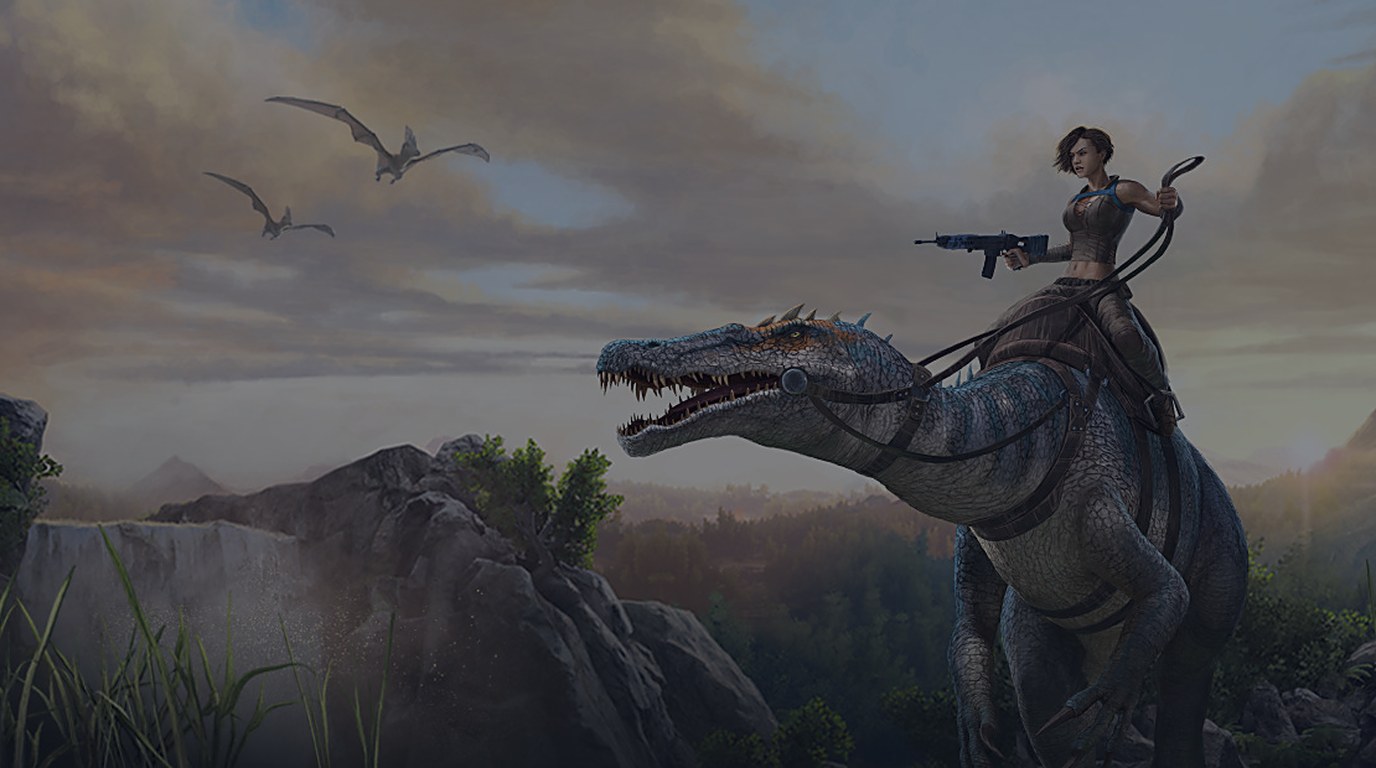
I woke up naked on a beach again, with a stubby dinosaur staring at me like I owed it rent. That’s ARK: Survival Evolved’s opening beat, and it lands differently with a headset on — the island spreads out around you, and the first thing that registers isn’t the danger. It’s how much of the place there is.
Worth being precise about what you’re putting on, because a lot of people get this wrong. ARK: Survival Evolved VR is not a mod, and it isn’t an injection wrapper bolted on by a fan. It’s the game’s own official VR mode, added by Studio Wildcard in patch 245.94 as Oculus Rift support, back in August 2016. You don’t buy anything extra to reach it. You own ARK, you tick the option, you put the headset on.
What the official mode gives you
It’s a seated, gamepad-first implementation, and that framing tells you most of what follows. You play with a controller or with keyboard and mouse. Motion controllers were never wired in — Oculus Touch support doesn’t exist here, so your hands stay wherever the gamepad is. You turn your head, the island responds, and everything below your neck is business as usual.
That’s a legitimate design choice for a survival game with a deep inventory and a crafting menu, and it’s also the ceiling on what the mode can ever feel like. You are not inhabiting a body on that beach. You are sitting in a chair looking at one.
How it plays
The strength is singular and it’s real: scale. ARK’s whole hook is that the animals are absurdly large and the map is absurdly open, and head-tracked 3D sells size in a way a monitor never will. I’d catch a Brontosaurus a short distance off and my brain would quietly register its mass. A Pteranodon wheeling over the water reads as a creature occupying space, not a sprite on glass. If you want to understand why people care about these dinosaurs, the headset does that job in about ten seconds.
Everything around the edges of that is where it falls down. The visuals are the biggest problem. Detail smears out past a short distance, the lighting is aggressively blown out — look anywhere near the sun and you’re squinting — and turning the brightness down to cope just buries the dark areas instead. Text and menus sit in front of you as a flat layer on a plane, legible but lifeless, never wrapping into the space the way a built-for-VR interface does. You’re looking at a very convincing window, not standing in the room.
Performance is the other tax. ARK was never a light game and the VR mode carries all of that weight with the added cost of stereo rendering, which is why the mode has a reputation for needing patience and a fast machine before it behaves.
A note on ARK Park
If you searched “ARK VR” and landed on ARK Park, that’s a different animal entirely. ARK Park is a standalone VR spinoff — a dinosaur theme-park gallery experience rather than the survival game, with no taming loop, no base building, and no persistence. It’s a separate purchase and a separate thing, and it is not what this article is about.
Support, and the honest shape of it
The thing that keeps ARK’s VR mode at a C rather than higher is what happened after launch. The developers shipped it, and then effectively stopped. It hasn’t seen meaningful attention in years, and it was never well supported from the start — the impression the mode leaves is of a feature someone enabled once and then walked away from. Nothing has been broken by a later patch in the way some abandoned modes are, but nothing is coming, either.
So the scale is the sell, and the official mode delivers it. But your body stays in the chair, your hands stay on a gamepad, and the survival loop plays out in front of you rather than around you. If you already own ARK and have a headset and an evening to spare, walking that beach in 3D is genuinely worth seeing once. For everyone else, the flat game is the better version of the same experience, and it doesn’t ask you to squint through the foliage to find it.