
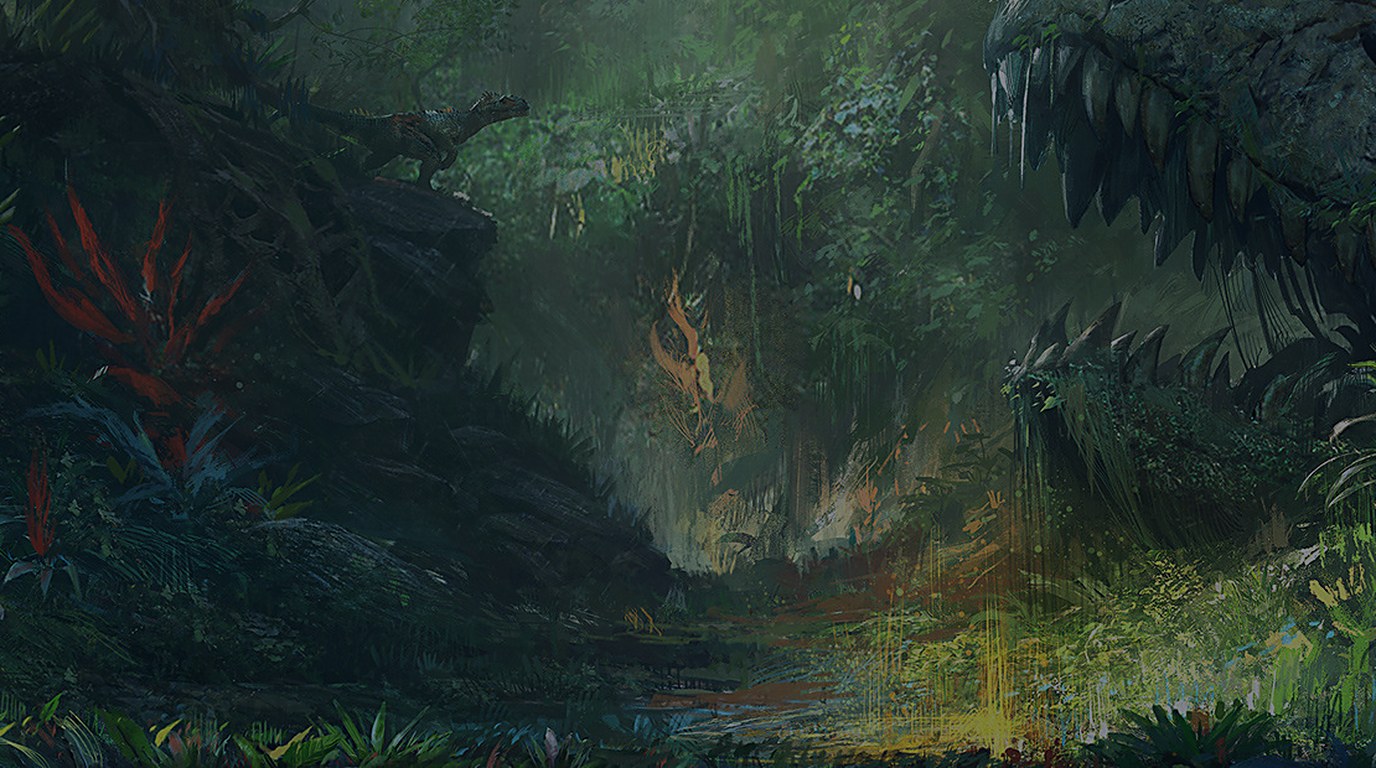
I spent my first ten minutes in ARK Park with my neck craned straight up at a brachiosaur. Not a flat-screen render of one — a creature the size of a house, chewing leaves twenty feet over my head, completely indifferent to me standing there like an idiot on the jungle floor. That’s the pitch, and for those few minutes it absolutely lands.
ARK Park is a standalone spin-off Snail Games built for headsets from the ground up, with creative input from Studio Wildcard — not a VR mode bolted onto ARK: Survival Evolved. You don’t gather rock and build a base. You walk a dinosaur park. There are two halves to the experience: a tour-and-exploration mode where you scan creatures into a “Dino Dex,” collect DNA and materials, craft Engrams, hatch and raise dino eggs, and ride the occasional tame — and wave-defense combat missions where you pick up weapons and hold the perimeter. Both halves run on tracked motion controllers, so you reach out to scan a raptor, cradle an egg, or shoulder a rifle instead of tapping a gamepad.
Getting in is as simple as a VR game gets: buy it, install it, put the headset on. PC players need a SteamVR or Oculus PC setup; PlayStation owners run it on PSVR. There’s no mod scene to wrangle because there doesn’t need to be — the game ships native stereo rendering out of the box. On the hardware side it’s a 2018 Unreal Engine 4 title that asks for a GTX 970 at minimum and looks its best on a 1080-class card, so a mid-range PC handles the parks without drama. Snail Games shipped it and moved on; there’s been no meaningful post-launch update, but the build is stable and still on the store.
The exploration half is the stronger one, and it’s not close. The park is built around getting close to dinosaurs, and the scale does a lot of the work that flat screens never could. You lean in to scan a compsognathus the size of a housecat, then turn and there’s an allosaurus cutting across the treeline at a distance that actually reads as distance. The 100-plus species across more than ten scenes give the tour real variety, and the collection loop — scan, store DNA, hatch an egg, raise the thing — scratches a specific itch that ARK fans will recognize and that newcomers can enjoy without knowing the source game at all.
This is the part that justifies the headset. You’re in a place, surrounded by animals that don’t care about you, and the act of physically craning, leaning, and reaching to fill out the Dex makes the scanning feel like fieldwork instead of menu management. The creature models and environments are, by every launch-era account, among the best-looking things VR had produced up to that point. Moments in here can feel magical, and they’re the moments the game lives or dies on.
Then you pick up a gun and the floor drops out.
The combat missions are wave-defense: creatures come at a perimeter, you shoot them, you don’t get overrun. The concept is fine. The execution fails in a stack of small ways that add up to a half that feels bolted on rather than designed. The shooting doesn’t have the weight or feedback that makes VR gunplay land. The enemy variety is thin. And critically, the two halves never fuse: the quiet wonder of the tour and the loud pressure of the defense missions feel like two different products that happen to share an engine, not a single game that earns its swings between calm and chaos.
That split is the core problem with ARK Park. On paper it’s one title. In the headset it plays like a beautiful nature documentary with a forgettable arcade shooter stapled to the end credits. You can absolutely ignore the combat — the tour alone is a worthwhile afternoon — but it’s sold as a full experience, and the gap between its best and worst minutes is wide enough that a lot of players walk away remembering the worst.
Comfort sits at moderate intensity: the scale of the creatures and free motion can catch you if you’re not used to it, but nothing here is built to make you sick the way a bad injection profile or a flick-movement racer will. The motion controls themselves are clean: tracked hands do the scanning, crafting, and shooting without fighting you.
The reception was rough. Launch coverage landed hard: UploadVR titled its review “Disappointasaurus,” and the critical consensus on Metacritic sat at generally unfavorable for the PS4 build. Steam user reviews have held at mixed since launch, with more negative than positive notes. That weight of opinion isn’t mine to dismiss, and it tracks with the structural problem I just described — the two halves don’t cohere, and a game that doesn’t cohere tends to get remembered for its weakest quarter.
But I’m rating the headset time here, not the averages. And the honest read is that ARK Park is a lopsided experience, not a bad one. The tour half is genuinely a thing you can’t get on a monitor — a calm, gorgeous, walkable dinosaur park where the scale does what only VR can do. If you go in expecting that and treat the combat as a bonus mode you can bail on, you’ll have a good afternoon. If you go in expecting a complete, polished ARK experience with teeth, you’ll leave annoyed.
It helps to be primed. ARK fans who already know the creature roster and the collection loop will get more out of the Dex than a newcomer will. So will anyone with a kid or a curious friend who wants to stand under a brontosaurus without a museum line. It’s a poor fit for players chasing tension or a deep game — this isn’t survival, it’s a guided exhibit with a shooting gallery attached.
Where it lands, then, is simple. The park is real, the creatures are stunning, and the motion controls make the exploration feel like something you’re doing rather than watching. The combat undercuts it, the critical reception reflects that, and there’s no post-launch patch coming to stitch the two halves together. Recommended with caveats: go for the tour, lower your expectations on the guns, and you’ll get your money’s worth out of a VR dinosaur park that — whatever its flaws — puts you inside the enclosure in a way no monitor ever could.