
No Man's Sky: Every Major Update, and Which Ones Matter in VR
From a 2016 launch disaster to a 2026 comeback with a full VR mode, here is every major No Man's Sky update in order — and the handful that actually changed how the game plays in a headset.
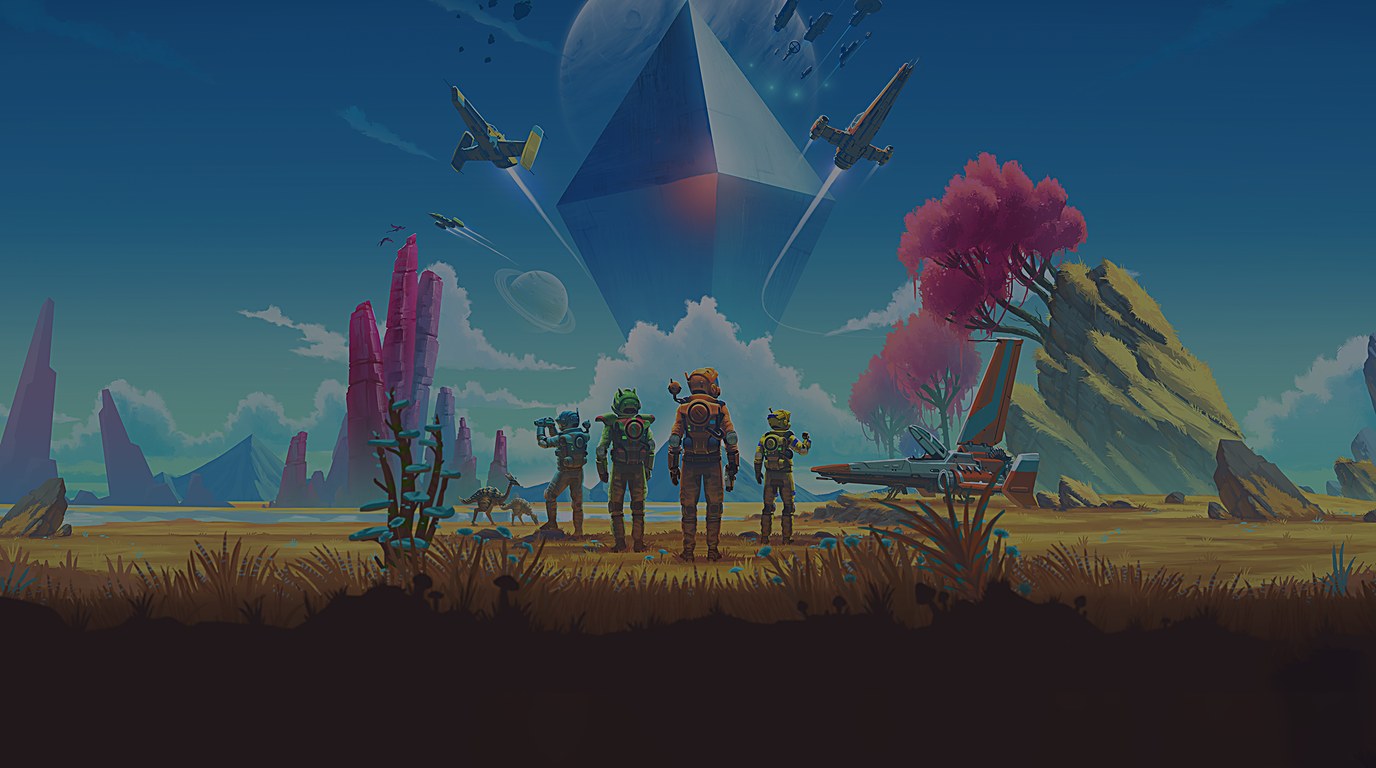
In August 2016, No Man’s Sky launched to a backlash that nearly wrote the game’s obituary. Missing multiplayer, a developer that went quiet, and a marketing campaign that became a cautionary tale in the industry. Ten years later it’s the redemption story everyone points to — and, just as importantly for this site, one of the only large non-VR-native games with a complete, free VR mode sitting inside the same install.
If you’ve ever stood in a headset wondering which of its dozens of updates actually changed the experience, you’re in the right place. I’ve walked through every major release from launch through the September 2026 Cosmos update, in order, and for each one I’ll tell you what changed and whether it matters to you in VR. My full verdict on the game itself lives in the No Man’s Sky review.
One honesty note before the list: “every major update” has no official count. Hello Games ships numbered updates and seasonal expeditions, and in some years the lines blur. I’m counting the named major updates and flagging where a year’s content landed as expeditions rather than a single headline drop. What I won’t do is invent a name or date no source supports, and where a VR claim is contested I’ll say so straight.
2016 — Launch, and the foundation that followed
No Man’s Sky hit PS4 on 9 August in North America and 10 August in Europe, with Windows following on 12 August. The core promise was real: 18 quintillion procedurally generated planets, seamless planet-to-space flight, a loop of explore, gather, repair, trade, and push toward the galactic core. What was missing is what burned the launch — the multiplayer people expected, and a level of polish the marketing implied.
VR relevance: none. The game had no VR mode at launch, so nothing here touched a headset.
Foundation (27 November 2016) added base building, freighters, and farming. It was the first signal that Hello Games intended to keep building rather than walk away.
VR relevance: still no VR mode. Irrelevant to headsets, but it’s the foundation the later VR mode would inherit.
2017 — Vehicles and story
Path Finder (8 March 2017) brought exocraft — surface rovers you could drive — plus permadeath mode and base sharing with other players.
VR relevance: no VR mode existed yet, so none.
Atlas Rises (11 August 2017) rewrote the story and Atlas path, added portals and a more structured mission system, and let players explore jointly.
VR relevance: no VR mode yet. The joint-exploration groundwork here is worth noting only because the VR mode would later share the same world.
2018 — The multiplayer the launch promised
NEXT (24 July 2018) is the update that fixed the launch’s biggest hole: full multiplayer, a third-person option, frigate fleet management, and the Xbox One launch. This is the moment the game became what 2016 advertised.
VR relevance: no VR mode yet, but NEXT’s multiplayer framework is the skeleton the later VR mode plugs into — every co-op session you’ll have in VR traces back to this.
The Abyss (29 October 2018) opened up underwater exploration and bases. Visions (22 November 2018) added exotic, weirder biomes to the planet mix.
VR relevance: neither touched a headset. At this point the game was still strictly flat-screen.
2019 — The update that created VR
Beyond (14 August 2019) is the single most important update in this entire piece. It added full VR support on PSVR (PS4) and on PC through SteamVR-compatible headsets, and it folded in the Nexus multiplayer hub and base-building refinements. Crucially, VR is a free optional mode inside the same game — not a separate purchase or a separate SKU.
VR relevance: this is the one. Before Beyond there was no VR at all; after it, you could stand on a procedurally generated shore in a headset with motion controllers, full locomotion, cockpit motion controls, seated or standing play, and comfort options like vignetting and snap turn. Every VR player of No Man’s Sky exists because of this update.
Synthesis (26 November 2019) was a quality-of-life pass — including ship scrapping, which let you break down unwanted ships for parts.
VR relevance: indirect. The QoL and inventory changes applied to the VR mode too, so your headset sessions got a little smoother, but nothing here was built for VR.
2020 — Crossplay, and the current-gen leap
2020 was a stack of themed drops: Living Ship (19 February), Exo Mech (7 April, the minotaur mech suit), Crossplay (11 June, enabling play across all platforms), Desolation (16 July, derelict freighters), Origins (23 September, a terrain and planet-variety overhaul), and Next Generation (10 November, the Xbox Series X/S versions — with the PS5 landing 12 November in North America and 19 November worldwide).
VR relevance: here’s the split. Crossplay and the platform expansion meant VR players on PSVR or PC could finally share a universe with friends on flat-screen Xbox or Switch — that’s a real win, even if you’ll only ever meet them as avatars. Origins’ planet-variety work shows up in VR as more interesting worlds to stand on, which matters more in a headset than on a monitor. Next Generation’s console boost helped PS5 players running PSVR, but it didn’t add VR-specific capability. None of these were VR updates; they were flat-screen-first drops that carried through to VR.
2021 — Visuals and settlements
Companions (17 February) let you tame and raise creatures. Expeditions (31 March) launched the seasonal mode. Prisms (2 June, Update 3.5) was a visual and lighting overhaul. Frontiers (1 September) added player-built settlements.
VR relevance: Prisms is the one worth calling out — a lighting and visual overhaul reads differently in VR than on a flat panel, and a sharper, better-lit world is the difference between a headset session that feels alive and one that feels like a slideshow. The rest carried through as content, not as VR changes.
2022 — Combat, piracy, freighters, and Switch
Sentinel (16 February) overhauled combat. Outlaws (13 April) leaned into piracy. Endurance (20 July) reworked freighters and fleet command. Waypoint (7 October) shipped the Nintendo Switch launch alongside a big inventory and UI overhaul plus custom modes.
VR relevance: Waypoint’s UI overhaul is the quiet MVP for VR here. Flat-screen UI is hard to read in a headset, so a cleaner, more navigable interface helps headset players directly. The combat and freighter work all shows up in VR, but none of it was tuned for the headset specifically.
2023 — PSVR2 arrives, and the blur gets fixed
Fractal (22 February 2023) brought PSVR2 support to PS5 owners for free. This is the second pillar of the VR story: a native next-gen headset, with better resolution and tracking than the original PSVR, running the same free mode.
VR relevance: huge for PlayStation owners. If you’d been grinding on the soft, blurry original PSVR, PSVR2 through Fractal was the jump you’d been waiting for. PC VR was unaffected — Fractal was a PlayStation update.
Interceptor (5 April) brought corrupted planets and Sentinel capitals. Singularity (June) was an expedition-and-story drop. Echoes (24 August) added the Autophage and new space encounters — and, critically for VR, added foveated rendering on PSVR2.
VR relevance: Echoes is the fix that made PSVR2 actually look good. Before it, players complained about blurry visuals on PSVR2; after foveated rendering concentrated the headset’s rendering where your eyes actually look, players comparing both versions said the PlayStation build now offered the best visual experience against SteamVR. That’s a concrete, measurable step up for PSVR2 users specifically. PC VR got the content but not the rendering trick.
2024 — Worlds, finally
2024’s named drops were Omega (February), Orbital (March, a space-station overhaul), Adrift (May, an empty-universe mode), Worlds Part I (17 July, overhauled clouds, water, and planet variety), Aquarius (September, fishing), Liquidators, and The Cursed (October, an alternate-reality mode). Omega, Adrift, Aquarius, Liquidators, and The Cursed all appear on Hello Games’ official 2024 holiday-expeditions roundup, which is the source I’m trusting for those five names.
VR relevance: Worlds Part I is the headline for headset players. Clouds, water, and richer planet variety are exactly the things your eye catches in VR first — a flat procedural rock is forgettable on a monitor and genuinely striking when it fills your field of view. Orbital’s station rebuild also lands harder in VR, where a redesigned station lobby is something you physically stand inside. The fishing, liquidator, and cursed-mode content all carries through as more to do, but none of it was engineered for the headset.
2025 — Worlds Part II and the Switch 2
Worlds Part II arrived in late January 2025, extending the planet and terrain overhaul. The other 2025 named expeditions were Beachhead, Titan, Relics, Corvette, and Breach — and Hello Games’ official 2025 holiday roundup lists those as the year’s expeditions, with rewards including the SSV Normandy SR1, a living ship, a living-stone appearance override, the Mecha Mouse companion, and Atlas-themed corvette modules. The Nintendo Switch 2 version launched 5 June 2025. I’ll be straight about a gap: whether those five are separate numbered updates or seasonal expeditions isn’t settled, so I’m naming them as Hello Games listed them.
VR relevance: the “Corvette” expedition’s rewards include Atlas-themed corvette modules, tying corvette-class ships to 2025’s content even though the expedition wasn’t built for VR specifically. Worlds Part II’s continued terrain work is more of the same VR win as Part I. The Switch 2 version is flat-screen only — no VR there. Everything 2025 landed in VR as content, not as headset-specific engineering.
2026 — Cosmos, the tenth-anniversary update
Cosmos (update 7.0) released 9 September 2026 as a free drop for PC, PS4, PS5, Xbox One, Xbox Series X/S, Switch 1 and 2, Mac, PSVR 1 and 2, PC VR, and Xbox Game Pass. It’s the tenth-anniversary update, and it’s the biggest single content drop on this list. You can become a space-station director, customise lobbies and decorate exteriors, found galactic alliances with banners and leaderboards, build free-floating orbital bases, spacewalk salvaging derelict hulks with six degrees of freedom, and use an overhauled star-system map that finally lets you revisit fixed points of interest — asteroid belts, ice fields, and yes, you can fly to the sun, which is lethal. There’s also a 10-year-anniversary expedition with developer commentary read by Sean Murray. At the anniversary itself, Murray noted players had visited less than 1% of the game’s planets.
VR relevance: this is the rare update that shipped actual VR-specific fixes alongside the content. The Cosmos patch notes include corvette-class ship recolouring in VR, improved exocraft UI readability in VR, a fix for a black screen in VR when ambient occlusion was disabled, and a “Switch Base” controller binding for PSVR Move controllers. A station you physically walk around inside and six-degrees-of-freedom spacewalks are about as VR-native as this game gets. So Cosmos matters more to headset players than most of what came before it — both for the world and for the directly addressed caveats.
Now the honest caveat, because it’s the kind of claim that’s circulating in a broken form. Cosmos’s patch notes list “added support for foveated rendering on PCVR,” with eye-tracked rendering concentrating resources at the centre of vision. But UploadVR reported on 11 September 2026 — after the patch shipped — that the feature was not actually in 7.0. Their reporting, citing XR analyst Brad Lynch, says the patch-note line was included early by mistake and the feature is planned for a later patch. The two sources disagree, and I’m not going to tell you it shipped when a VR outlet of record says it didn’t. Treat the PC VR foveated-rendering line as unconfirmed. As of this writing I have no later-patch source to settle it.
The performance tax you actually feel
None of the above matters if your framerate collapses, and No Man’s Sky in VR is demanding. The procedural generation hammers the CPU, and then VR’s high-resolution rendering piles GPU overhead on top — a tall task for anything below a top-tier PC. One reviewer’s measured route: a Quest 3 with an RTX 3070 and Ryzen 5 5600X needed resolution scale around 50% and graphics just above the lowest settings for an acceptable framerate, and even after upgrading to a Ryzen 7 9850X3D and RTX 5070 Ti, they still had to drop settings below the max used in flat-screen. That’s one setup, not a benchmark table, but it tells you the shape of the problem. PSVR2 benefits from the foveated rendering Echoes added; before that, the original PSVR was widely criticised for blur and low resolution. And if you’re on PC VR with a Quest, community workarounds like OpenComposite builds with Virtual Desktop / VDXR support and a working VR keyboard were still being posted in 2026 — so the platform isn’t plug-and-play for everyone.
Which updates actually matter in VR
If you skip the whole list, read this. Ranked by what they changed for a headset player:
- Beyond (2019) — created the VR mode. Without it, nothing else on this list exists for VR.
- Fractal (2023) — brought PSVR2 to PS5 owners, free. The resolution and tracking jump from original PSVR alone earns its place.
- Echoes (2023) — fixed PSVR2’s blur with foveated rendering, turning the best-looking version into the PlayStation build over SteamVR.
- Worlds Part I (2024) and Worlds Part II (2025) — clouds, water, and terrain variety are the exact details that sell a planet in VR; this is where the game started looking like the 2016 promise.
- Cosmos (2026) — the only update here with genuine VR-specific fixes, plus station-ownership and six-degrees-of-freedom spacewalks that are built for a headset. Discount the contested PC foveated-rendering line until it’s confirmed.
- NEXT (2018) and Crossplay (2020) — not VR updates, but they built the shared universe your VR co-op sessions run on.
- Prisms (2021) and Waypoint (2022) — visual and UI passes that read better in a headset than on a monitor.
Everything else — Foundation through 2017, the 2018 Abyss/Visions pair, 2020’s Living Ship/Exo Mech/Desolation/Origins, 2021’s Companions/Expeditions/Frontiers, 2022’s Sentinel/Outlaws/Endurance, and the 2024–2025 expedition content — is worth playing in VR because it’s more world to inhabit, but none of it changed how the headset experience fundamentally works.
My take: if you own a PSVR2, the VR story is Beyond, then Fractal, then Echoes, and it’s been good ever since — Cosmos just made it better. If you’re on PC VR, you’re waiting on a foveated-rendering fix that may or may not have shipped, so budget for a strong GPU and expect to tune. Either way, the comeback is real, and the game you’d be buying into today is the one this whole list was building toward.