
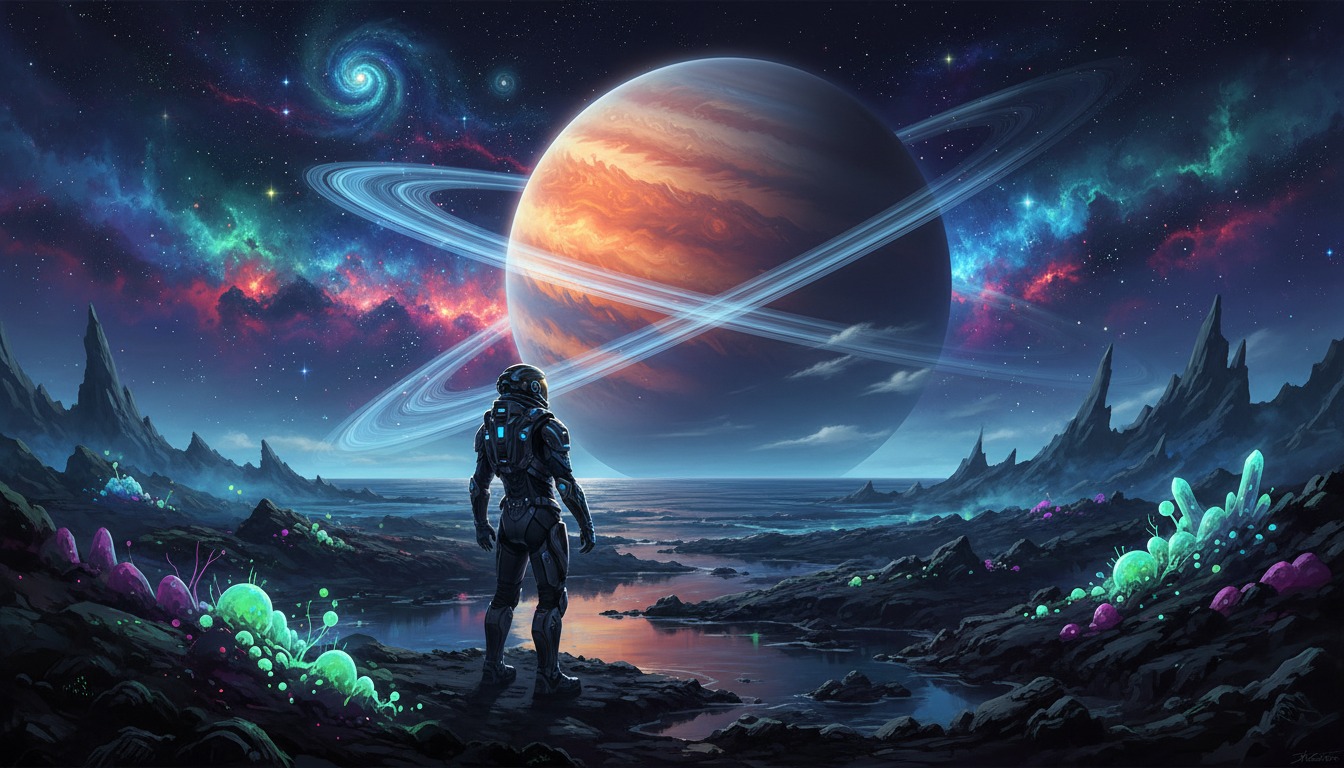
The first time you stand on an alien shoreline in No Man’s Sky VR, look up, and watch a ringed gas giant drift across a sky full of unfamiliar stars, you understand exactly what Hello Games was chasing. It is not merely that the game looks good in a headset. It is that the scale of this universe — eighteen quintillion planets, each one a complete, walkable surface — finally makes sense when it is wrapped around your head. The sense of place is overwhelming. The ambition is undeniable. And then you try to open your inventory, and the whole thing wobbles.
No Man’s Sky did not launch as a VR game. It arrived in 2016 as a flatscreen survival-exploration title, survived a turbulent reception, and rebuilt itself over three years of substantial free updates. The VR support, added in August 2019 as part of the Beyond update, was free for anyone who already owned the game. This is not a separate mode or a truncated experience — it is the full game, start to finish, from resource gathering on a toxic moon to warp-jumping between galaxies. The entire procedural universe is playable in VR. That fact alone is one of the most technically audacious things a major studio has attempted in virtual reality.
The transition to motion controls is where the magic lives. On foot, you physically reach behind your back to pull out the multi-tool. You grab virtual joysticks in your starship cockpit and physically push them forward to burn toward orbit. The quick-menu lives on your left wrist, accessed by raising your arm and pointing at it with your right hand. These are not token gestures. They fundamentally change how it feels to inhabit this world. Piloting a starship through an asteroid field while physically gripping throttle and stick is the kind of moment that justifies the entire update. The tactile layer Hello Games added makes the flat version feel like a prototype by comparison.
But the implementation is rough, and the roughness is impossible to separate from the wonder.
Performance is the first and most serious problem. Even on high-end PC hardware, maintaining a stable frame rate requires aggressive compromises. The game is rendering an enormous procedural world with complex shaders, dense foliage, and atmospheric effects — all in stereoscopic 3D — and it shows. Dropped frames in VR are not cosmetic. They are physically uncomfortable. On PC, players reported needing to drop settings to low and reduce render resolution to hit consistent performance. The PlayStation VR version fared worse visually, with heavy blur on planets and space stations that dulled the impact of those epic vistas. It was a remarkable technical achievement to get the game running on PSVR at all, but the tradeoff in clarity is obvious the moment you put the headset on.
The user interface is the second major weakness. The HUD remains locked to a fixed forward position in many situations, refusing to track with your head as you turn. If you are using room-scale space and physically rotate your body, you may find yourself staring at empty space while your mission markers and health bar remain glued to where you were facing thirty seconds ago. Menu navigation through holographic panels is functional but clunky, and many interface elements feel like they were translated from flatscreen rather than rebuilt for VR. The wrist-menu is a good idea that becomes tedious when you need to access it repeatedly. Inventory management — already a slog in the flat version — is worse when every click requires a deliberate arm gesture.
Controls are a mixed bag that tilts positive. Ship piloting with motion controllers is genuinely excellent. On-foot movement is less elegant. Locomotion options include teleportation and smooth movement, which helps with comfort, but the sprint mechanics and jetpack activation involve button combinations that never feel fully natural. Some interactions demand precision the controllers struggle to provide. The DualShock 4 works as a fallback on PSVR, but it is a poor substitute — a strange halfway house between VR presence and traditional gamepad play that satisfies neither.
Stability at launch was also a concern. Crashes were common enough in the first days that Hello Games pushed a rapid patch to address the worst of them. Even after that, the experience retained a fragility that flatscreen players never had to think about. Windows Mixed Reality users in particular reported compatibility headaches that required workarounds. This is a game that demands patience not just for its pacing, but for its technical behavior.
And yet. When the frame rate holds, when the UI stays out of your way, and when you are standing on the deck of your freighter watching a solar flare paint the hull in shifting light, there is nothing else like this in VR. The procedural universe that felt cold and repetitive on a monitor becomes genuinely majestic at scale. The creatures look stranger up close. The storms feel threatening. The silence between worlds carries weight. No other VR title offers this breadth of exploration, this density of systems, this sheer volume of places to go and things to build.
The question is whether the friction is worth it for you. If you already own No Man’s Sky and have a headset that can handle demanding PCVR titles, the Beyond update is a no-brainer addition — free, transformative, and occasionally breathtaking. If you are buying into the game specifically for VR, understand that you are signing up for a demanding, sometimes awkward experience that will test your hardware and your tolerance for jank. This is not a polished native VR title. It is a massive flat game wearing a headset, and the seams show.
Patient explorers, base-building obsessives, and anyone who has ever wanted to physically sit in a cockpit and cruise toward an undiscovered planet will find something here that no other VR game offers. Players who want tight controls, stable performance, and menus that respect their head tracking should look elsewhere — or wait to see if future updates sand down the rougher edges.
No Man’s Sky VR is a wonder and a mess, often within the same minute. That contradiction is what makes it unforgettable.