
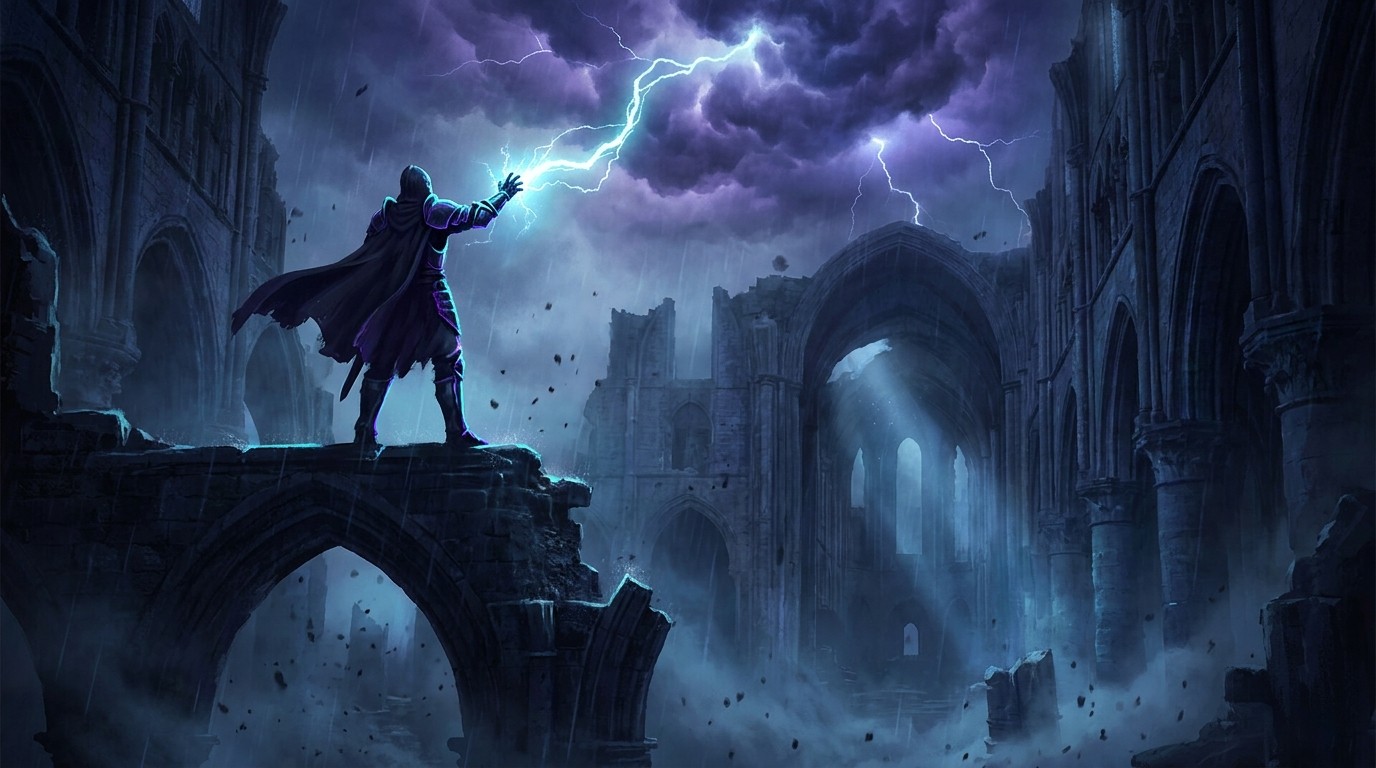
I raised my left hand, palm out, and willed a bolt of storm magic across the chamber. The Nighthaunt wraith dissolved into spectral ash. For a second, I forgot I was standing in my living room in socks — I was Castor Stormscryer, Lord-Arcanum of the Hammers of Sigmar, and the Realm of Death was answering my call. Then a second ghost lunged, I wound up my warhammer, and the head passed straight through its skull like my weapon was rendered on a different layer than the enemy. That’s Tempestfall in a single motion: a genuinely great VR power fantasy undercut by melee combat that forgot to ship with physics.
A Stormcast in Shyish
Tempestfall is a VR-native action-adventure from Carbon Studio, the Polish studio behind The Wizards and Alice VR. There is no flat version of this game — it was built for headsets from the first line of code, and that decision shows in the right places. It launched on PC VR (Steam, Oculus Rift, and Viveport) in November 2021, then arrived on Meta Quest 2 in May 2022 with an added roguelike mode called Storm Trials. You play a Stormcast Eternal — a reforged super-soldier of the god Sigmar — cutting through the undead Nighthaunt across the decaying Realm of Death, Shyish, in the aftermath of a cataclysm called the Necroquake.
The setup is pure Warhammer: you lead a retinue, recover stolen souls, and reclaim a stolen artefact from a necromancer. If you know the lore, there’s a lot to like in the environmental storytelling and the scattered lore tomes. If you don’t, “fire lightning at skeletons” is enough of a premise to carry you.
Storm Magic Is the Star
Combat splits across both hands. Your melee weapon — warhammer, blade, or shield — responds to how you actually swing it. Thrust, overhead, horizontal slash: the angle and force change the result. The other half is storm magic, cast by tracing gestures in the air, and this is where Carbon Studio’s Wizards pedigree pays off. Slinging lightning by moving your arm feels better than it has any right to in a licensed tie-in. Different gestures produce different effects — a thrust might fire a focused bolt, a sweep a wider arc — and chaining them mid-fight, ripping a skeleton apart by hand between casts, is the moment the game earns its license.
You two-hand heavy doors open, climb ledges with a grab button (with a skip option when climbing wears thin), and gather Sigmarite Ore and scrolls to upgrade weapons at forge stations — hammering the upgrades onto the anvil yourself, a small tactile touch that lands. Movement is teleportation by default, with snap turning and a comfort vignette available, and you can play seated or standing in a small space. Carbon Studio has shipped VR since 2016 and knows the comfort basics; I never felt queasy and never fought the controls to get around.
Where the Steel Goes Dull
Here’s the honest catch. The melee system that the game hangs half its pitch on is, to be direct, shoddy. Weapons have no physics — they pass through enemies and through each other when you clang them together in your hands. You don’t block by timing a parry; you kind of wave your weapon near your face and hope the animation registers. After the precision and feedback of the spellcasting, the melee feels like a cheaper game bolted onto the good one, and a lot of fights devolve into flailing until the health bars empty.
Enemy variety is the other wall. You fight skeletons and wraiths, and they’re the same skeletons and wraiths the entire campaign, with similar attacks and shared animations. The AI will wait off-screen until you’ve cleared the three guys in front of you, then clip into a doorway and stall. When cleared areas respawn the same fights on your return, the backtracking shifts from atmospheric to tedious.
The art direction is inconsistent — some environments are genuinely striking, others look like they shipped a generation early — and at five to seven hours with no DLC and no post-launch content beyond a Hardcore mode patch, what’s in the box is what you get.
Storm Trials and the Long Game
Storm Trials, the mode that arrived with the Quest 2 version, is a roguelike arena with weapon and character progression. It’s the best reason to keep the headset on after the story ends: short, repeatable, and a cleaner showcase for the magic than some of the thinner story missions. On Quest 2 the fidelity drops, as you’d expect from standalone hardware, but the game stays feature-complete.
Tempestfall is for two groups: Warhammer fans who want to stand inside the Age of Sigmar universe and call down lightning, and VR action enthusiasts willing to tolerate rough melee for a real power fantasy. If you go in expecting the combat depth of Until You Fall or the polish of a first-party title, you’ll leave disappointed. Go in for the storm magic and the atmosphere, and there’s a good time waiting.
This is a B-tier VR experience. The spellcasting alone makes it worth a playthrough for the right audience, but shoddy melee, thin enemy variety, and uneven production keep it from being an easy recommendation. Bring patience for the sword, and the storm will carry you.