
There’s a moment early on where you’re standing in a WWI trench, a worn leather wristwatch strapped to your forearm, and you reach out and catch a cricket ball out of mid-air to nudge a puzzle into place. Not a button prompt. Your actual hand, closing around the thing. That’s the contract Wanderer signs with you in the first ten minutes: the world is solid enough to touch, and the puzzle is the time machine.
Wanderer is a VR-native narrative puzzle-adventure from Mighty Eyes — co-developed with M-Theory and Oddboy — and there is no flat version hanging behind it. This was built for a headset from the first line of code. You play Asher Neumann, who inherits a wristwatch that happens to fold time, and you hop across eras untangling a story that’s bigger than the rooms it drops you into. Buy it on Steam or the PlayStation Store, install, and play. There’s no mod to chase, no profile to confirm, no Discord step. Full 6DOF, dual motion controllers, and both teleport and smooth locomotion on the table, so it’s an easy sit-down-and-play session even if you keep snap-turn on.
The watch is the whole game
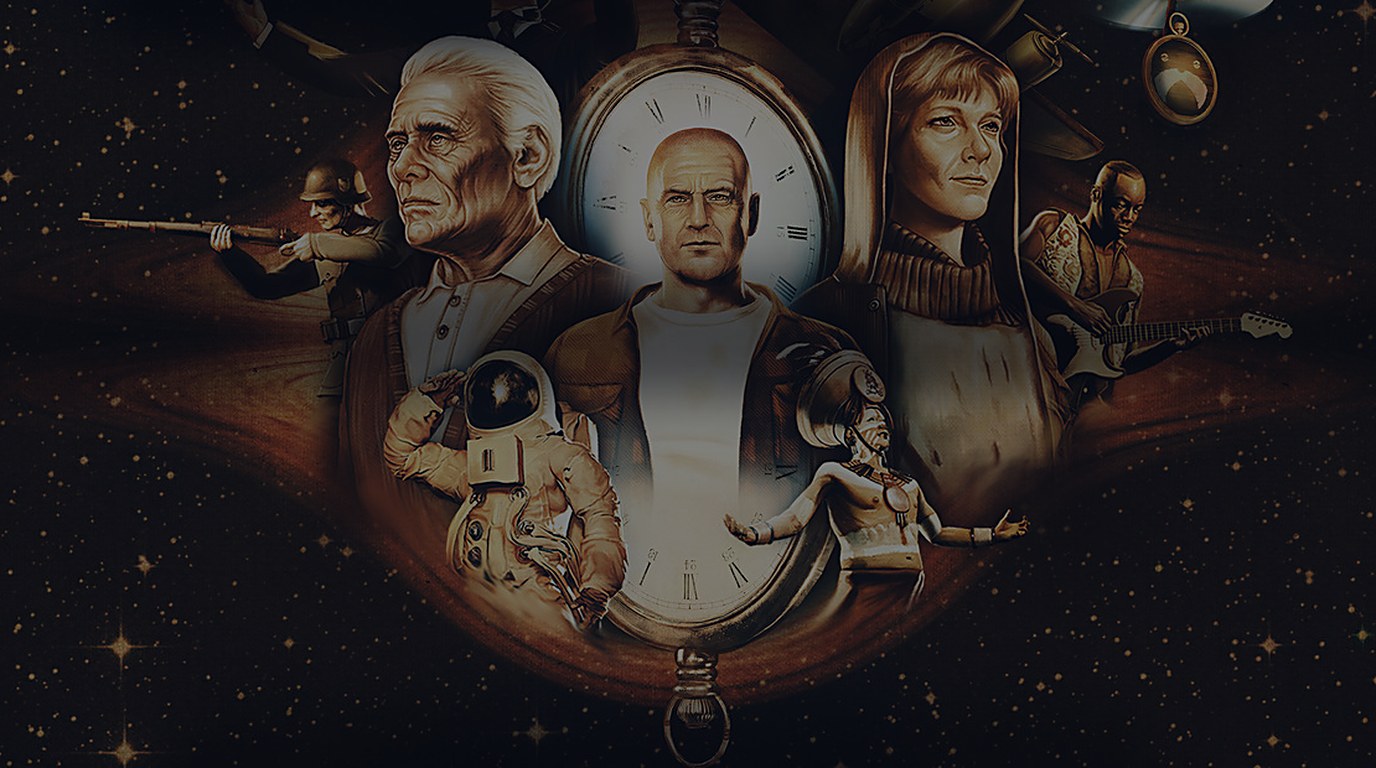
Most VR puzzle games give you a box of objects. Wanderer gives you a device that rewinds the room you’re standing in, and that single idea carries the whole experience. You’re not solving puzzles about time travel — you’re manipulating it directly. Spin the dial and a WWI trench collapses back into a quiet study; fast-forward and a 1960s space mission assembles itself around you. The eras are the real draw: a moon launch, ancient Egypt, 1969, each one rendered with a level of art direction that earned the game an Excellence in Visual Art award. This is a good-looking headset game, and more importantly it feels like places rather than levels.
The interaction model is the other half of the pitch. Almost everything is grab-and-go. You pick up records and place them on a turntable, crank mechanisms, hold artifacts up to the light to read them. The physics aren’t fussy in a bad way — they’re loose enough that fumbling a thing across a table feels like your clumsiness, not a broken engine. When it clicks, it clicks hard: you stop thinking about controls and start thinking about what’s in front of you.
Where it earns the headset
The time-hopping structure does something flat puzzle games can’t: it keeps the world feeling vast and alive without asking you to walk across a giant open map. Each era is a self-contained set piece, but they ladder into a single narrative about Asher and his grandmother’s legacy. I came for the puzzles and stayed for the slow realization that the rooms I’d already left mattered to the one I was in. That’s world-building you inhabit rather than read, and it’s exactly the kind of thing native VR is supposed to do.
Standing in the lunar module, watching the Earth through the viewport while I fumbled with toggles, was the moment I stopped evaluating the game and started playing it. The presence is real, the art sells the scale, and the tactile layer means you’re doing the astronaut stuff instead of watching a cutscene do it for you.
Where it misses
Here’s the honest catch: the game is at its best when you’re manipulating objects in a quiet room, and it knows it. The action sequences — the bits where it wants you to do something more physical or time-pressured — are the weakest stretches. They’re not broken, but they feel like the developers were less sure of themselves out of the puzzle sandbox, and it shows. You can feel the seams.
Pacing is the other soft spot. Some puzzles are crisp and satisfying; a few are obtuse in a way that reads as under-clued rather than clever, and the occasional solution is “wave your hand near the thing until the game decides you’ve done it.” None of it stopped me, but a couple of beats stalled the forward momentum the time-travel hook works so hard to build. And at a sitting, it’s a tighter experience than the era-spanning premise implies — you’ll finish feeling like you got a complete story, not a sprawling one.
The verdict from inside the trench
I keep landing on “just shy of greatness,” which is the kindest accurate way to put it. Wanderer is a confident, well-made VR-native adventure that respects the medium: real hands, real presence, real places worth standing in. It’s not a sprawling systemic world like Asgard’s Wrath or a generational shooter like Alyx, and the action bits wobble — but as a tactile time-travel puzzle game with genuine art direction, it’s one of the stronger recommendations in the genre, sitting comfortably alongside The Room VR and Red Matter for players who want to handle their mysteries.
Get it if you like your VR smart and hands-on, and you’re fine with a story that’s a tight six hours rather than an open world. Skip it if you need constant physical action or bulletproof puzzle clarity — the slower, fiddlier stretches will test your patience. The headset time is worth it for the eras alone.