
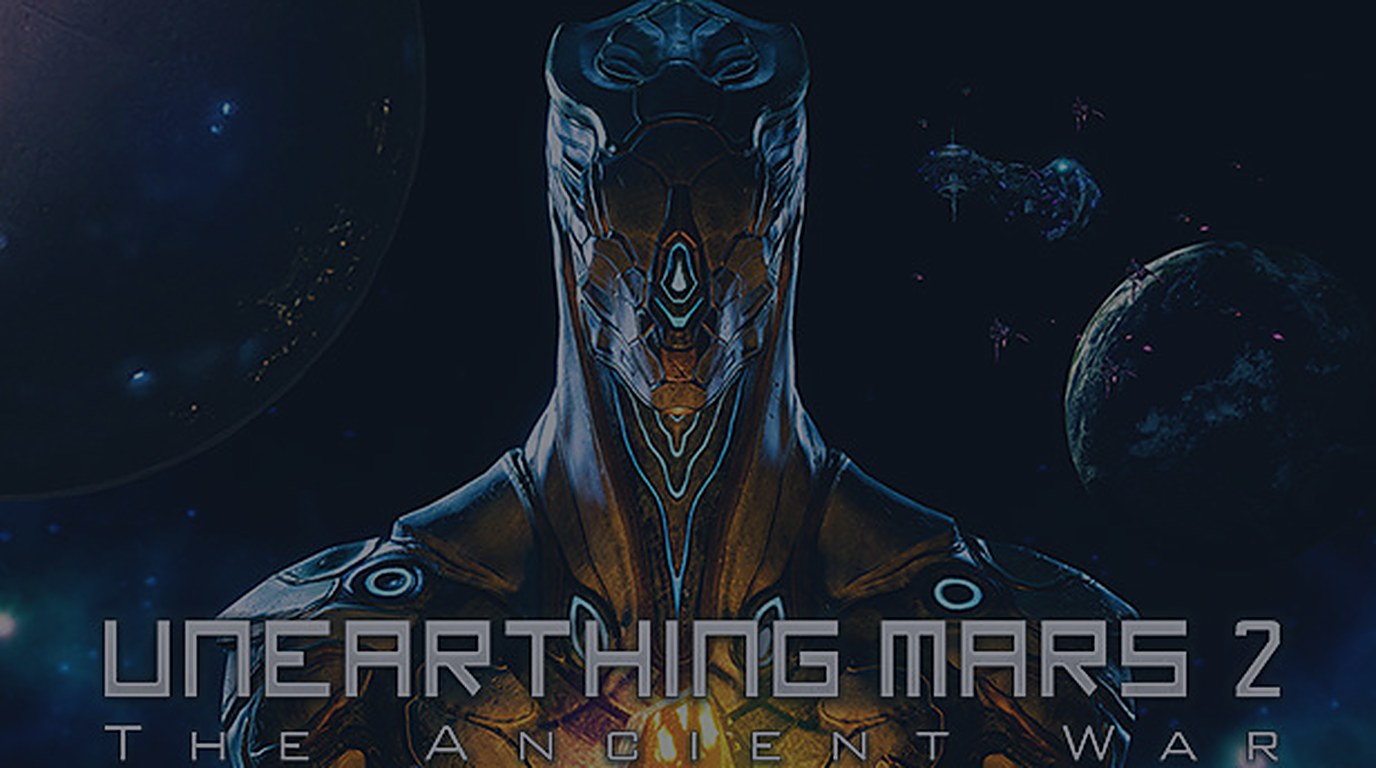
There’s a moment about twenty minutes in where Unearthing Mars 2 stops being a shooter and just lets you stand on Mars. I lowered the gun and looked at the ruins and open ground, and for a second the wave spawners could wait. Most launch-window VR shooters want to show me a place more than they want to test me, and this one is honest about which it’s better at.
It’s the sequel to Unearthing Mars from 2017, and it’s a native VR title — there’s no flat version with a mod bolted on, no community conversion to wrangle. You buy it on PSVR or PCVR and you’re in. It’s single-player, and for a game this short that’s the right instinct — you’ll be out the other side in three or four hours.
What you’re actually getting into
It’s a first-person adventure with shooter set pieces bolted on. The exploration and light puzzles inherited from the original form the backbone, and the breaks between them are arena fights — waves of enemies, a few unlockable guns, weak points to hit, and a boss to close each stretch. On PSVR you aim with the Move controllers; on PCVR it’s Vive wands or Touch. The gun handling is the one physical bit that sticks — you’re actually pointing the thing, not nudging a reticle with a stick. Setup is install-and-play; there’s nothing to configure.
How it feels to play
The loop is simple and it knows it. You pick a gun, aim at the weak point, clear the wave, move on. There are six or more guns to unlock, and the weak-point aiming is the core skill the game asks for — line up the bright bit, pull the trigger, watch the thing fold. The special skills give the arena fights a beat of spectacle between reloads, and they’re the moments the game clearly spent its budget on.
Where it works, it works because Mars reads as a place with real stakes. The production values were solid for a 2018 launch-window PSVR title — environments that hold up at headset scale, lighting that does something, and a sense that you’re standing somewhere rather than watching a cutscene about it. The quiet stretches between fights, where the game lets you look, are the better half of the experience.
What’s actually good here
The respect for your time is the real strength. No grind padding, and nothing that pulls you back once the credits roll. You get the experience once. For a launch-window VR title that’s a feature, not a confession — three or four hours isn’t nothing, and the game doesn’t fake a reason to keep you past the idea it had.
The shooting is competent. Not deep, not clever, but the weak-point loop is the spine of every encounter and it stays readable under pressure. Boss fights light up a bright bit and dare you to find it fast, and when you do, the payoff lands.
Where it falls apart
The thin systems will annoy you before the credits do. The enemy AI isn’t going to outflank you, which is fine for a showcase and fatal to any claim this is a shooter you’ll study. But the arena template repeats, and the novelty wears off. By the third or fourth skirmish you’ve seen the trick: find the weak point, clear the wave, move to the next arena that looks like the last one. The resolution runs out of budget before it runs out of ambition, and you feel the cut.
The reception tells the same story from the outside. UploadVR scored it 4/10 under the headline “Best Left Buried,” and on Steam it sits at 57% across 21 reviews — Mixed. Both are fair as complaints about value, and neither is the whole picture — the game looks and moves better than a 4/10 suggests, and the weak-point shooting is more satisfying than a Mixed tag implies. I’d treat those scores as a price-and-length warning, not a quality verdict on the time you do spend in the headset.
The call
Grab it on sale and it’s an easy yes; at full price it’s a harder sell. At $19.99 on Steam today you’re paying for a single afternoon, and that afternoon is better than the aggregate makes it look but thinner than the trailer promises. Watch for the discount and you get a compact Mars showcase with a competent gun in your hand and a few views worth lowering the weapon for.
Skip it if you need systems that reward mastery, or if you’ve already burnt out on wave-shooter arenas. This is a place to visit, not a game to live in — and for three or four hours on sale, that’s a fair trade.