
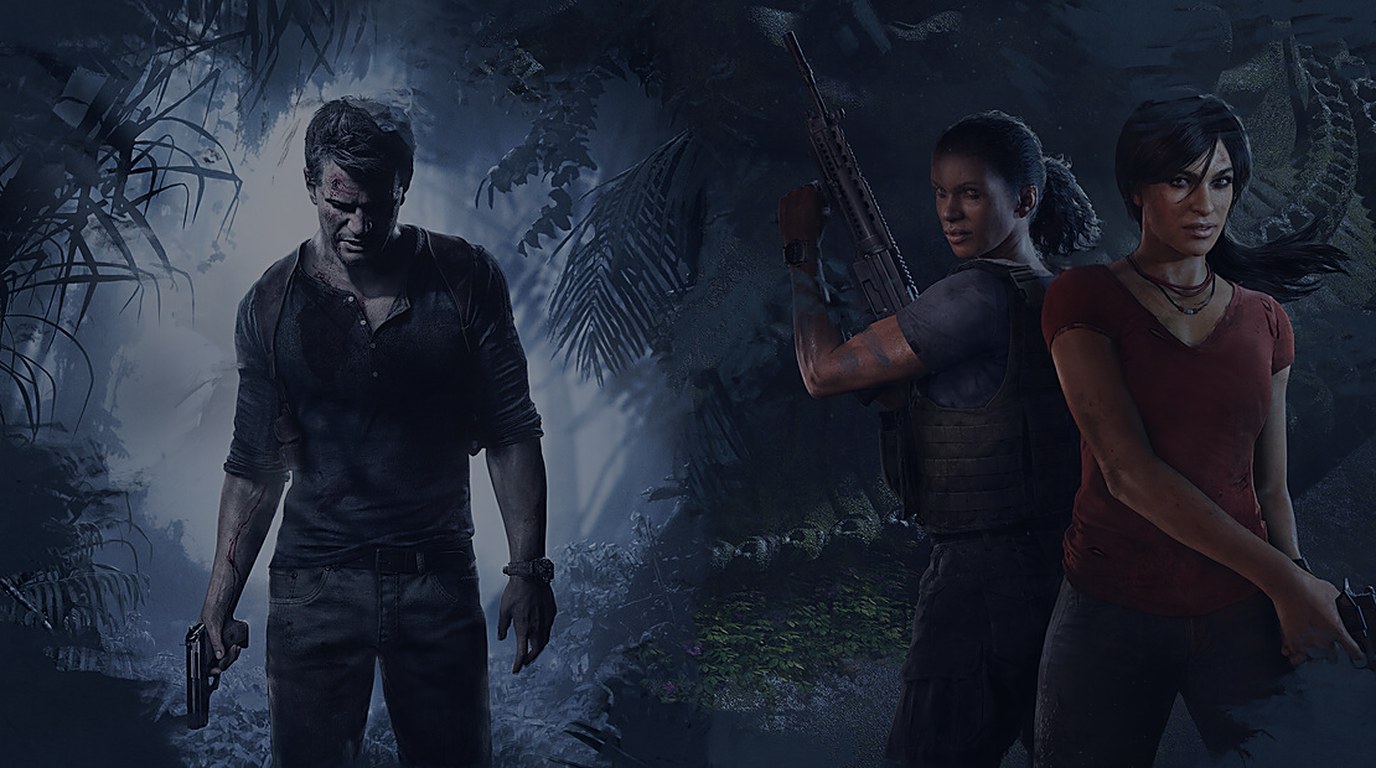
I spent a weekend climbing Madagascar cliffs behind Nathan Drake’s back, and the first thing that hit me wasn’t the gunplay or the puzzle — it was the drop. You’re standing at the edge of a ruined clock tower, Drake’s boots scuffing loose rock, and the coastline below opens up in a way the flat screen never gave me. The game is seven years old on console, but in VR it reads as a place.
This isn’t a native VR port and it isn’t a community mod with rebuilt systems. It’s a third-person cinematic VR conversion built on Luke Ross’s R.E.A.L. framework — the same line that put Red Dead 2 and God of War into headsets. Someone hands you a stereo 3D, head-tracked version of the PC port (the Legacy of Thieves Collection, which bundles Uncharted 4 and The Lost Legacy) and leaves Naughty Dog’s animation, writing, and camera work completely intact. You keep Drake on screen the whole time. You’re a guest behind the camera, not a body in the world.
That frame matters, because it sets the ceiling and the floor at the same time.
Getting it running
The path is one: you own Legacy of Thieves on PC (Steam or Epic), you grab the R.E.A.L. package from the creator’s own page, and you drop the framework files beside the game executable. Run the config utility once, launch the game normally, and you’re in. It’s moderate, not scary — but treat it like a real install, not a toggle buried in a menu.
Two discipline notes that will save you a bad afternoon. First, strip out competing injectors and overlays before you start — ReShade and old VR hooks fight the injection and leave you with a black screen. Second, and this is the one people miss: a newer game patch can quietly break the injection. Before you commit, confirm the build you’re running is still listed on the creator’s current setup page and match the tested version. The framework is maintained and the collection is still covered, so The Lost Legacy rides along for free — but verify the listing, don’t assume.
That’s the whole barrier. No tracked hands, no rebuilt systems, no engine swap. Just a clean injection of stereo depth and head tracking onto a game that was never built for VR.
What you’re actually holding
There are no tracked hands here. This is gamepad-only, full stop — the conversion uses the original control model, and there is no motion-control layer for climbing, aiming, or grabbing. You drive Drake with a pad the same way you would on a monitor, and the headset just changes where your eyes sit relative to the action. PCVR Central calls Uncharted “one of the strongest arguments for gamepad VR,” and after a weekend I get why: third-person framing means you’re never reaching for a gun that isn’t there. The camera is the VR.
That’s also the honest catch. You are watching a beautifully directed movie where you happen to control the protagonist’s body and the camera responds to your head. If “I need to be the one pulling the trigger” is your non-negotiable, this won’t convert you, and that’s fine — say it plainly and move on.
Where it earns the headset
Here’s the thing: Uncharted 4 is one of the best-looking, best-directed games Naughty Dog ever made, and the conversion makes the world the subject instead of the spectacle. The Madagascar coastline isn’t a backdrop you pan across — it’s a volume you’re standing inside, and the scale of the set pieces lands as location rather than choreography. When the jungle truck fishtails through mud and the spray catches the lens, you’re not watching a cutscene about a vehicle chase; you’re watching Drake get filthy in real space.
The clock-tower scaffolding, the city ruins, the way the world rushes past your peripheral vision during a traversal climb — these are the moments the flat version flattens. Third-person VR has a bad reputation because most of it is a floating action figure on a green screen. This isn’t that. The head tracking lets you lean around cover, study a fresco, actually feel the height before you jump. The drop you instinctively step back from isn’t a trick; it’s the game finally having somewhere to put its ambition.
And it’s stable. The conversion covers the whole collection, runs the full campaign, and the reception tells the story: seven-plus channels covered it, a hardware-focused creator came back four times across Quest 3 and Pico 4 footage, and at least one best-of VR-mods roundup gave it a ranked slot. PCVR Central labels the method “Excellent.” This isn’t a launch-day novelty that melted in a week — it’s a respected, watchable full-game VR run.
Where it falls short
The ceiling is structural, not janky. No tracked hands means no physical climbing, no aiming down sights with your own arms, no sense of your own body in the space. For a game whose entire identity is “a charming guy grapples and shoots his way through impossible places,” that’s a real omission — you admire Drake, you don’t become him. Some people bounce off that immediately, and I don’t blame them.
It’s also heavy on hardware. This is a dense, animation-rich AAA game getting stereo-rendered on top of its normal load, and you’ll want a high-end rig to hold 90Hz without reprojection during the busy set pieces. If your PC is mid-range, expect to trade resolution or supersampling to keep it smooth. The conversion doesn’t add a performance mode — you’re running the full flat game plus VR overhead, full stop.
And be honest about the source material: the flat version of Uncharted 4 is arguably just as good as a pure gameplay proposition, because you’re watching Drake either way. VR doesn’t rebuild the moment-to-moment loop. It rebuilds the world around it. That’s a meaningful difference, but it’s not a transformation of the systems — it’s a transformation of the frame.
The call
I keep coming back to one line from the coverage: the collection is an excellent fit for cinematic third-person VR because it preserves Naughty Dog’s animation-heavy traversal while giving the ruins, cliffs, cities, and characters real scale. That’s the whole pitch, and it delivers. It’s not the hands-in-the-world VR of a native title, and it never pretends to be. It’s a beautiful, elaborate window — and for a game this well-built, a window is enough.
Recommended with caveats, and the caveat is simple: this is for people who already love Uncharted and want to stand inside it, not for anyone chasing motion-control presence. If that’s you, own the PC collection, run the config, back the camera off, and play seated. You’ll spend a weekend in a world that earns the headset — just don’t expect to be the one holding the gun.