
I still remember the first time I reached out, grabbed the yoke, and felt the stick move under my fingers instead of a thumbstick.
That’s the whole game right there. Ultrawings 2 is a made-for-VR arcade flight sim, and Bit Planet Games built it around one idea: you don’t press buttons to fly, you use your hands. The studio that made the original Ultrawings brought back their virtual-hands cockpit system and doubled down on it, and on a Quest 2, a SteamVR headset, or a PSVR2, that decision is what separates this from every other flight game that asks you to pretend.
There’s no flat-screen version of this game. It was designed for VR from the ground up, which means you don’t install a mod, you don’t wrangle an injector, you don’t hunt for a profile. You buy it on your headset’s store, you launch it, and you’re sitting in a cockpit. That’s the entire setup burden. For a VR flight game, that’s almost shocking — the genre usually demands a HOTAS, a PC, and a tolerance for pain.
The hook is the hands. You physically reach down, wrap your virtual fingers around the stick, and pull the throttle back with your other hand. Flip the magneto switch. Toggle the landing gear. It sounds like a gimmick until you’re banked into a turn over an island chain and your brain fully believes you’re holding that yoke. The cockpit is your world — instruments sit where they should, your hands are where they should be, and the plane responds to your grip. This is the VR transformation the medium keeps promising and so rarely delivers: not a screen strapped to your face, but a body doing a real thing.
Each aircraft flies differently enough that the garage matters. The biplane wallows and loops with zero apology, the seaplane kisses the water on takeoff, the glider trades engine noise for silence and a long, patient fall through thermals. You feel the weight difference in your hands on the stick, not in a stat sheet. That’s the quiet genius of the virtual-hands system — the plane’s character shows up in your grip before it shows up on a HUD.
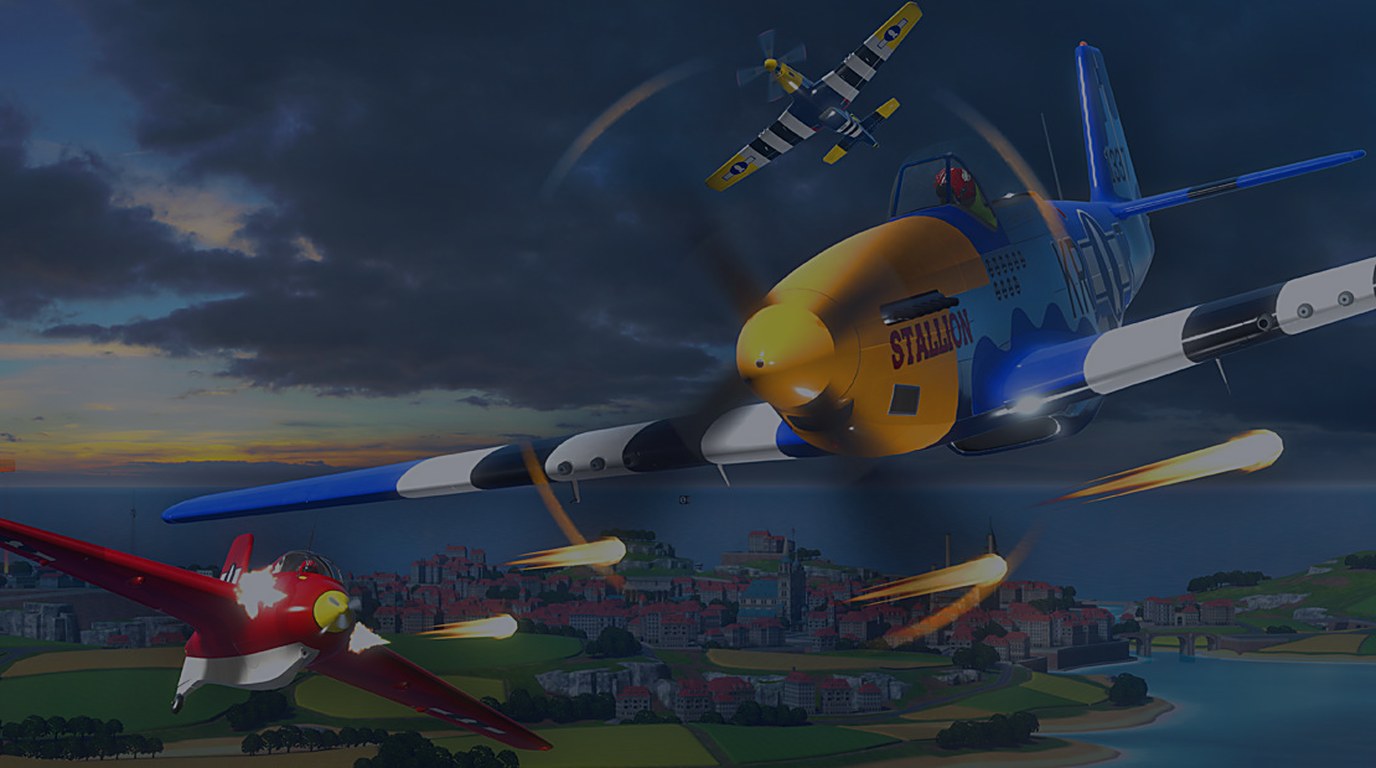
You’re not just free-flying, either. The world is an island-themed archipelago with five distinct aircraft to earn and fly — a biplane, a seaplane, a glider, a jet, and more — and the loop is classic arcade progression. You take hand-crafted missions, you bank the cash, you buy new aircraft and unlock new islands to explore. Some missions are gentle sightseeing and photo runs. Others are combat: strafing ranges, dodging fire, the kind of arcade dogfight that doesn’t pretend to be a study sim. The variety is the point — there’s always a different plane to grind toward and a reason to get back in the air.
That’s also where it earns its reputation as the accessible flight sim. If the idea of a hardcore simulator makes your eyes glaze over, this is the on-ramp. The flight model is forgiving, the controls map to your hands instead of a keyboard, and you can be airborne in thirty seconds. I’d hand this to a VR newcomer before I’d hand them a full simulator, and I say that as someone who loves the hardcore stuff. Ultrawings 2 isn’t competing with the study sims. It’s competing with the part of your brain that wanted to be a pilot at age nine.
And it’s got legs. The mission count is genuinely generous — reviewers kept flagging how much is actually in here for the price — and the loop of earning, buying, and exploring keeps it from feeling like a tech demo with aspirations. I’ve sunk sessions into nothing but island-hopping and stunt runs, and the world still had corners I hadn’t unlocked.
Now the honest part. This is arcade, not simulation, and if you came for systems depth you’ll find the ceiling fast. The flight model is approachable by design, which means it flattens a lot of what makes real flying hard and interesting. Combat missions are fun but thin — they scratch the arcade itch and then repeat the pattern. A few mission types wear thin after the tenth run, and the open world is pretty and populated but not dense with things to discover in the way a true sandbox is. Seated in a fixed cockpit frame, it’s one of the calmer VR experiences, though the stunt and aerobatic missions will find the limit of anyone prone to motion sickness.
None of that dents the core. Ultrawings 2 does one thing — put you in a cockpit with your own hands on the controls — and it does it better than almost anything else in VR. For twenty bucks at launch it was an easy yes; on any of the three storefronts it calls home now, it still is. If you’ve got a headset and even a passing interest in flight, this is the game that makes the fantasy real instead of simulated.