
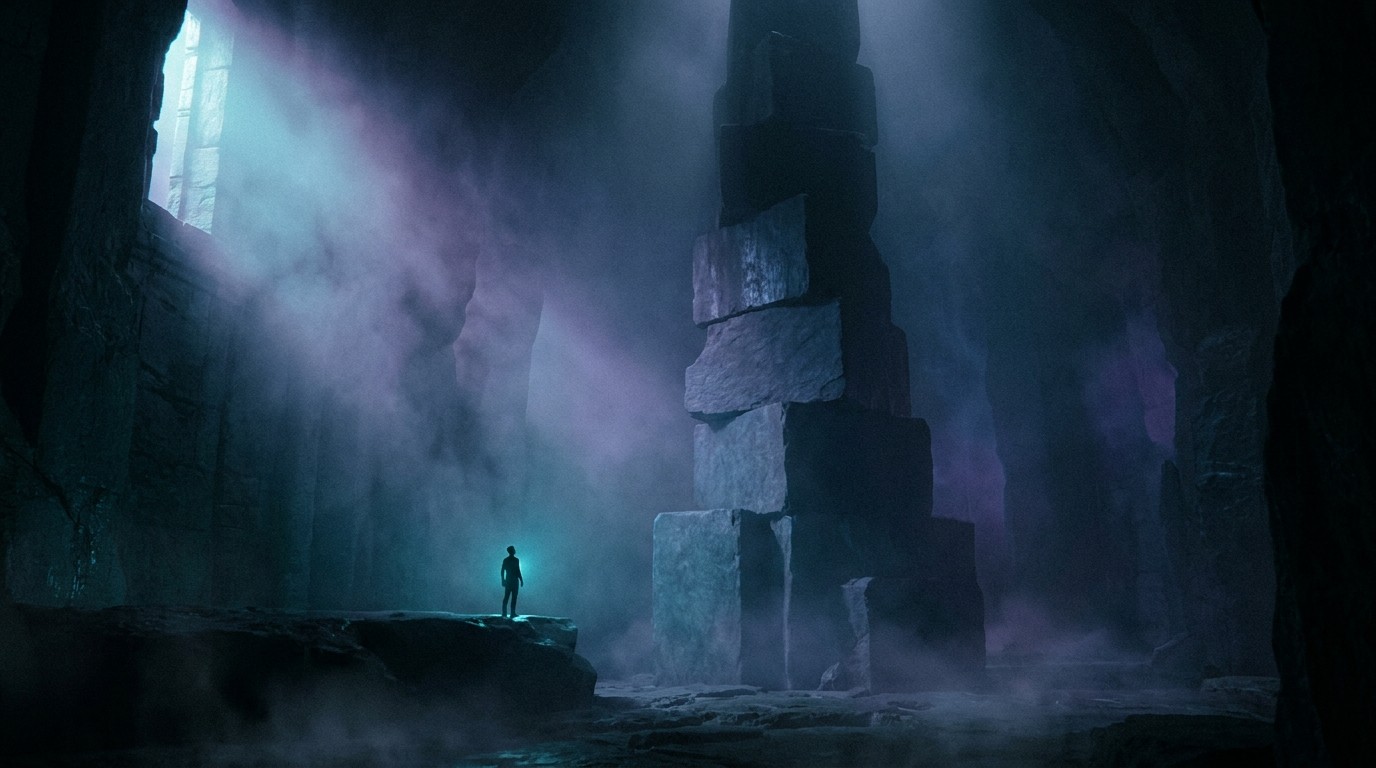
I spent a weekend on my PSVR with Tumble VR, and the moment that hooked me wasn’t the loud destruction levels — it was a quiet one. I was balancing a glass block on top of a wobbling stone tower, and I watched it teeter for a half-second before it settled. The weight was real. The friction was real. My hand — well, the Move controller in it — was doing something a flat screen never lets you do: feel out a 3D structure by reaching into it.
That’s the whole pitch. Tumble VR is a PSVR launch title, and it’s the rebuilt-from-scratch sequel to the PS3’s Tumble, the old PlayStation Move showcase. Supermassive Games tore it down and rebuilt it for the headset with new levels, a cleaner visual style, and a snarky robot drone supervising your every mistake. Over 80 single-player levels hand you blocks made of stone, rubber, wood, glass, foam, and plastic — each with its own weight and friction — and ask you to stack to a target height, demolish towers with mines, limbo under moving bars, bend light through a puzzle, and build bridges. There is no flatscreen version and no other VR platform; this is a native PSVR game, full stop.
What you’re actually buying
Setup is the usual PSVR plug-and-play: a PS4, the headset, the PlayStation Camera, and you’re in. A single PS Move controller is recommended because grabbing and placing blocks with it feels natural — you reach in, close your hand, set the block down. But the full game is playable with a DualShock 4 too, using the controller’s motion tracking, so you’re not locked out if you only have the standard pad. For local multiplayer, a second player grabs a DualShock 4 and harasses you from the TV with laser beams and wind turbines while you’re stuck in the headset. It’s pettier than it sounds and twice as fun — the kind of couch mode that makes a puzzle game into a party.
How it plays
The core loop is spatial manipulation, and that’s exactly the thing VR is good at. On a flat screen, stacking blocks is a menu of clicks. In the headset, you lean in, tilt your head to check the tower’s center of mass, and place the next piece by feel. The material system is what gives it teeth: a rubber block bounces, a stone block is dead weight, glass shatters if you drop it wrong, foam is near-weightless. Early levels are gentle — hit a target height. Then they start asking you to demolish towers with mines, thread blocks under sweeping bars in a limbo section, or route light through a puzzle. None of it is hard in the way an action game is hard, but the physics constantly ask you to think in three dimensions, and the headset makes that thinking physical.
Comfort is a non-issue: you’re stationary and seated, reaching into a puzzle that never moves you through space.
What’s genuinely good
The satisfying part is the tactile feedback loop. When a tower you built holds, you feel it. When it collapses, you see exactly why — the camera angle you chose, the block you overloaded. That’s a level of cause-and-effect a flat puzzle game can’t give you, because you can’t actually orbit a structure with your body in front of a TV. The variety across those 80 levels is real, not filler padding: destruction, limbo, light-bending, and bridge-building each play differently enough that the campaign doesn’t stale out. And the robot drone’s commentary lands more often than it misses — enough to keep a puzzle game feeling like it has a personality rather than a loading screen between challenges.
Where it’s thin
Here’s the honest catch. Tumble VR is a puzzle game with no story and no world to inhabit. You’re not somewhere — you’re at a workbench. The environments are sparse by design, and after the novelty of reaching into 3D space wears off, what’s left is a competent block-stacking puzzle. If you don’t already enjoy physics puzzles, the “wow, I’m in 3D” wears into “okay, another tower.” Critics at launch mostly filed it under tech-demo filler, and they weren’t entirely wrong — this is a launch title doing launch-title duty, showing off the hardware more than it’s showing off a deep game. The DualShock-4-only control scheme also loses something: grabbing blocks with a tracked controller is the intended feel, and playing without a Move makes the interaction flatter than it wants to be.
Bottom line
Tumble VR isn’t essential VR, but it’s the rare launch puzzle that earns its spot rather than coasting on the hardware. The spatial manipulation is the real thing — you’re not watching blocks stack, you’re stacking them — and the material physics give it more depth than the concept implies. Get it if you like puzzle games and want something calm that shows off what headset presence does for spatial thinking. Skip it if you need a world, a story, or a reason to care about the blocks beyond the puzzle itself.