
The Witcher in VR: A Fan Remake, Not a Real Port
I did not expect to stand on the battlements of Kaer Morhen in a headset. The Witcher came out in 2007, built on a modified BioWare Aurora engine that had no business being anywhere near virtual reality. But here it is, sort of: a free fan project that imports chunks of the first game into Unreal Engine 4 and lets you walk through them in VR. If your question is “can I play The Witcher in VR?” the honest answer is “a tiny piece of it, yes.” And that piece is more of a museum than a full game.
What this actually is
There are three Witcher games, and none of them has an official VR mode. The only dedicated VR path is Witcher in Virtual Reality by Patryk Loan, a Nexus Mods project that rebuilt select maps and the prologue of the original 2007 game in Unreal Engine 4. Version 1.0 in early 2020 was just Kaer Morhen: you could walk around, shoo birds, and that was about it. The 2.0 release in July 2022 added the full prologue — combat, dialogue choices, cutscenes, five maps, tutorials, and a reworked battle system. It requires owning the original game, but it runs as a separate UE4 executable.
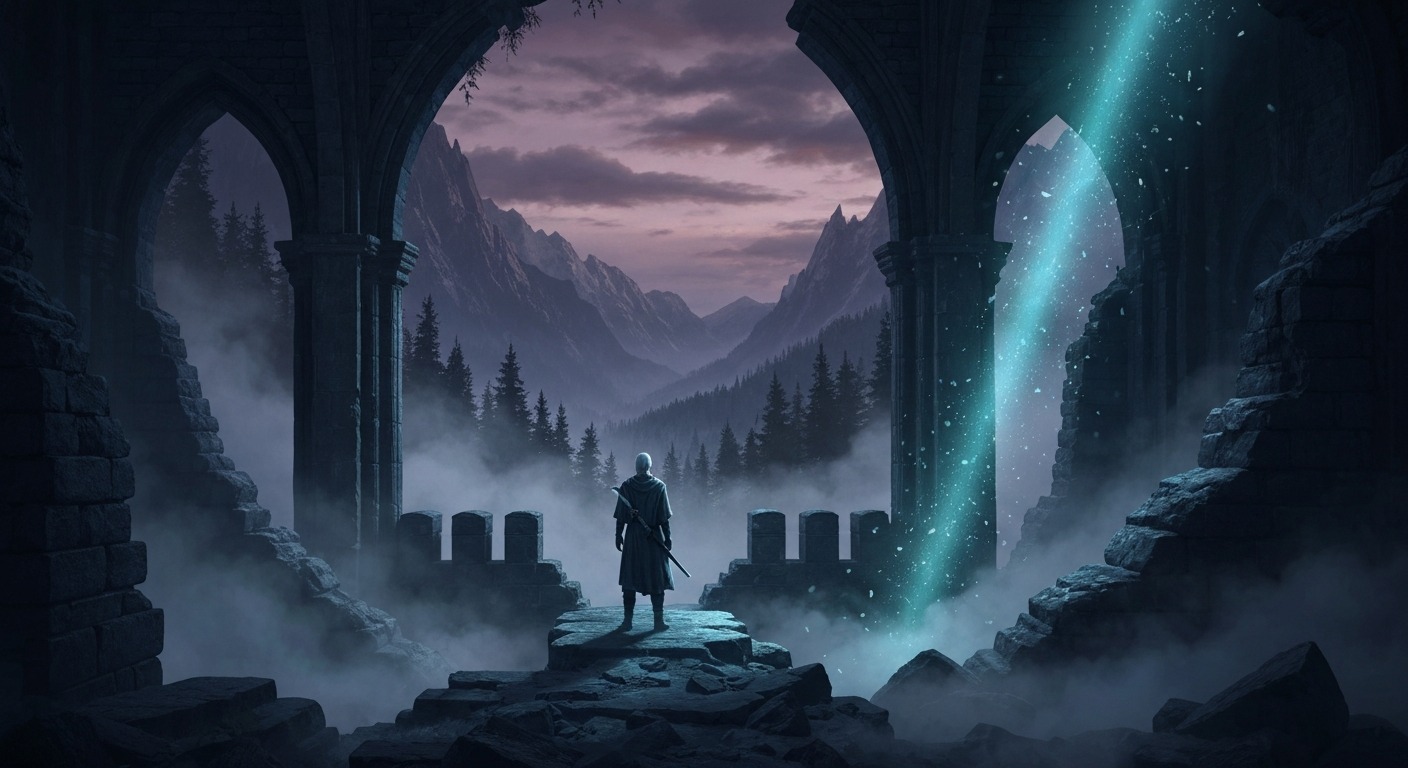
The first time I launched it, the launcher asked if I wanted normal or VR mode. I picked VR, strapped on my Quest 3 over Link, and spawned in the fortress courtyard. The scale is the thing that hits you first. Kaer Morhen is smaller and emptier than your memory insists, but standing inside it still works. The stone walls have that low-poly 2007 charm, the skybox is hazy, and the sound design pulls enough original assets that the place feels recognizable. It is not pretty by modern standards, but it is unmistakably The Witcher.
Then I tried to actually do something.
Setup reality
Installation is blessedly simple for a fan project. Download the RAR from Nexus Mods, extract it, run the included install script, then launch witcher.exe from the game’s System folder and choose VR mode. Total setup time for me was about fifteen minutes, including the Nexus login dance. The project supports Oculus / Meta headsets, HTC Vive, Valve Index, and Windows Mixed Reality. I ran it over Oculus Link; Air Link had too much stutter for comfort.
You will need a copy of The Witcher: Enhanced Edition Director’s Cut on Steam or GOG. The mod does not modify the original Aurora-engine executable in any meaningful way; it uses the original assets as source material for a UE4 rebuild. That is a good thing, because it means the mod is not trying to force VR into an engine that predates consumer VR by a decade.
First impression: a walk, not a game
The first area is pure tourism. You walk the ramparts, look at the mountains, and realize how small the original level geometry actually was. The sense of presence is real but fragile. There are no enemies, no loot, no dialog trees. For the first ten minutes it feels like a proof of concept with excellent source material.
Once the prologue opens up, things get more interesting. Combat uses motion controls for sword swings, though it is closer to rhythmically waggling than a physics-driven blade. The tutorials hold your hand through the systems, and the dialogue choices let you feel like you are actually negotiating with Vesemir. Cutscenes have been rebuilt from scratch and include some new lore flourishes and author Easter eggs, which is either charming or intrusive depending on your tolerance for fan additions.
I spent about an hour in the prologue before the seams started showing. Collision is loose, some props float, and the UI is clearly a flat-screen menu scaled up for a headset. Text is readable if you lean in. It is not polished, but it is playable.
Extended play: where is the rest of the game?
Here is the catch: the project only covers the prologue and a handful of maps. The full Witcher campaign is not available in VR and, based on the update cadence, may never be. Loan’s plan was always to add more maps and possibly a playable plot, but after the July 2022 version the project has been quiet.
That makes this a curiosity, not a replacement. If you want the complete story of Geralt’s amnesia, the Salamandra conspiracy, and Chapter IV’s moral choices, you still need to play the flat version. The VR mod gives you the opening act as a standalone experience and then stops.
Comfort was better than I expected. The movement is smooth-stick locomotion with no teleport option, so newcomers may feel it. I had no issues in a forty-five-minute session, though the headset’s weight started bothering my cheekbones around the half-hour mark. Performance was stable on a mid-range PC at medium settings; a few shader-heavy moments dipped, but nothing unplayable.
The other paths (or why they are not really paths)
People always ask about The Witcher 2 and The Witcher 3 in VR. Technically, both can be injected through VorpX. Realistically, neither is worth recommending unless you are already obsessed with the idea.
The Witcher 2 has a VorpX profile with G3D and Z3D support. It runs, but the game is a third-person action RPG built around mouse-driven quick-time combat and cinematic camera angles. VorpX gives you stereoscopic depth and head tracking, which makes cutscenes feel like a big-screen movie, but you are still playing with a gamepad or keyboard and mouse. There is no hand presence, no motion-controlled swordplay, and no reason to tolerate the performance overhead instead of playing flat.
The Witcher 3 is the stronger injection candidate. VorpX has had an official profile for years, and after CD Projekt’s December 2022 next-gen update the VorpX 23.1.0 beta added a scripted game mod that handles alternate-frame 3D, automatic FOV, and EdgePeek during cutscenes. Pair that with a first-person mod like Gervant First Person and you can explore Novigrad from Geralt’s eye line. It can look genuinely impressive in short bursts.
But it is still an injection driver. Menus are flat, combat is gamepad, and performance tanks in cities. The first-person mod breaks some shadows with ray tracing and makes a few object interactions finicky. I tried it for an hour and spent most of that time tweaking FOV and resolution to keep the frame rate above water. It is the best VorpX implementation in the series, and it still made me want to take the headset off and play on a monitor.
UEVR is not an option for any Witcher game because CD Projekt uses its own REDengine, not Unreal Engine. Emulators are not practical either. The 360 version of The Witcher 2 exists, but nobody is doing a stable VR wrapper for it that is worth your time.
The Witcher in VR is a fun piece of fan tourism for the first game’s prologue and little else. Patryk Loan’s remake captures the atmosphere of Kaer Morhen well enough that fans should try it once, but it does not transform the original RPG into a full VR experience. The Witcher 2 and 3 through VorpX are injection-driver curiosities for the already converted. Play the flat versions if you want the actual games; fire up the VR mod if you want to spend an afternoon standing where Geralt trained.
Who this is for: Hardcore Witcher fans who want a low-effort VR stroll through Kaer Morhen.
Who should skip it: Anyone looking for a complete, polished, or motion-controlled Witcher campaign.