
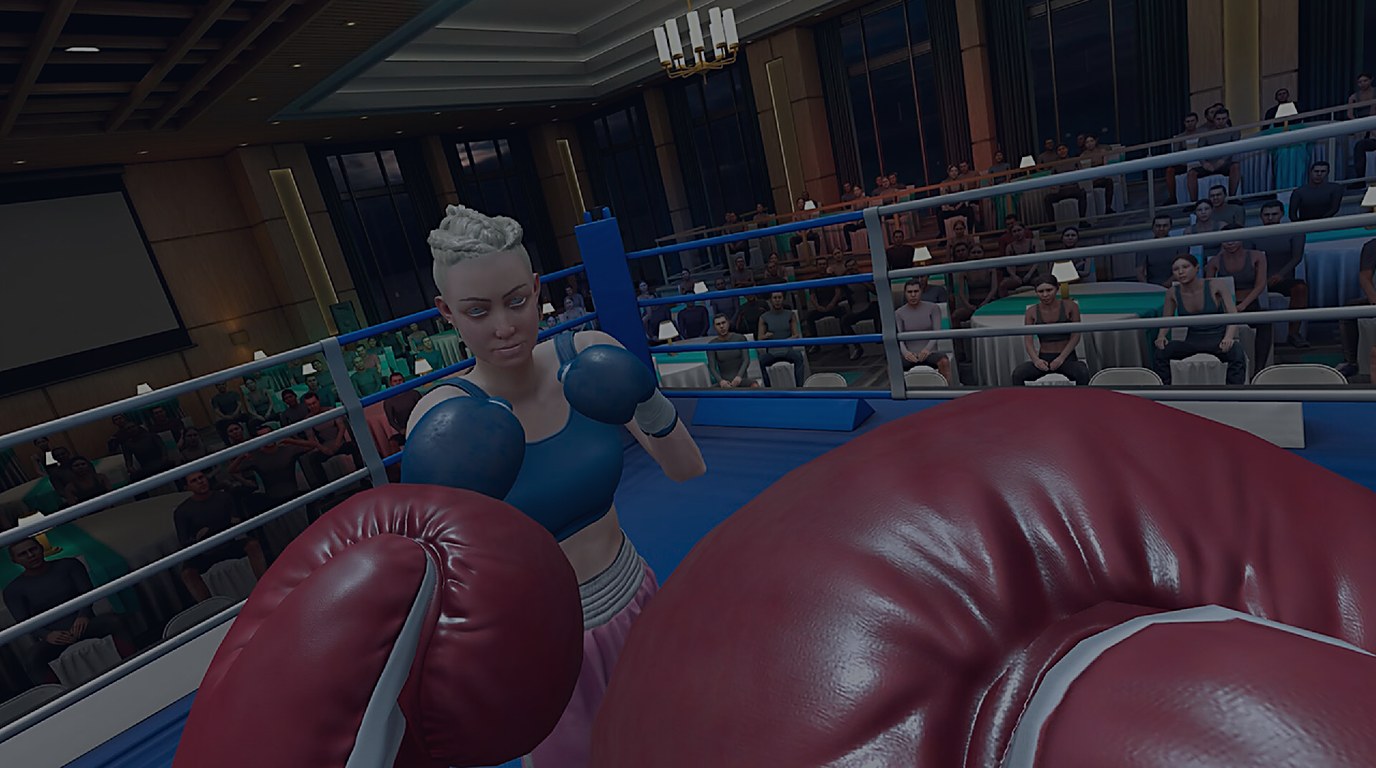
The first round tells you everything
I threw my first real hook in The Thrill of the Fight 2 and my shoulder told me the truth my eyes were lying about: this is a game that measures you, not just your controller. The original built its reputation on exactly that promise — your punch is only as good as the shoulder rotation, weight transfer, and commitment behind it. The sequel keeps that gospel and bolts on everything the first game didn’t have: live opponents, a career ladder, and a grading system that claims to read the effort your whole body puts into a shot.
What it is, mechanically, hasn’t changed at its core. You stand (or move inside a roomscale box) and you fight with your actual arms. There is no gamepad fallback and no button to map a jab to. Both tracked controllers are your gloves, and the menu makes that obvious before you land a single punch: the game greets you holding a small tablet in your gloved hands, asks you to calibrate your height and arm length, then hands you a stylus to pick your mode. That calibration matters more than it sounds, because everything downstream — how far you reach, how the camera sits, how your punches register — is built off the body it measured in the first thirty seconds.
It launched in Early Access on Quest in late 2024 and reached its full 1.0 release about a year later, the update that finally added Career Mode and cleaned up the multiplayer that Early Access had let rot. A second standalone storefront, Steam Frame, arrived in 2026 with full crossplay to Quest, so the ladder you climb is shared across both. There is no Windows PCVR build and no PSVR2 version, which matters if your headset is an Index or a Vive — this is standalone hardware or nothing.
The punch grading is the whole argument
The idea that makes or breaks the sequel is “body effort” grading, a system built to stop people from cheating the fight by flicking their wrists. Put your back into a cross and the game knows. Throw it limp and it knows that too. It’s a brilliant idea for a boxing sim, because it’s the only way to make a VR fight about conditioning instead of who can flap fastest.
But the system that’s supposed to reward honesty is the same one that currently can’t quite see you. The damage model under-reports real effort — UploadVR’s reviewer described fights where the hands felt padded, like pillows rather than gloves had been strapped on. You throw a punch you know in your shoulders was a full, committed shot, the kind that would have rocked a real opponent, and the scoreboard shrugs. It’s the core grading, and it’s the single biggest thing standing between this game and greatness.
That failure cuts both ways. When the game can’t tell a committed shot from a lazy one, the people who train — who treat this like a bag session — get robbed, while the flailers who spam volume still rack up damage the grading can’t discount. The Early Access era was drowning in exactly that problem, which is why the full release’s multiplayer cleanup mattered so much. It’s better now. It is not solved.
Three ways to get in the ring
The game gives you three modes, and they pull in different directions. Training is the honest warm-up: a dummy to drill on and a sparring bot that doesn’t keep score against your ego. It’s where you learn that the camera drifts when you swing from your hips, that a straight left lives or dies on your back foot, and that the game is reading your whole frame, not just your wrists. If you’ve never boxed, this is where the illusion of knowing how breaks down in about ninety seconds.
Career Mode is the post-Early-Access addition, and it’s the reason a solo player has a reason to keep the headset charged. You work through a bracket, qualify for tournaments, and — this is the part that bit me — if you miss the cut in a season, the game skips your ass a year and you come back older in the fiction but starting the climb again. It’s a loop with stakes, even if the stakes are cosmetic, and it gives the single-player side a shape the original never really had.
Online is the live wire. Ranked is a global ladder; casual is open sparring. The full release fixed what Early Access broke: the flailing-toddler problem, where arm-spammers racked up damage the grading couldn’t punish, is mostly gone, replaced by fights where footwork and timing actually decide who’s standing. Crossplay means the pool is Quest and Steam Frame together, so you’re not waiting on a dead matchmaking queue. The punches you earned land; the punches you didn’t, don’t — most of the time.
Where it lets you down
Two things broke my trust in the fight itself, and they’re not comfort problems.
The AI can clip into your space and draw fouls you didn’t throw. You’re standing your ground, guard tight, and the opponent walks through your guard like it’s a suggestion, then the whistle goes against you. That’s not a skill issue you can drill out — it’s the bot ignoring the geometry of the ring. When the thing you’re hitting can occupy the same space you do and get credited for it, the simulation’s contract with you frays.
The roomscale bounds detection is the second one. The game repeatedly failed to read how much space I actually had, and dropped me out of roomscale into a tighter standing box mid-fight, with no warning and no way to argue. One round I was working angles with my feet; the next the game had quietly shrunk the floor and I was fighting in a closet. It’s the kind of bug that doesn’t show up in a review’s bullet points but lives in your memory of every third session.
The presentation is the counterweight. This is the best-looking boxing sim the genre has shipped — the gloves, the sweat, the way a clean hit reads on the opponent’s face. It’s not a fitness app wearing a game’s clothes; it’s a game that will push your heart rate up and leave your shoulders arguing with you the next morning. That’s the crossover signal: this is gym equipment that happens to run on a headset.
The boxing world noticed
The biggest numbers aren’t on VR channels. Olympic boxer Tony Jeffries put the game in front of nearly three million people on one video and three-quarters of a million on another, trading hands with a VR opponent and reacting like the simulation earned it. That’s not a VR curiosity getting a passing nod — that’s a trained fighter taking the resistance seriously. When the boxing community treats your game like a sparring partner instead of a gadget, you’ve built something the headset crowd alone never could have validated.
The sustained-use signal is the quieter one and the more honest. One creator has posted over 120 numbered “Boxing Workout” episodes using this game, several captured from public test builds — a daily-series cadence that only happens when people keep coming back because the sweat is real, not because the novelty is fresh. UploadVR’s own verdict lands in the same place: a departure from the first game that might surprise anyone expecting more of the same, with graphics and mode variety praised and the damage detection named as the thing that still needs work, and a closing line that this can eventually be an all-timer with some improvements. I agree with that read, which is why it sits where it does.
Worth the gloves
I keep coming back to it, and that’s the only metric that survives the caveats. The grading lies about your hardest punches, the AI walks through your guard and gets away with it, and the roomscale bounds will shrink your ring without asking. None of that is a comfort problem and none of it is a reason to put the headset down for good — it’s friction inside a fight that, when it clicks, is the most physically honest thing the genre ships.
This is for the VR owner who treats the headset as a gym they can’t talk themselves out of skipping, and for the boxing curious who want to find out whether their hands actually know what their eyes think they know. If you want a scoreboard you can trust absolutely, wait for the detection patch. If you want to be sore tomorrow, climb in.