
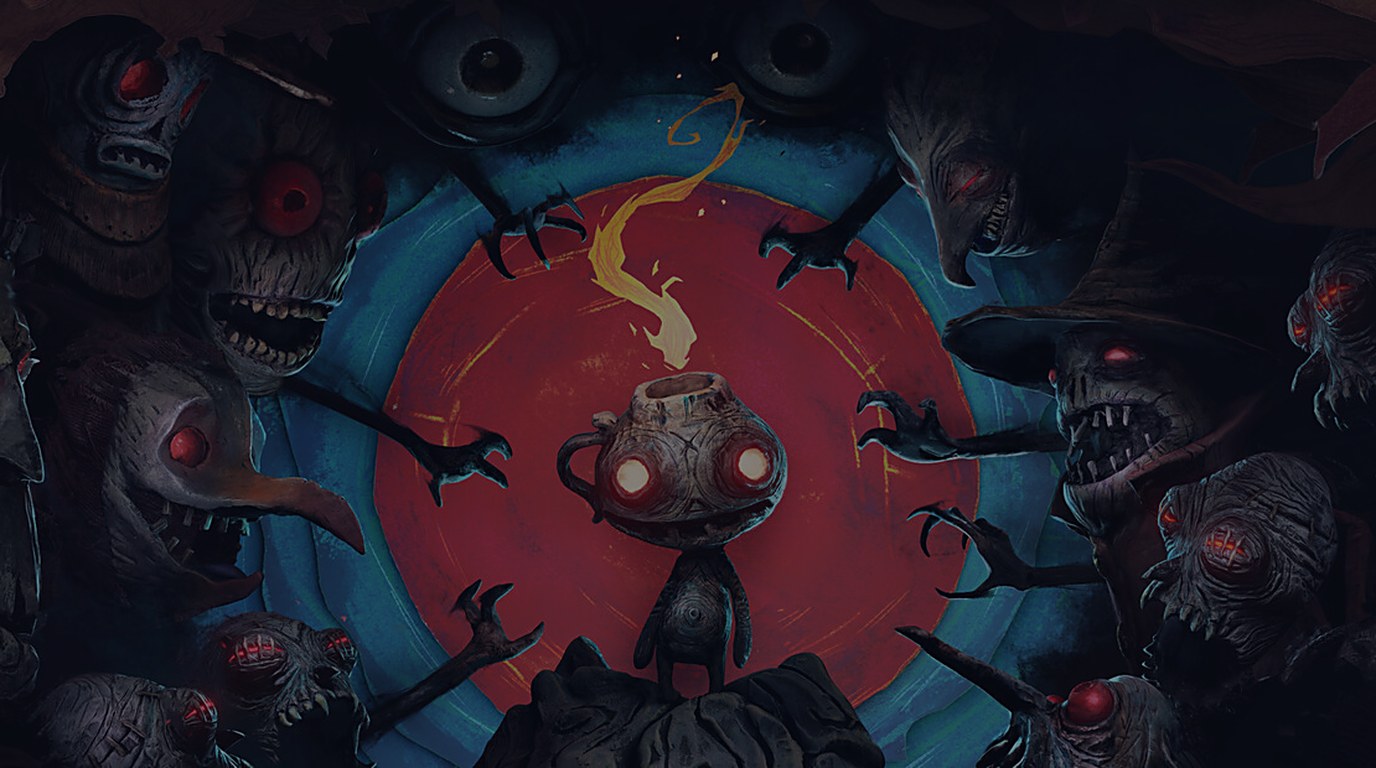
The night this game told me to shut my eyes
I was creeping through a forest of crooked paper trees with a lantern creature named Potboy balanced in my hands when the game told me, flatly, to close my eyes. So I did. The headset went dark, the soundtrack dropped to a low hum, and when I opened them a moment later a lumbering monster on the path ahead had frozen mid-stride, turned to stone, and crumbled.
That single beat is the whole pitch for The Midnight Walk in VR. It’s a first-person dark-fantasy walking sim from MoonHood — the studio behind Fe and Lost in Random — published by Fast Travel Games, and it shipped with native VR support on the exact same day and same purchase as the flatscreen build. No mod, no injector, no community patch. You buy it on Steam or the PlayStation Store, you pick VR, and you’re in.
What you’re in is a world built out of actual clay and papier-mâché. The studio physically sculpted 700-plus models, then 3D-scanned them into Unreal Engine 5. The result is a stop-motion storybook that looks like Tim Burton’s sketchbook came loose and started haunting you — uneven little buildings, hand-painted monsters, flickering lantern light that actually flickers. In the headset, that handmade texture reads completely differently than it does on a monitor. Every surface has fingerprints.
What the VR version actually gives you
It’s a hybrid build: one purchase, your choice of VR or flatscreen at launch. On PCVR it runs through SteamVR and works with tracked motion controllers. On PSVR2 it’s the same game with one killer addition — eye-tracking. The signature mechanic, closing your eyes, is detected by the headset literally watching your eyelids on PSVR2. On PCVR you hold a gaze and a trigger instead, which works but loses a little of the magic.
Beyond the eye trick, your hands are in the world. You strike a match to light Potboy’s flame with a controller gesture, grab items straight from your inventory, and yank door handles open when something is hunting you. Plenty of interactions still collapse to a button prompt, a “Press A” moment when you’d rather be doing the thing — but the physicality is real and present far more often than not.
Setup is the easiest it gets: buy, launch in VR mode, done. The one wrinkle is a launch prompt that insists a gamepad is required, which sent me grabbing a controller before I realized my Quest controllers were already tracking fine over the PC stream. It’s a confusing first ten minutes, not a real blocker.
Five tales and a lantern you have to protect
The structure is five self-contained stories, each a chapter in the longer walk of the Burnt One — you, a charred wanderer — escorting Potboy toward a distant light. There’s no combat. The tension comes from stealth-avoidance: shadows and things in the dark that you duck past, hide from, or turn to stone by shutting your eyes at the right second. That’s a quieter kind of VR horror than a shooter, and it suits the headset. You’re not flinching at gunfire, you’re holding your breath because the thing on the path can hear Potboy’s flame.
The eye-closing mechanic is the spine of the whole thing. On PSVR2 especially, physically shutting your eyes to change the world is a trick no flatscreen can touch — it turns a control into a felt action. Even the PC version, which fakes it with a held trigger, lands because the game goes genuinely dark and quiet for those beats. It’s a small, weird, confident idea.
The world-building is where the A-tier case lives. This is a hand-built storybook with a real sense of place — crooked towns, a moon that hangs wrong in the sky, creatures that look sculpted because they were. Roughly five hours for the main walk, pushing toward ten if you chase the collectibles, and it earns that length by making each tale feel distinct rather than stretched. The voice work and sound design do heavy lifting: when you close your eyes, what’s left is audio, and it’s good enough that you stop missing the picture.
Where it shows the seams
This is a walking sim, and it never pretends otherwise. If you came for systems, failure states, or agency over the story, you’ll hit the wall fast. The interactions that should feel physical often don’t — too many doors, levers, and climbing sequences resolve with a button press rather than your hands actually doing the work. Road to VR nailed the critique: there’s little that qualifies as “VR-native” gameplay, and the familiarity of the control language is exactly what you’d expect from a game built to also run flat.
The pacing is deliberate to the point of stubborn. Some stretches are pure traversal with the lantern lit, nothing happening, and whether that’s meditative or padding depends entirely on your mood that evening. And the eye-tracking gimmick, wonderful as it is, is also the one place the PSVR2 and PC versions diverge in feel — if you’re on PC, you’re approximating a feature the other platform gets for free.
Performance sits in the moderate-demand range. On a high-end rig the PC build held steady on its top settings through a streamed headset; lower-end machines will want settings trimmed, and there’s some LOD popping at the highest preset that’s worth turning film grain off to help with. Nothing here is a slideshow, but it’s not a featherweight either.
Who this walk is for
The Midnight Walk is for the VR owner who wants to be somewhere strange rather than do something skillful. If you love narrative adventures, stop-motion horror, or games that treat the headset as a place to inhabit, this is an easy yes — the eye-closing mechanic alone makes it one of the more distinctive things on PSVR2 and PCVR. If you need combat, failure, or interactivity deeper than a held trigger and an occasional door handle, wait for a sale and temper expectations; it’s a slow, authored walk.
For me it earns the headset. A game this handmade, this committed to one weird idea, doesn’t come along often, and VR is clearly the version MoonHood wanted you to play. I’d rather spend an evening closing my eyes in its crooked little world than most of what passes for a VR horror release — and that’s the only recommendation that matters.