
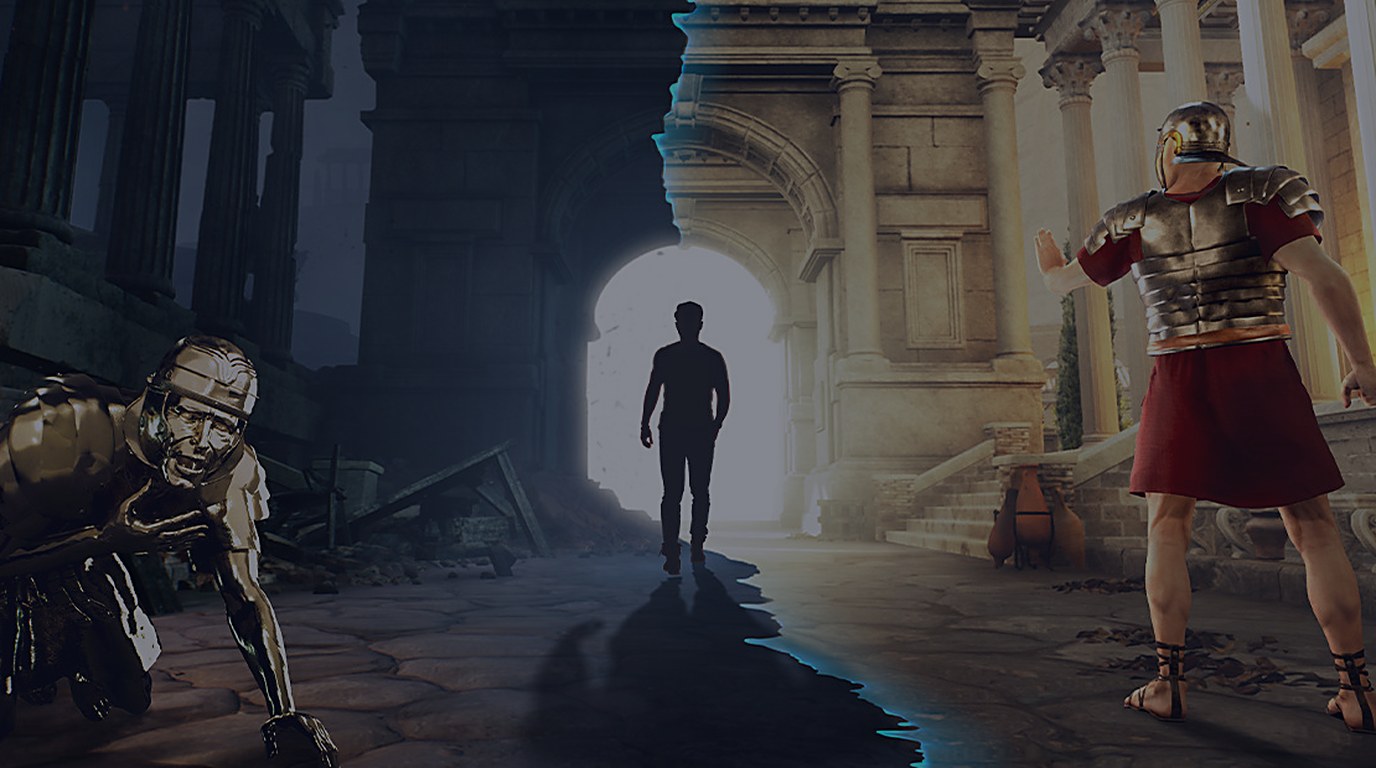
I fired up The Forgotten City through UEVR on a Tuesday night fully expecting a novelty. What I got was the most convincing argument I’ve seen that a flat game can quietly beg for a headset without ever asking for one.
If you haven’t played it: you’re dropped into a sunlit Roman city in the mountains, bound by one rule — if anyone commits a sin, everyone turns to gold. You’re stuck in a single day that resets every time the rule is broken, and you spend those loops untangling which of the eighteen residents is about to shatter everything. It’s a mystery box built around a time loop, and it took a Writers’ Guild award as a mod before it was ever a standalone game. The writing is the draw, not the gunplay.
What you’re actually installing
There is no official VR mode. The developer said plainly, before and after launch, that there are no plans for native VR. So the only way into this city with a headset on is UEVR — Praydog’s universal Unreal Engine injection tool. The Forgotten City runs on Unreal Engine 4 with DirectX 11, which sits inside UEVR’s supported range, and the injection gives you proper 6DOF head tracking and stereoscopic 3D. You install UEVR, launch the game, inject, and you’re standing in the forum.
One thing to be clear about: your controllers act as an Xbox-style gamepad, not tracked hands. You aim a reticle, you push a stick to walk, you confirm dialogue with a face button. There’s no reaching out to grab a goblet, no physical puzzle-solving. The presence comes from being inside the space, not from touching it. And if you played the original 2015 Skyrim mod in Skyrim VR, that’s a different game entirely — Dwemer ruins, different script, different cast. This is the standalone Roman city, and UEVR is the only door.
Standing in the forum
Here’s the thing: a slow, talky, exploration-heavy mystery is close to an ideal first UEVR candidate. There’s no twitch shooting to expose the framework’s seams. You walk the cobbled streets, you look up at the aqueduct, you lean in to read the panic on someone’s face during a confrontation. The 6DOF head tracking does real work here because the game is built around noticing details — a freshly broken seal, a coin that wasn’t on the floor an hour ago, a citizen who won’t meet your eyes. Flat, those are things you click on. In the headset, you’re the one who has to turn your head.
The slow walking pace keeps the first-person movement easy on the stomach, which matters more than it sounds for a framework injection with no comfort toggles. You’re not sprinting or plummeting. You’re ambling through a city that’s small but dense with intent, and the scale of the architecture lands harder when it’s wrapping around your peripheral vision.
Performance is the honest cost. In my runs it took a high-end PC to hold 90Hz without the city’s shadows and gold effects dragging it down — UEVR stacks its overhead on top of a game that already likes a capable machine. On anything mid-range you’ll be trading resolution and supersampling to keep it from stuttering, and a stutter in a quiet mystery kills the mood faster than it would in a shooter.
What actually works
The world-building is the whole point, and it survives the framework translation intact. Eighteen characters with interlocking secrets, a loop you unravel by talking and poking rather than fighting, and an ending structure that rewards obsession — all of it plays in VR exactly as written. The audio, which carries half the game’s tension, sits in your ears correctly. Standing in the central plaza during the moment the rule triggers, watching the gold creep, is a better seat than my monitor ever gave me.
For a game this dependent on reading a room, head tracking is a genuine mechanic, not a gimmick. You catch lies by watching where people look. That’s the kind of thing VR was supposed to add to every game and mostly doesn’t — here, the framework happens to line up with what the game already wanted you to do.
Where it fights you
No hand presence is the ceiling. Every interaction is reticle-and-button, so the city feels observed rather than inhabited. You’ll never physically place the artifact, never shove the gate, never do the small physical things that make VR stick in memory. For a mystery that’s a softer limit than it’d be in an action game, but it’s still the difference between “I was there” and “I watched it closely.”
Setup friction is real but one-time. UEVR isn’t a retail product with a profile button — you inject, you tweak, and there’s no dedicated community profile for this title, so you’re on default settings and your own patience. Most people get it running in a few minutes; some fight it. I also ran into a VR-specific bug: after I took a particular ending and reloaded that save, I was stuck staring at sky and clouds until I loaded it flat. It’s rare and workaround-able, but it’s the kind of framework scar you don’t get on a native port.
The call
This is an A-tier VR experience by an imperfect route: the underlying game is exceptional, the VR is real but borrowed. If you already own a strong PC, already run UEVR, and you like a story that respects your attention, climb in. You’ll get a narrative world worth standing inside, with presence flat can’t match and friction that never quite disappears. If you’re on a modest rig or you need VR to mean hands-on interaction, play it on the monitor — the writing is just as good there, and you’ll skip the bill.