
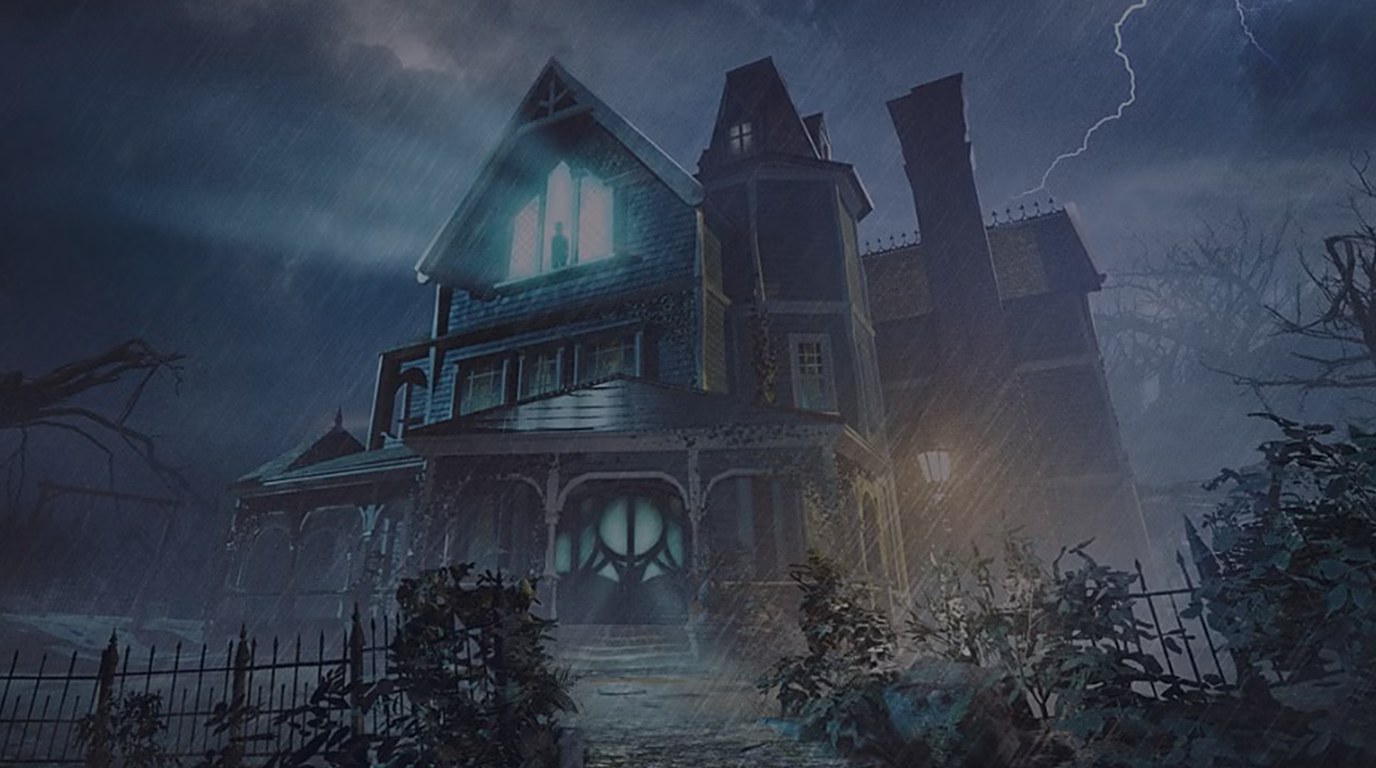
I stepped into Henry Stauf’s mansion expecting a nostalgia trip. What I got was the only VR experience I’ve had where the dead people felt more present than the furniture.
The 7th Guest VR is Vertigo Games’ ground-up rebuild of the 1993 CD-ROM classic. It launched the same day on Quest, PSVR2, and PCVR at $29.99, and from the first minute it’s built like a native headset game should be: you stand in the foyer, the doors are real height, and the mansion is yours to walk.
The mansion is yours to walk through
This is a first-person puzzle-whodunnit. Six guests are invited to Stauf’s hilltop mansion, a seventh is hiding somewhere in the walls, and your job is to piece together what’s actually happening while the house plays tricks on everyone. If you remember the original, the bones are the same: the puzzles, the unease, the sense that the building itself is the real antagonist. What’s different is that you’re inside it now instead of clicking through a pre-rendered room.
Vertigo didn’t just drop the old puzzles into a 3D shell. The mansion is room-scale, and you move between its spaces on foot — a slow, deliberate prowl through a house that’s been rotting with intent. There’s no combat and no timer. It’s a mystery box you’re invited to sit inside, and the VR press treated it as one of the standout puzzle experiences of its launch year. Having stood in those halls, I get why.
The ghosts are the trick
Here’s the part nobody else in VR is doing. The ghost characters — the spectral performances that carry the story — are captured with volumetric video, real actors recorded as 3D volumes you can walk around. They aren’t flat video pasted onto a plane. They’re standing in the room with you, and when one turns its head to follow you across the space, it reads as a person who died here, not a cutscene asset.
Working the puzzles with your hands
This is full motion-control VR, and the interaction model is the spine of the whole thing. You pick a dominant hand at the start — that hand holds the Spirit Lantern, your light source and the tool that reveals clues and interacts with the world. Your other hand carries the Spirit Board, which is where most of the actual puzzle logic lives: sliding tiles, pressing buttons, arranging pieces by hand.
That phrase matters. By hand. The puzzles aren’t abstracted to a pointer or a floating cursor. You reach out and physically pick up the small objects, you press the buttons on a board with your finger, you slide a tile where it needs to go. When a puzzle is the kind of thing that wants you to manipulate physical pieces, the game makes you manipulate physical pieces in VR space. For a puzzle-adventure, that’s the right call — it’s the difference between solving a screenshot and solving an object.
Comfort is handled with the options you’d expect from a native title: teleport, smooth, or a mix, plus snap or smooth turning with increment choices, and a dominant-hand selector so lefties aren’t fighting the lantern. Seated or standing both work. The tone stays eerie rather than shocking — no egregious jump scares, just a sustained, low-grade wrongness that suits the mystery.
Where it clicks
The puzzle variety is the real strength after the ghosts. There’s an impressive spread of types in here, and a good number of them are genuinely formidable — the kind where you stare at the board, try three wrong approaches, and then the solution lands like a punchline you should’ve seen. That’s the feeling the original had at its best, and Vertigo preserved it.
Because the mansion is fully explorable, the pacing is yours. You can grind on one brutal puzzle until it cracks, or wander off and let a different room reset your brain. The atmosphere does the heavy lifting between puzzles: the lighting, the creaks, the way a ghost will be standing in a doorway you could’ve sworn was empty a second ago. It’s a confident, complete VR world to inhabit.
The reception backed this up. Major VR outlets covered it as a launch-week event on all three platforms, with dedicated reviews on Quest and PSVR2 and a best-of-2023 framing from a leading VR channel. When a native title lands that wide across the headset ecosystem on day one, it’s usually because the experience holds up — and it does.
Where it fights you
The hand interactions are also the game’s weakest link. Picking up small objects, or pressing tightly-positioned buttons on a board, can be finicky — the grab doesn’t always land where your hand says it should, and you’ll occasionally fumble a piece you meant to place. It’s not broken, but it’s the one place where the physicality that makes the game special also reminds you the tracking isn’t magic.
Two design choices genuinely sting. There’s no way to reset a puzzle once you’ve started it — if you mangle the board state, you live with it until it resolves, which is frustrating on the harder ones. And the hint system is inconsistent: sometimes it nudges you, sometimes you’re alone with a puzzle you’ve been staring at for twenty minutes. For a game built around patient puzzle-solving, an unreliable hint hand is a real miss.
One more note for PSVR2 players specifically: the launch build didn’t surface the haptics you’d expect from that controller. Not a dealbreaker on a game this quiet, but worth knowing your rumble is doing less than it could.
The bottom line on Stauf’s house
The 7th Guest VR is the rare remake that deserves the headset. The volumetric ghosts alone justify the price of entry — there is no other VR game where dead characters have this much actual presence in the room with you — and underneath them sits a full, explorable mansion of real puzzles that you solve with your hands, not a cursor. The grabbing is occasionally fussy and the missing puzzle-reset will irritate you on the hard boards, but neither one breaks the spell. If you like a slow-burn haunted mystery you can physically poke at, this is an easy yes on whatever headset you own; if you need constant action and fail states to stay engaged, the quiet of this house will wear on you.