
The first time it clicks, you are not playing a game about walking — you are walking. I paced a straight line across my living room, turned a corner that should have put me through the wall, and kept going for what felt like a city block. My play space is a rectangle I can cross in six steps. Tea For God quietly rebuilt the laws of geometry so that six steps becomes a loop that never ends, and my feet did all the traveling. No thumbstick glide. No teleport hop. Just me, moving, inside a room that lies to itself.
That lie is the whole game, and it is the most honest “only in VR” trick I have touched in years.
A VR game that was never anything else
Tea For God is built by void room — effectively one person, Jarek Ciupiński — and there is no flat version sitting underneath it. This was conceived for the headset from the first line of code, and you can feel it in the camera. You are not a third-person avatar somebody bolted a VR view onto. You are a body in a space that folds back on itself, and the space is rebuilt fresh every run by procedural generation.
Getting in is about as close to zero friction as VR gets. It’s a native title on SteamVR, the Oculus Rift store, and Meta Quest (via App Lab), so you buy it, launch it from the headset, and you’re walking within a minute. No dependencies, no config files, no “did I bind the right axis” panic. PlayStation owners are out of luck for now — this one is PC and Quest only — but if you already have a headset that fits those stores, the barrier between you and the experience is just your own nerve.
What the walking actually feels like
The core idea is “impossible spaces”: non-Euclidean, procedurally generated geometry that lets you move infinitely on foot inside whatever physical area you’ve got. The developer’s own pitch is the cleanest description — use your own feet to move, no teleporting, no sliding — and the game adjusts to your play area no matter how small or how big it is. I’ve got a modest rectangle and it still fed me corridors that bent back into themselves without ever asking me to step outside the safe zone. That adaptability is the real engineering flex: most roomscale experiences demand a minimum footprint or they fall apart, and this one shrugs at the size of your room.
It runs on roomscale walking first, with a smooth-stick option added as a secondary way to move if your space or your legs give out, and on Quest you can play entirely through hand tracking — a feature that’s been in since 2020. But the designed intent is clear: your feet are the controller. You lean, you turn, you step, and the world rearranges itself so the step always lands somewhere new.
The disorientation is the point and the catch. For the first ten minutes your brain argues with the geometry — you know you just walked north for two minutes and you’re somehow still in your bedroom — and then it stops fighting and starts enjoying the contradiction. When it lands, it lands hard. There is no other consumer VR title doing this specific thing. Eye of the Temple gets close on the holodeck-locomotion front, but it needs a fixed, generous space and a rigid route. Tea For God adapts to a closet.
The game around the trick
Here is where I stop cheering. Tea For God wraps its gorgeous locomotion in an arcade roguelite shooter, and the shooter is workmanlike. You move through procedural rooms, robots show up, you shoot them with motion-controlled weapons, you collect upgrades, you die or you push deeper. It is functional and it is fun in bursts, but it is not doing anything the genre hasn’t done flat a hundred times. The combat AI is simple, the enemy variety is thin, and the loop wears thin faster than the walking novelty does.
The modes are genuinely flexible — a relaxing walk, a checkpoint arcade shooter, a roguelite explorer, with three rulesets and three failure styles including permadeath — so you can tune the pressure down to a stroll or up to a run-ending crawl. That flexibility is a real strength for a game whose headline act is the movement, not the gunplay. If you want the holodeck without the bullets, the walking mode is there and it is glorious.
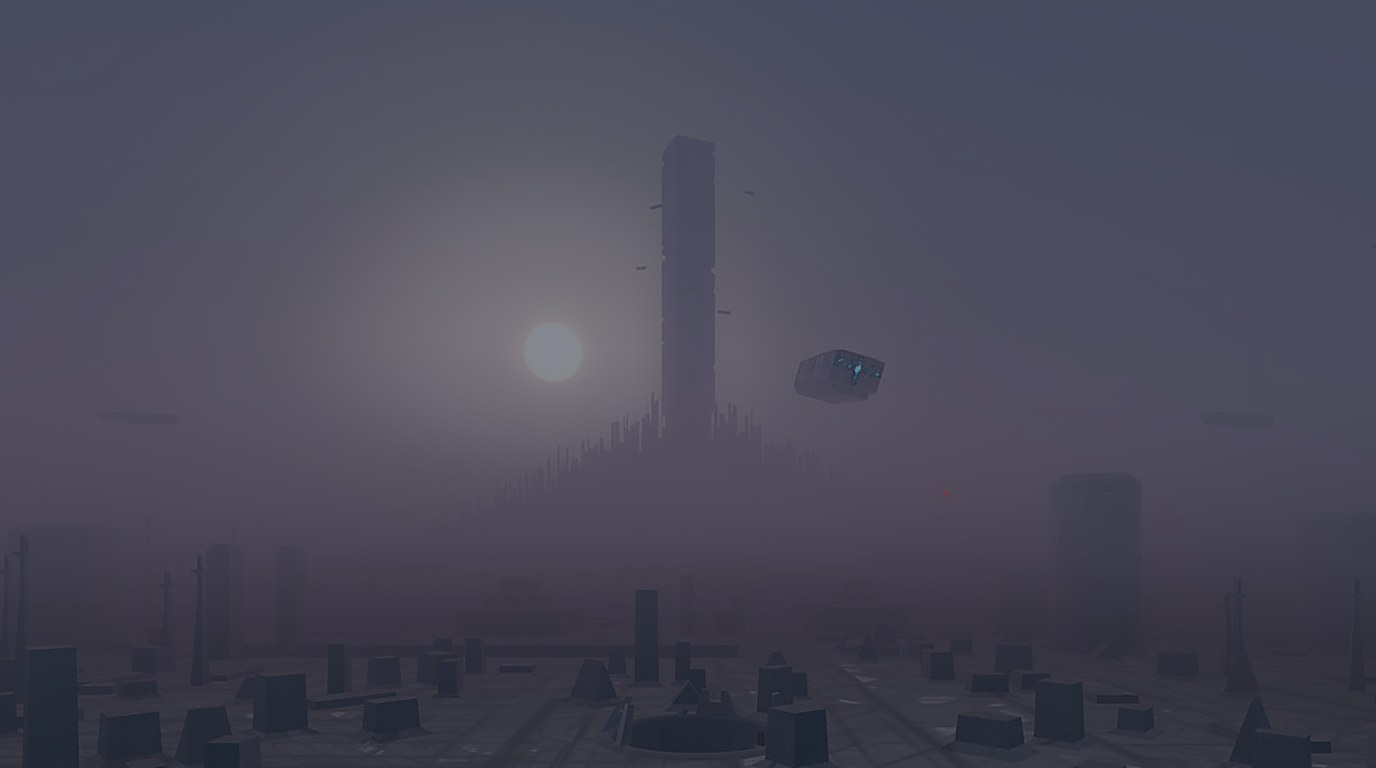
Visually it is clean but plain: flat-shaded rooms, readable shapes, no pretense of a big-budget look. That is the right call — the spectacle is the architecture, not the textures — but don’t come expecting Asgard’s Wrath production values. This is a craftsperson’s experiment with a gun taped to it, and the experiment is the reason to care.
Who this is actually for
This is not a blockbuster and it does not pretend to be. It is a cult favorite among roomscale obsessives for one specific, unrepeatable reason: it solves the locomotion problem the rest of VR keeps dodging. If you bought a headset to feel like you are somewhere else, and you have the floor space (or even if you don’t), the walking here is a “you have to feel this” experience that justifies the hardware on its own.
The shooting will not hold a newcomer who came for combat, and the repetition will thin out your sessions faster than the wonder wears off. But for the VR enthusiast who has spent years apologizing for the fact that we mostly glide or teleport — this is the answer we keep pointing at. It is the most convincing holodeck demo shipping today, and the fact that there’s a game attached is almost a bonus.