
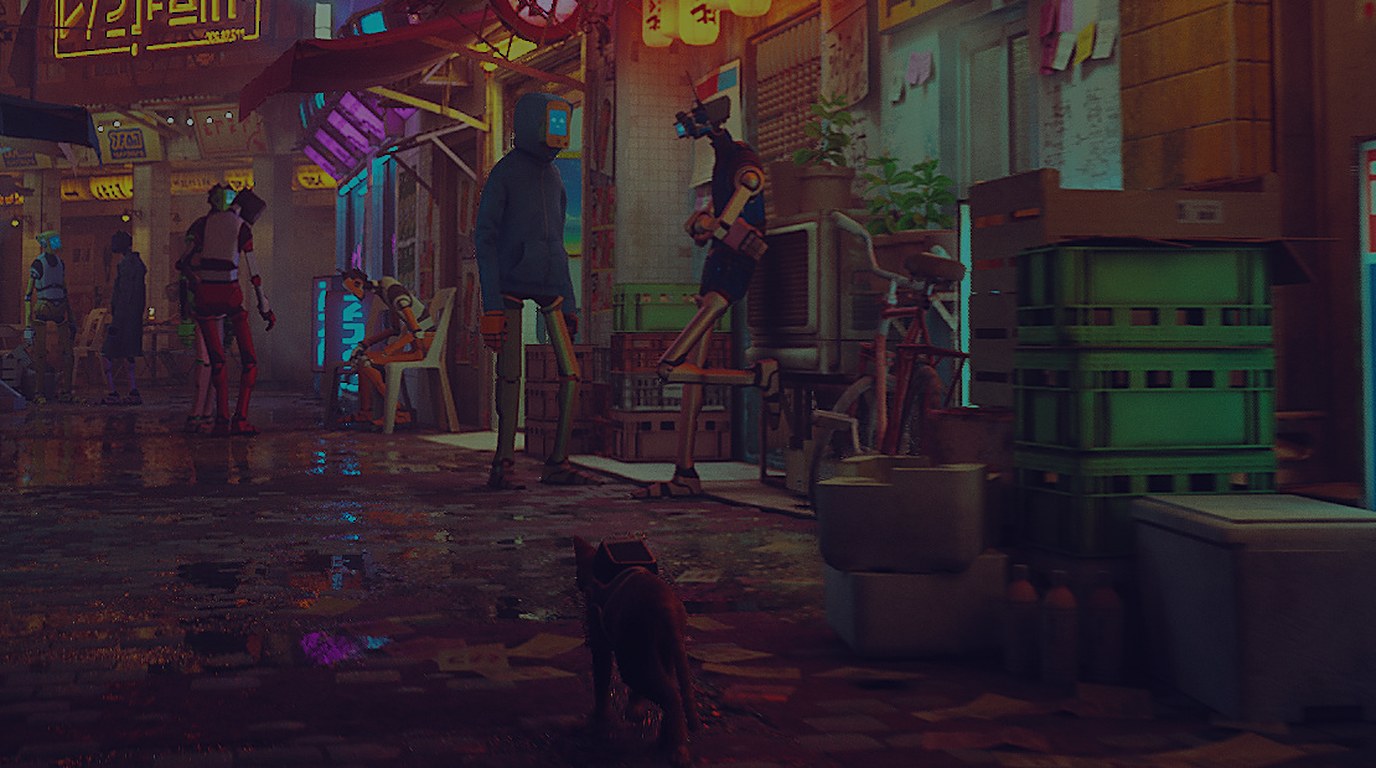
I booted Stray in VR expecting a novelty. What I got instead was the most relaxed hour I’d spent in a headset in months: a small orange cat, at cat height, staring up at a wall of neon signs in a rain-slicked robot slum. The city leans over you. You are very small and the world is very big, and for once that isn’t a horror-game trick — it’s just being a cat.
There is no official VR mode for Stray. Annapurna and BlueTwelve never shipped one, and there’s been no signal of an official port. What exists is community-built, and it’s two pieces that only matter together: Jessica Natalia’s first-person camera mod, which pulls Stray’s third-person camera down into the cat’s own eyes, and UEVR, the Unreal injection framework that takes that first-person view and pushes it into a proper stereoscopic, six-degrees-of-freedom headset experience.
That combo is the whole trick. The camera mod alone just changes your viewpoint on a flat monitor — fine, but not VR. UEVR alone gives you a third-person cat you orbit behind in 3D, which is novel and a little unsettling if you actually play it that way. Put them together and you’re inside the cat, and that’s where Stray stops being a game you watch and becomes a place you occupy.
Getting there is a moderate lift, not a nightmare. You download the camera mod manually from Nexus, drop it into the game’s files, and inject UEVR into the running executable. Neither step is hard on its own, but you’re juggling two separate community projects with no installer holding your hand, and UEVR’s per-game profile settings want a little attention before the image looks right. Plan on twenty minutes the first time, less after. If you’ve run a UEVR injection before, this is the familiar dance.
Once you’re in, the honest part is: This is gamepad play with a headset strapped on. UEVR handles head tracking and stereo depth, and the camera mod handles the viewpoint, but there’s no hand presence, no motion-control mapping, no VR UI. You move with a stick and look with your head, which for a slow, deliberate exploration game like Stray is far less of a compromise than it sounds. You’re padding through alleys, solving gentle puzzles, and reading the environment — gamepad suits the pace.
What sells it is the world. Stray’s robot city is one of the most lovingly rendered environments in modern games — layered signage, volumetric light bleeding through wet streets, a sense of cramped, lived-in verticality that flat play flattens into a pretty diorama. In VR you finally get the scale. You crane your neck up at a flickering billboard and the city closes around you. You duck through a pipe and the grime is right there on your whiskers. Paradise Decay called it “stunning in VR and glorious 3D,” and Flat2VR’s own channel feature flatly titled it “The Most Beautiful VR Game I’ve Played Yet.” That beauty carries the experience, and it should — Stray is a short, gentle game, maybe five hours, with no combat to hide behind. The pleasures are environmental and quiet: a robot bartender’s small talk, a dead-end server room you have no reason to explore but do anyway, the way the cat’s body language reads even without a word of dialogue. VR doesn’t add gunplay or new systems. What it adds is presence, and for a game whose entire point is atmosphere and a feeling of smallness in a vast, indifferent machine, presence is exactly the right upgrade. You’re not watching a cat be lonely in a city. You are the lonely cat.
The friction is real but specific. The two-project setup means you’re dependent on both a Nexus camera mod and the UEVR framework playing nicely with Stray’s build, and the research shows some players hitting performance walls — “can’t get Stray to run well” threads are out there, and third-person profile setups give people trouble. UEVR overhead on Unreal is never free, and this is a dense, lighting-heavy game, so a mid-range PC will want settings tuned rather than maxed. None of that broke my session, but I’m flagging it: this is not a drop-in experience, and the payoff depends on your willingness to fiddle. There’s also the platform wall — this is PC only, full stop. The console versions of Stray have no path into VR, and nothing in the community picture suggests that changes. That’s reach, not a quality knock, but it means if you’re a PlayStation or Switch player, this particular cat stays flat for you.
And you should know what you’re not getting. No paw-swipe motion controls. No VR interface. No sense that BlueTwelve designed a single frame of this for a headset. That’s the honest ceiling of the community route: it’s a gorgeous window onto the world — an experience for your eyes, not your hands. For Stray, that’s a smaller loss than it’d be for a shooter, but it’s a loss.
Where it lands for me is simple. Stray is a B-tier VR experience not because the world is anything less than exceptional — it’s because the route that delivers it is a community injection with gamepad-only control and setup friction you can’t hand-wave. The world-building does the lifting, and it lifts hard. If you already own Stray on PC and you’ve got even a passing tolerance for UEVR tinkering, this is one of the more quietly rewarding afternoons you can give a headset. Skip it if the idea of juggling a camera mod and an injector sounds like work you don’t want — the flat version is still a great game, and you won’t be missing transformed combat, because there isn’t any. But if you want to actually be that cat in that city, this is the only way to do it, and it’s worth the twenty minutes of setup.