
Star Wars: Tales from the Galaxy’s Edge VR
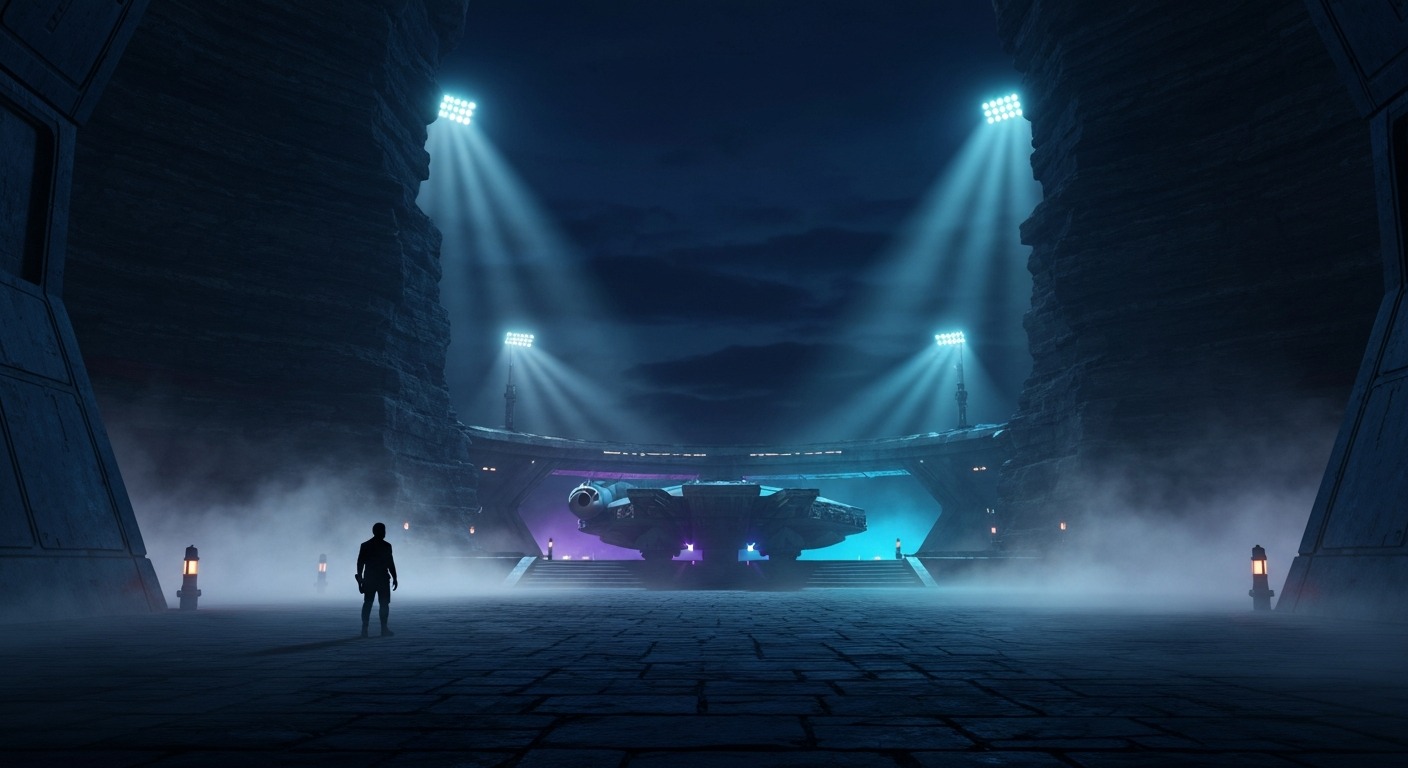
The first thing that hits you is the light. You step off the transport and you’re standing in Seezelslak’s cantina on Batuu, and through the window the Millennium Falcon is parked in the same courtyard you’d walk through at Disneyland’s Galaxy’s Edge. It isn’t reinterpreted. It’s the place.
ILMxLAB built this natively for VR from the start, and you feel it in your body before your brain catches up. Everything you carry lives on your body. Your inventory pouch is on your chest. Your multi-tool hangs from a strap. Your blasters snap into hip holsters. When you need your datapad, you glance at your left wrist. When you want a new gun, you reach down and grab it. The game expects your hands to do the work, not a menu cursor.
Once the tutorial ends, Tales from the Galaxy’s Edge settles into a clean, linear corridor shooter. You walk forward, duck behind rock formations, pop up, and shoot bandits until the path opens. The AI is basic — enemies run to cover, stand up, shoot, repeat. Rush them and they sometimes forget how to respond. The weapon system keeps you moving by making guns overheat and expire after a couple of minutes, so you’re constantly dropping a dead blaster and grabbing the next one from a crate or a fallen pirate. It solves the ammo problem, but it also strips away the fantasy of charging a blaster or slamming in a power cell. You feel the arcade logic under the Star Wars paint.
The combat is competent, not deep. The real pleasure is the incidental stuff: prying open panels with the multi-tool’s screwdriver and solder modes, scanning cargo, repairing droids, pretending you’re a technician who got dragged into a firefight. The physicality of reaching, holstering, and wrist-checking your datapad makes even simple tasks feel like they belong in this universe.
The comfort options are generous enough that you can hand this to a VR newcomer: at first launch it asks seated or standing, teleport or free movement, snap or smooth turning, then lets you fine-tune movement speed, turn strafing, FOV dimmer, even a Southpaw layout. The default pace is gentle enough that motion sickness rarely becomes the story.
The original Quest release from November 2020 is a standalone app — around $25 for the base game, another $10 for Last Call, essentially no setup. The PlayStation VR2 Enhanced Edition arrived in February 2023 as a roughly $50 PS5/PSVR2 bundle with richer character models, denser environments, haptic headset rumble, and adaptive triggers on the Sense controllers. In just about every way that matters, the Enhanced Edition is the better version, assuming you already own the hardware. There is no PCVR version, no UEVR profile, no VorpX profile, because there was never a flat-screen release to convert. If you own a Valve Index, Vive, Reverb G2, or Pimax, you cannot play Tales from the Galaxy’s Edge. That’s a real limit, but it doesn’t change what’s inside the headset for the people who can.
The campaign runs about three to four hours, with Last Call adding another chunk. It’s short, and the corridor-shooter loop wears thin before the credits. But the standout is the Jedi-in-training tale inside the cantina, maybe fifteen minutes long, where you get a lightsaber, force push and pull, and Yoda — voiced by Frank Oz. It is the most memorable thing in the game, and it ends so quickly it feels like a teaser for a full Jedi campaign that doesn’t exist. I finished it wanting ILMxLAB to make that game instead of another wave of pirate cover fire.
For all the polish, this is a theme-park ride, not an open-world Batuu adventure. The setting carries the experience more than the systems do. Standing in that cantina genuinely feels like standing inside Disney’s Galaxy’s Edge, and for a Star Wars fan with a Quest or PSVR2, that presence is enough to forgive the short runtime, the shallow AI, and the weapon-decay system that breaks the fantasy every time you toss aside a dead blaster. The world is real, the comfort options are generous, and that one Jedi tale makes you remember why you put the headset on. That’s an A-tier Star Wars VR experience.