
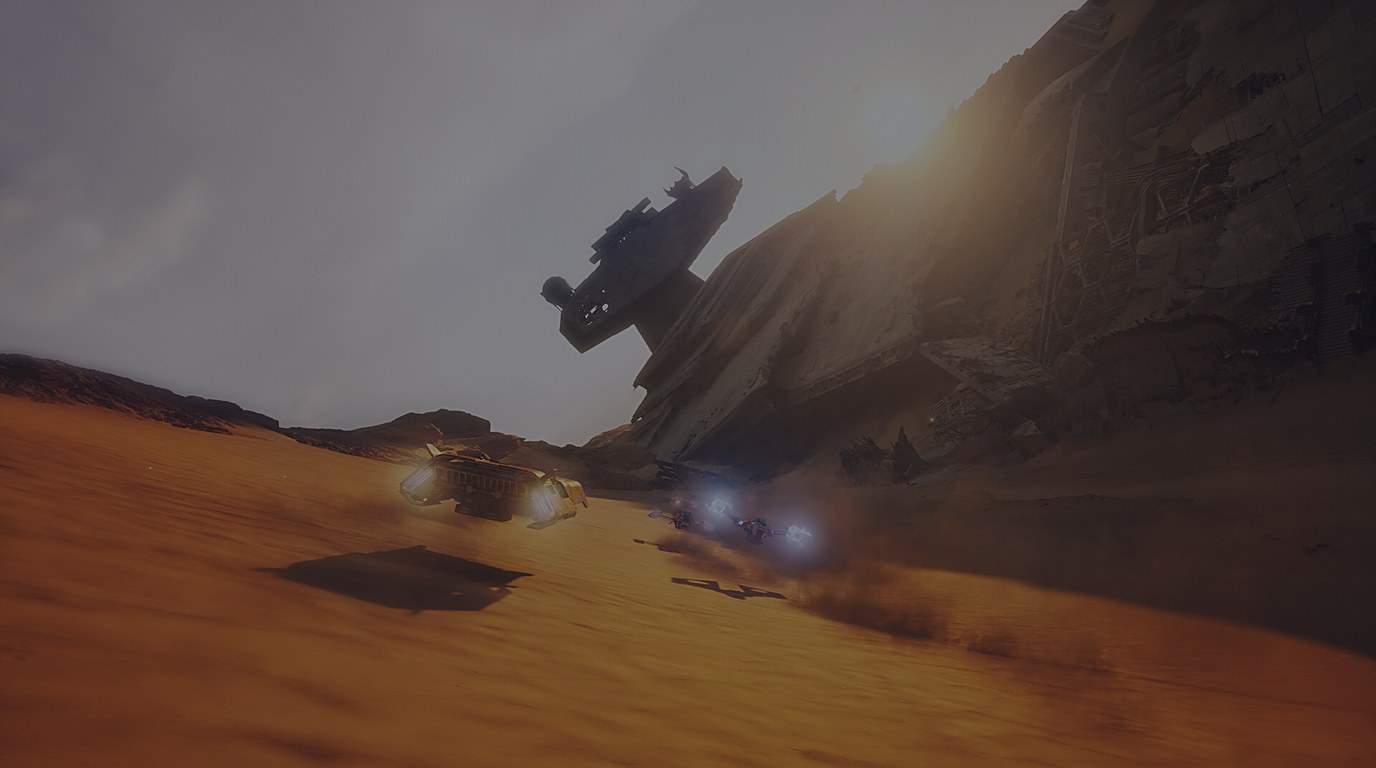
I spent a stupid amount of launch week watching flat footage of Galactic Racer and thinking the same thing every Star Wars fan thinks the first time they see a podrace: I want to be in that machine. Not behind it on a third-person camera, not watching it on a screen — in it, with the engines roaring past my ears and the track falling away ahead. The flat game is a good arcade racer. It is not that feeling.
What “VR” means here
Galactic Racer has no native VR mode. What it has is a community cockpit profile built on UEVR, the Universal Unreal Engine VR injector, and on a UE5 title this is the right tool for the job. UEVR shoves true stereo rendering and 6DOF head tracking into the flat build, and the SWGR-VR-Cockpit profile — maintained on GitHub, already at v2.1.1 within two weeks of launch — bolts you into a seated pilot camera for every vehicle, so you’re looking out from the cockpit instead of chasing the racer from behind.
That profile is the difference between “a racing game in a headset” and “podracing.” It adds per-vehicle rumble — engine thrum, road shake, the lunge when you boost, the nose lift, the slap of a landing hit — plus look-back on a stick, brightness tuning per track, and an optional pak that strips the flat-UI letterbox bars and floating transition slabs that would otherwise hang in your face like ghost panels. The backend is joeyhodge’s UEVR DLL for this specific game. Setup is moderate: install UEVR, drop in the backend DLL, load the profile and its Lua script, optionally add the pak. Several video install guides exist if you’ve never run UEVR before. Support is active — the profile is iterating fast, not abandoned.
Sitting in the cockpit
This is a seated, gamepad-or-wheel experience. You steer with sticks or a wheel; there are no motion controllers to swing at a throttle, and that’s correct for a podracer — you’re a pilot in a seat, not a wizard casting spells. The head tracking is the whole point. Lean left and you’re craning past the engine nacelles to check your lane; hold look-back on the stick and the pack is right there behind you. At speed the cockpit is intense by nature — repulsorcraft haul — but the profile ships ride-shake off by default, so if you’re sensitive you can kill the extra jolt and keep the world rush.
UE5 at full tilt asks a lot of your GPU. This is a Heavy Demand title: you’ll want a high-end rig to keep the desert and the crowds smooth at 90Hz without reprojection kicking in. The flip side is that when it holds, it holds — the draw distance on a straightaway, the way dust kicks off the bike ahead of you, the scale of the stands as you bank through a canyon. That’s the stuff flat screens flatten.
The run that sold me
The first time the profile hands you the camera at a finish line instead of yanking you to a replay, I caught myself grinning like an idiot. You’ve just out-dragged a landspeeder through a canyon and the game lets you sit there in the seat, head tracking free, watching the dust settle. It’s the kind of small thing that flat racing games never give you, because their cameras are busy selling the action to a spectator. VR hands the camera to the driver.
Galactic Racer’s structure helps the headset more than I expected. It’s runs-based — short, high-stakes arcs through the Outer Rim rather than a 40-hour career — so every session is a self-contained dash. You pick a craft class, you run a stretch of lawless track, you either bank the run or you eat dirt and try the next permutation. In VR that loop reads as pure arcade thrill: get in, haul, get out, do it faster. The four repulsorcraft classes — landspeeders, skim speeders, speeder bikes, podracers — each feel distinct from the cockpit, and the profile auto-saves your per-vehicle tuning so the bike you set up on Tuesday is still yours on Friday.
What’s genuinely good
The presence is the headline and it earns it. This is the Star Wars racing fantasy the license has been promising since 1999 and never quite delivered in first person. The cockpit framing, the engine rumble through the headset, the head tracking that lets you actually look where you’re going instead of where the cinematic camera points — that’s transformation, not a checkbox. Remove the headset and you’ve got a fine arcade racer. In it, you’ve got podracing.
The community work is the other win. A cockpit profile that’s already at v2.1.1, with movement effects, look-back, per-track brightness, and a UI-fix pak, is the sign of a path being cared for, not a one-night hack. The motion-rig crowd has already built a SimHub addon around the UEVR path, so if you’ve got a seat or a bass shaker, this game is on the list. That’s a community treating the VR version as real, and they’re right to.
Where it fights you
The caveats are the framework tax, plain and simple. You’re running an injector on top of a brand-new UE5 build, so you live one patch away from a breakage — and a hotfix already landed in the flat game’s launch week, the kind of thing that can ripple into the backend DLL. You don’t get the comfort of a native SKU: no official comfort rating, no VR-optimized menus, just the profile’s best effort at hiding flat-UI slabs. If a guide’s steps feel foreign, this is not a five-minute toggle.
Controls are gamepad or wheel only, which is right for the genre but means anyone hoping to physically reach for a throttle won’t find it. And the intensity is real — high-speed racing in a full 6DOF cockpit is demanding by design. That is the honest shape of a UEVR cockpit racer.
The bottom line
If you own a PCVR headset and the words “podracing” still do something to you, this is the version of Galactic Racer to play. It asks for moderate setup and a high-end GPU, and it pays that back with the one thing the flat game can’t: you in the seat, head free, watching the Outer Rim blur past your nacelles. Recommended for anyone who wants the fantasy in their hands rather than on their screen — skip it only if you’re not willing to run the injector, because that’s the entire deal.