
I spent a weekend in this headset, and the moment that hooked me wasn’t the lion. It was striking a rock against a wall to spark a fire. Not a menu prompt, not a button hold — I raised a stone to a stone and scraped until a spark caught. Twenty minutes later I was genuinely annoyed that real flint doesn’t work this intuitively. That’s the deal with Song in the Smoke: it’s a survival game that trusts the headset to do the work a flat screen would fake with a progress bar.
Song in the Smoke is VR-native. There is no flatscreen version — 17-BIT (the Galak-Z studio, now based in Kyoto) built it for Quest, Rift, PSVR, and SteamVR from the ground up in Unreal Engine 4, and it landed October 7, 2021 on the headsets with the Steam version following in December. If you own the Rift version on the Meta store, the Quest version is cross-buy. You buy it and you’re in. No mods, no injection drivers, no “does this have a VR profile” archaeology.
What you’re in is a prehistoric world outside of time. You harvest, hunt, craft, and try not to freeze or get eaten. The loop sounds generic — gather sticks, make arrows, cook meat — but the VR execution is what separates it. Crushing petals with a mortar and pestle is rustic work that somehow feels worthwhile. Running a bone knife along a branch until it becomes kindling is a small, satisfying ritual. You don’t manage inventory through a flat menu; you use your hands. It supports smooth and teleport locomotion with snap and smooth turning, and the slow, methodical pace keeps it gentle on the stomach even across longer sessions.
The hunting is where the presence pays off. You track prey by smell and footprint, then decide: bow from distance, club up close, or sneak past entirely. The arrow quiver only holds so much and the rest sits in your pouch, which sounds like a nitpick until you’re mid-fight and realize you can’t reload without dropping what’s in your hands. That friction is real, and it’s the kind of thing that makes a fight tense rather than smooth — sometimes to the game’s credit, sometimes because the systems fight you.
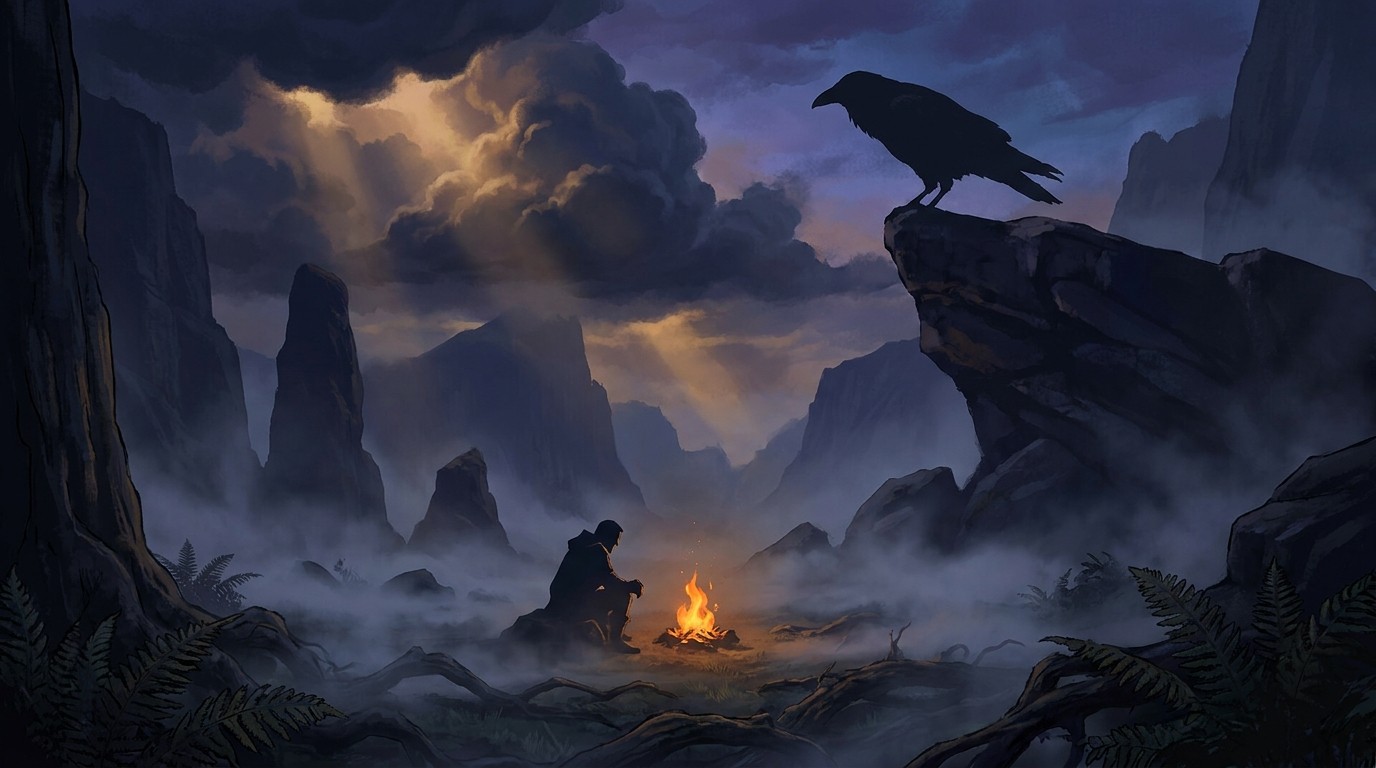
Here’s what’s genuinely good. The world has a spirituality to it that most survival games never attempt. The art is built around Katsuya Terada’s illustration work — the man behind some of the most striking character design in the medium — rendered in a toon shader with a fog color system that shifts with distance and time of day. It’s not a pretty game in the technical sense; the character models are dated and the forest walls are muddy. But standing in a clearing as the light goes orange and a crow watches from above, you feel watched in a way flat survival games never land. Status ailments show up as hallucinogenic smokescreens instead of UI bars. That’s a studio that understood the headset.
The audio does heavy lifting too. Rustling leaves, branches cracking, insects — and at night, footsteps in the dark that follow you but never show. I spent one session building a fire purely because I did not want to find out what was out there. That’s the game earning its VR.
Now the caveats, because there are real ones. Combat AI is the weakest link. Enemies are built to feel primal and erratic, but too often they just circle you, and the “skittish” behavior reads as broken pathing rather than ferocity. You can’t swap items in your hands without dropping them, a small annoyance that adds up across a hunt. And there are bugs: I lost progress to a save slot that didn’t spawn the collectibles I needed, and I hit an area that simply didn’t load when approached from one angle, leaving me staring into mist with resources just out of reach. Use two of your three save slots and rotate them. The third is for right before a new zone.
None of that sinks it. The nine-to-fifteen hour campaign (longer if you chase everything) is structured around seeking three stones per area to unlock a boss, then moving on — enough direction to keep you from flailing, enough freedom to feel like you’re actually surviving. Each zone takes at least an hour, and the hidden health boosts for risking the night give the world teeth.
One note for PSVR2 owners: 17-BIT later shipped an enhanced “Rekindled” version that adds headset haptics, Sense controller trigger effects, and eye-tracked rendering on top of the PS5’s cleaner visuals. If you’re on PSVR2, that’s the version to get — and PSVR1 digital owners upgrade free. It’s the same game underneath, just with the hardware finally pushed.
Song in the Smoke isn’t the best-looking VR game and its combat won’t win any AI awards. What it is, is a survival game that respects the medium. The crafting has weight, the world has soul, and the fear at night is real in a way that only happens when the headset is doing its job. If you own a Quest or a PSVR and you’ve got patience for a slow burn, this is one of the better reasons that hardware exists.