
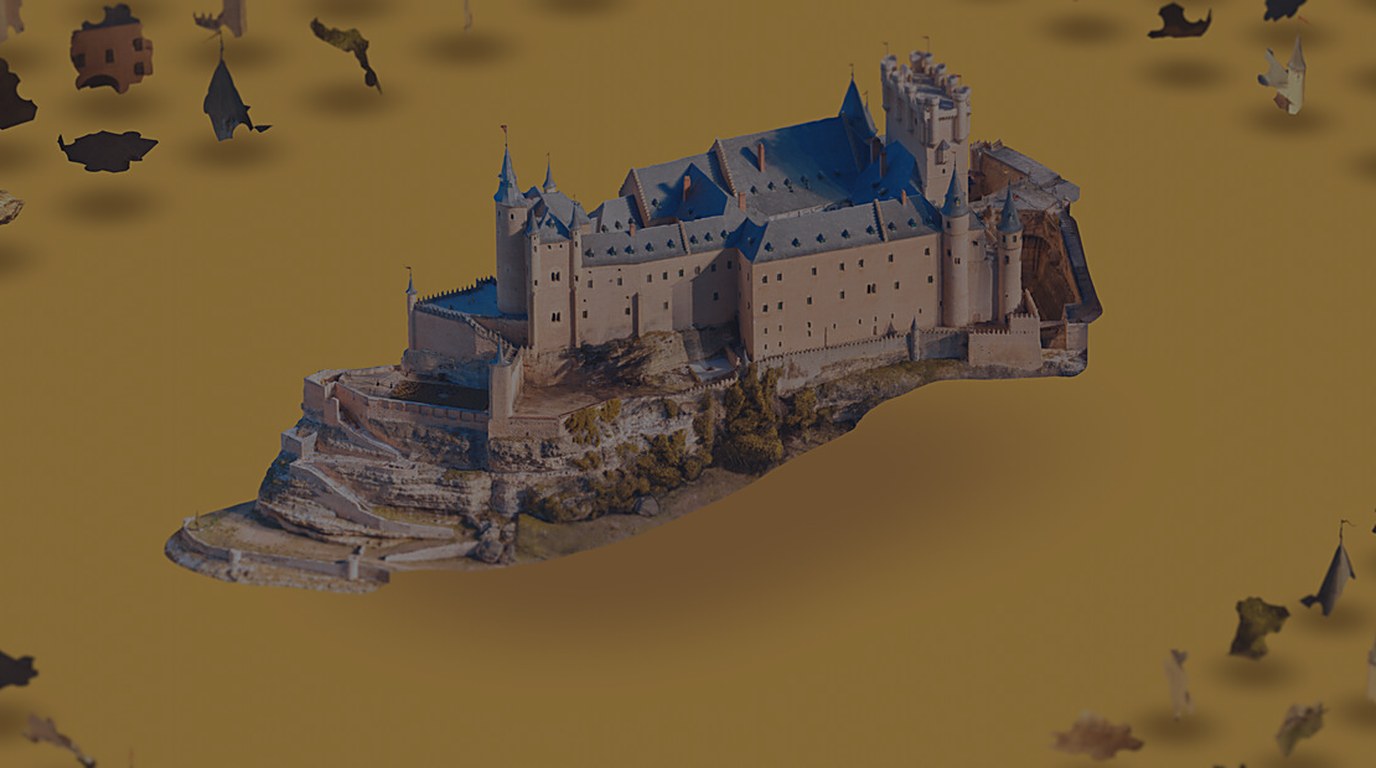
I put the headset on after a long night of something loud, and there’s a small stone chapel floating in front of me, about the size of a shoebox. I pinch a piece out of the tray with my fingers — actual fingers, no controller required — and the wall of a village church settles into my palm as a real, dimensional object. I rotate it, find the seam, and it clicks home with a soft wooden tap.
This is a jigsaw puzzle that happens to feel like holding the world in your hands, and it runs on just about every headset there is — Quest, PSVR2, PCVR, Pico, Vive, and Vision Pro.
What You’re Actually Building
It’s a real, dimensional object you can walk around, tilt, and inspect from every angle. Every set is a photogrammetry scan of an actual place — a chapel in Catalonia, a street in Bangkok, a cozy reading nook somebody actually lived in — chopped into pieces and handed back to you to reassemble in 3D space. You’re holding a small, detailed version of it, and your hands did the building.
The first time I finished a set, I took the headset off and felt calmer than I had any right to. No timer, no fail state, no score. The audio hotspots drop you into the real ambience of the place — a market, a café, a quiet square — and the puzzle just lets you be there.
Most VR wants to pump your adrenaline or test your reflexes. Puzzling Places wants you to sit down, breathe, and fit the last roof tile onto a miniature train station. As a way to prove to a skeptical friend that VR isn’t all shooting galleries, it’s close to perfect.
How the Pieces Move
Controllers do the heavy lifting, but the game also supports controller-free hand tracking, and it works. The gestures are the kind you learn once and never forget: pinch your index and thumb to grab a piece, pull backward to yank it free of the tray, and make a two-handed thumbs-up to glide around your little construction site. No menus to memorize, no button map to look up.
Comfort is a non-issue here — a seated or roomscale experience with no artificial locomotion, so nothing in it will ever turn your stomach. On a standalone Quest it holds a rock-solid frame rate, so the only thing that tires is your focus.
The developer built in a few quiet helpers that keep frustration at zero. Force-Pull snaps a piece toward its correct neighbor when you’re close. Puzzle Groups lets you grab a whole assembled chunk and move it as one unit. See-Through dims the rest of the model so you can line up a tricky seam without losing your place. ## The Library You’re Assembling
Where the game earns its keep is the catalog of real places. Puzzles ship in different piece counts, so a quick ten-minute session and a sprawling hour-plus build both live in the same app. The dioramas are small enough to hold in your lap but detailed enough that you’ll spot a sign you recognize or a window someone actually looked out of. That specificity is the whole trick: it’s a real location, shrunk, and your hands are the only thing between the scattered pieces and the finished thing.
The reception tells you how reliably that lands. UploadVR called it a “resounding success.” Road to VR said it’s “better than physical puzzles in almost every way” — the kind of line that sounds like hype until you’ve done a 200-piece set on your coffee table and felt the difference of rotating the whole model in mid-air. Android Central called it “a perfect fit for every VR owner,” which is the sort of blanket praise I’d normally ignore, except the awards back it up: a D.I.C.E. Immersive Reality finalist, a VR NOW Best VR Entertainment win, a Road to VR Design Award, and a Deutscher Entwicklerpreis Innovation Prize. Four bodies, all pointing the same direction.
Playing With Someone Else
Multiplayer is the part that surprised me most. Two-player cross-play is live across Quest, Pico, and PSVR2 — you and a friend on different headsets can sit in the same diorama and build together, passing pieces and racing to claim corners. There’s also a local mixed-reality mode where two people in the same room share the table. The same-account limitation is a real annoyance (two headsets on one Meta account can’t pair), but for the normal case — you and a friend, separate accounts — it just works.
The Honest Catch
Puzzling Places knows exactly what it is and refuses to be anything else. There’s no world to inhabit and no story to carry it — the loop is satisfying, then done. The piece counts top out well before a true marathon build, so the second time through a set, the discovery is gone; you already know where the roof goes. That’s the repetition-without-depth ceiling the format sets, and it’s why this is an A and not an S. It’s a perfect thing, but a small perfect thing.
And be clear about who shouldn’t reach for it. If you want a headset to thrill you, this won’t. There’s no stakes, no enemies, no winning — just the quiet satisfaction of a place reassembled. Action players who boot it up expecting a game will be bored inside twenty minutes, and that’s the correct reaction to the wrong expectation.
The One to Hand a Skeptic
It arrived legitimate. This is the game I reach for when my headset has been punishing me with bullet sponges and I want proof that VR can also be gentle. It’s the demo I put on a friend who thinks VR is all shooting and sweating — pinch a piece, rotate a chapel, watch their shoulders drop.
For the right evening it’s close to the best thing on the platform: real scanned places, real hand-built assembly, no stress, and now someone to build them with. Keep it installed for the nights you don’t want a fight. Brew a cup of tea, put the headset on, and finish that little train station. You’ll feel better than the game ever asks you to.