
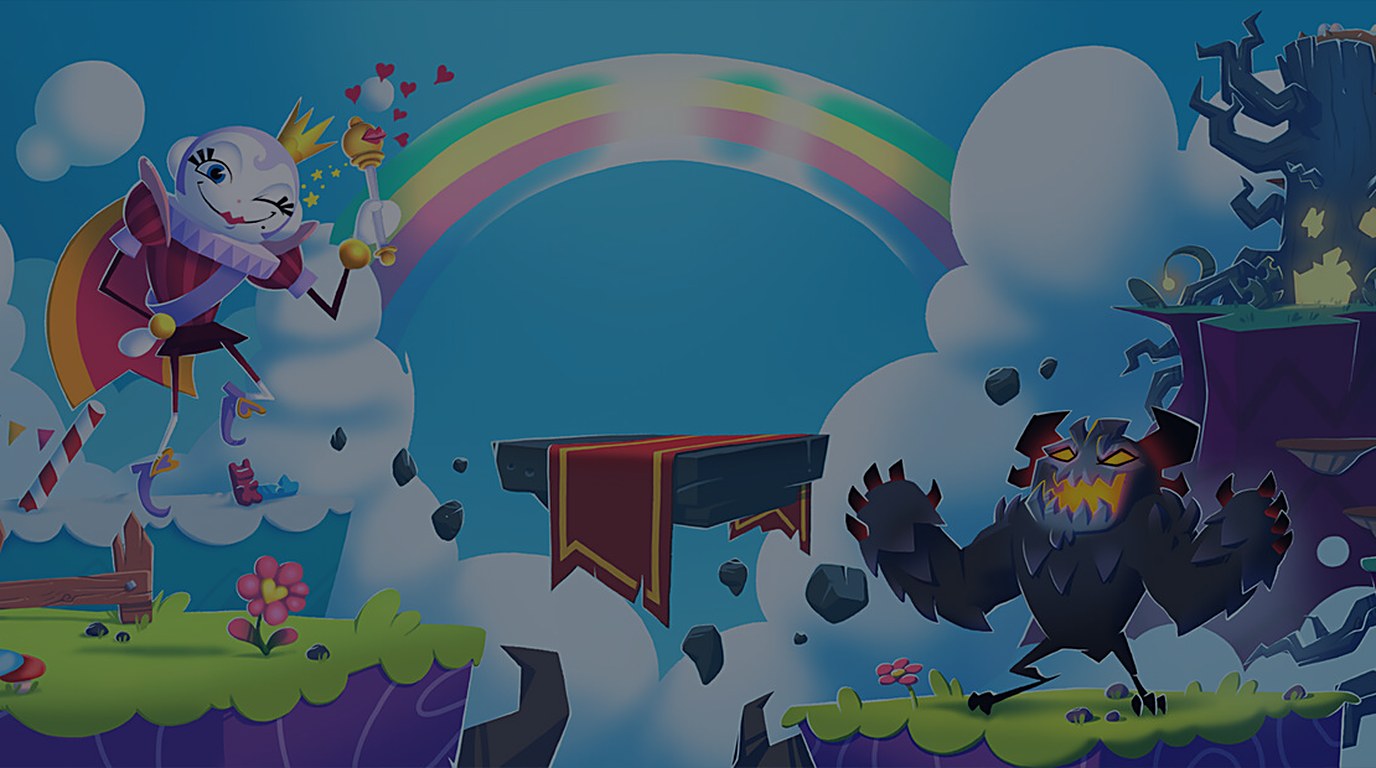
I spent a weekend in the headset flinging myself across lava pits with nothing but my own two hands, and somewhere around hour three I stopped thinking about the controls entirely. That’s the trick No More Rainbows pulls off. It’s a first-person platformer built from the ground up for VR, and it deletes the stick. You don’t walk. You don’t teleport. You grab the world with both controllers and haul yourself across it — vaulting, climbing, clawing, and occasionally face-planting into a wall you swore was a ledge.
What No More Rainbows actually is
Squido Studio, a small Montreal team, shipped this as a VR-only title on June 1, 2023 — at the same time on Meta Quest and SteamVR. There is no flatscreen version, and that matters more than it sounds. Every design decision was made for a headset and two tracked hands, not bolted onto a game that was finished elsewhere first. The pitch is simple and a little absurd: take the arm-swing locomotion that made Gorilla Tag a phenomenon and give it a real campaign — four worlds, a hub, and a structure that actually rewards you for learning the movement instead of just surviving it.
UploadVR called it “a genre-defining platformer for VR” at launch, and the description isn’t empty hype. Before this, VR platforming mostly meant either janky flat ports or baby-step physics sandboxes. No More Rainbows is the first one I played where the jumping and the climbing felt like the point, not the obstacle between you and the point.
Your hands are the entire control scheme
Here’s the part that takes a session to sink in: there is no thumbstick locomotion. None. You propel yourself by swinging your arms — synchronised gestures from both hands, vaulting off the ground and around the environment. Climb by grabbing surfaces. Claw your way up ledges. Punch through obstacles. The first ten minutes are humbling; you will flail. Then your brain figures out the timing and the whole game opens up.
The movement system is simple, but it’s got nuance, and that’s the line between a gimmick and a game. There’s no teleport option — the developers say offering one simply wouldn’t be possible given how the locomotion is built — but there are basic vignette comfort settings if you want them. I came away impressed by how responsive it stays under pressure; when you’re mid-vault and a projectile is coming, the game keeps up.
The campaign that earns the movement
The single-player campaign runs about four to five hours, which is exactly the right length for what this is. You start in a lava hub, then push into four distinct worlds — each one a hub of its own with portals out to individual levels. The hub areas aren’t just menus; they’re playable platforming spaces that teach you mechanics before the real tests arrive. Moving blocks, crumbling platforms, projectiles that want you dead — the obstacles are familiar, but the hand-driven traversal makes every one of them feel different from how they’d play with a stick.
What I kept coming back to: the game makes you feel like you beat the level. Not that you cleared it, not that you finished the objective — that you personally hauled your body across that gap and survived. That’s the presence dividend of building for VR first. There’s a leaderboard system built around clear times and “challenge points” for reaching collectables that are genuinely hard to get to, and they don’t feel like busywork. They feel like the game daring you to find one more route.
There’s no story in the traditional sense — no dialogue at all, just grunts and squeals, with a silently-mocking “uber cutie” as your antagonist. For a game this physical, that’s the right call. The silence lets the movement carry the experience instead of competing with it.
The multiplayer that’ll wear you out
The 3v3 arena mode is where this turns into a social game. You’re chasing floating chickens around for points in a platform arena, with power-ups and a social hub full of mini-games between matches. It’s cross-platform with PCVR, so your Quest-only friends and your wired-up PC crowd can share a lobby. UploadVR’s reviewer called the multiplayer mode “exhausting,” and that’s not a complaint — it’s a warning label. This is a game that will have you genuinely winded, and the multiplayer is where the arm-swing locomotion stops feeling like a clever control scheme and starts feeling like a workout you’re laughing through.
A later Deathmatch mode and a steady trickle of post-launch worlds — Molten Shores among them — keep the arena scene from going stale, but even at launch the 3v3 loop had enough chaos to justify the install.
Where it stumbles
It’s not flawless, and I’m not going to pretend it is. The biggest honest caveat is the audio. The soundscape does its job — every pick-up, landing, and impact registers — but it leans quiet and a little barren. After the visual and physical chaos of a level, the lack of a memorable score or vocal texture leaves the world feeling slightly hollow. I’d call it functional rather than forgettable, which is a narrow gap in a game this energetic.
The other catch is the one I already flagged: this is a physical game. If you’re the kind of player who wants to lean back with a stick and a comfortable chair, No More Rainbows will tire you out faster than almost anything else in your library. That’s the design, not a bug, but it’s a real filter. The easier difficulty mode helps — you can toggle it mid-level and it just drops checkpoints in more generously — but it doesn’t change that your arms are doing the work.
There’s also the novelty question every arm-locomotion game faces. Gorilla Tag has legs because the sandbox is endless; No More Rainbows has a campaign with a finish line. The four-to-five-hour story will absolutely get beaten, and after that the game lives or dies on whether its leaderboards and multiplayer keep pulling you back. On the evidence of the speedrunning and cosmetic-hunting community that formed around it, that pull is real — but it’s not the infinite toy that pure sandbox physics games offer.
The bottom line
No More Rainbows is the strongest argument I’ve played for the VR-native platformer. It takes the one locomotion style that only works in a headset, gives it a world worth moving through, and respects your time with a campaign that’s long enough to satisfy and short enough not to overstay. The movement is the star, the multiplayer is a genuine sweat, and the only thing holding it back from essential status is a soundscape that could’ve been twice as loud and a content model that leans on you wanting to replay rather than just keep going.
If you own a Quest or a PCVR headset and you’ve ever wondered what a real VR platformer feels like — not a port, not a tech demo, but a game designed around your hands from line one — this is the one to put on. Just clear some floor space first.