
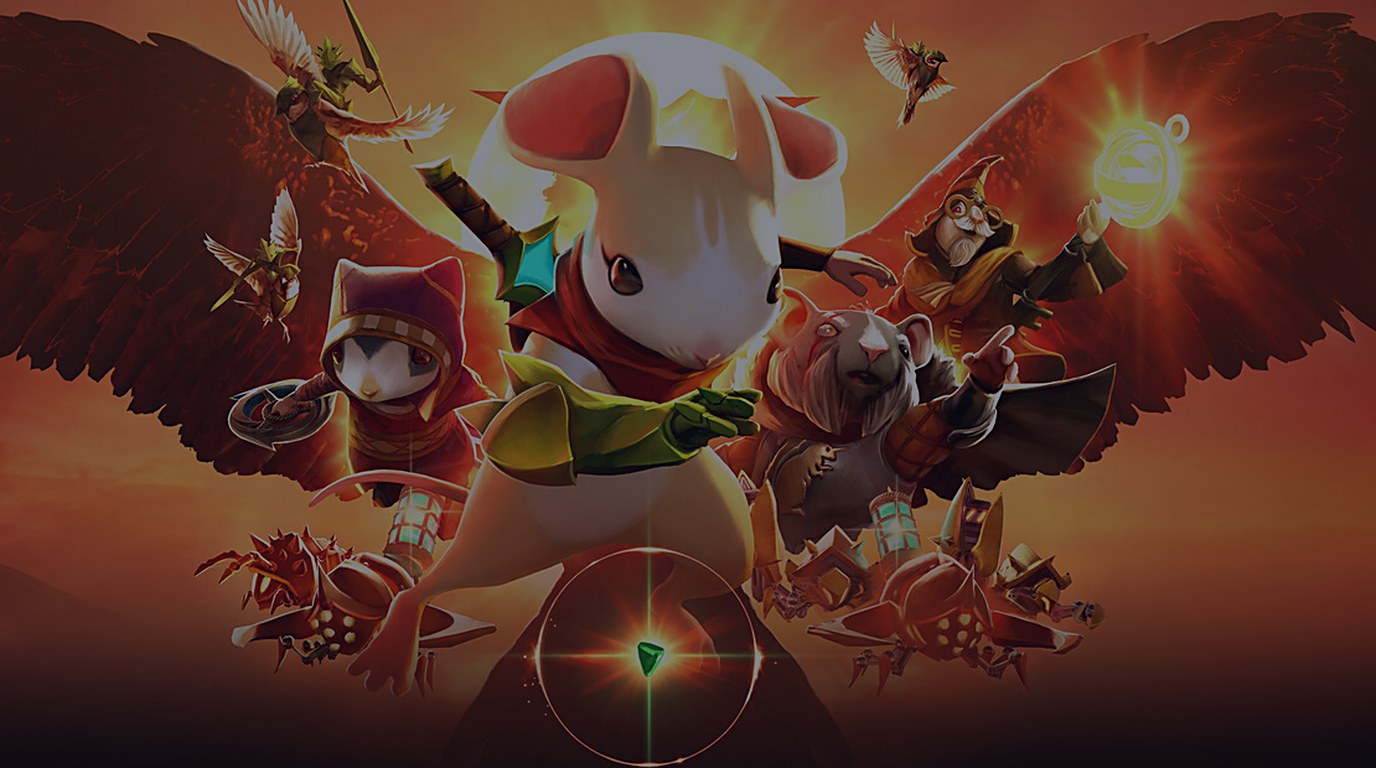
The first time the hammer came out in Moss: Book II, I laughed out loud. Not because it was funny — because it made me throw a weapon over my own shoulder like a discus, which is not a thing I can do on a flat monitor with a sword. Quill carries the hammer. You throw it. It’s a small, stupid, perfect demonstration of why Polyarc kept saying this game had to exist in a headset.
Four years after Moss, Polyarc went back to the same well and somehow found more in it. Book II is the same premise, the same diorama, the same masked Reader hovering over a mouse — and it is a bigger, more open, more mechanically ambitious version of the thing that already worked. It shipped on PSVR in March 2022, hit Quest 2 that July, came to PCVR in October, and got a PSVR2 version in February 2023 that reviewers met with something close to unanimity.
Two hands, one hero, four years later
The control split survives untouched, because it was never the weak part. You run Quill with the left stick — she jumps, she swings, she scampers. Your other hand is yours: physically reach into the diorama and move the world. Hold a gate, shove a block into a stair, rotate a mechanism. It’s the cleanest split between “I am playing a character” and “I am a presence in the scene” that VR has produced, and Book II understood that the answer was to keep it and extend it, not to redesign it.
The extension is where the sequel earns its keep. Quill can climb now, which turns every level from a set of dioramas into something with verticality — she goes up walls the way you’d expect a small creature with a sword to go up walls. The Reader grows vine bridges out of nothing to cross gaps you’d rather not jump. And you can grip an object and crush it, which solves a handful of problems that Book I solved by making you wait.
Then there’s the hammer, which is the mechanical signature of the whole game. Quill can’t swing it effectively at her own height. You lift your hand above your head and throw it down, and the impact connects. It’s the sequel’s thesis in one gesture: sometimes the solution to a problem is something your body does that her body cannot.
The diorama still rewards you
Nothing about that broke. Book II is still a hand-built model you lean over — Road to VR called each segment “a beautifully detailed diorama with masterful attention to lighting and composition,” and that’s fair. Stand up for an aerial read on a puzzle, crouch to see what’s tucked under a bridge, and the sense of scale holds: a mossy log is a cliff to her, a puddle is a lake.
The one structural change is openness. Book I was a contained campaign; Book II wanders. There are backtracks through areas you’ve already cleared, collectibles hidden throughout, and a world that got bigger because players kept telling Polyarc it was too small. That’s a reasonable thing to want from a studio sitting on “we made the good one, now what.”
What carries it
Quill. She still doesn’t speak, and she still talks in American Sign Language — signs for look, for thank you, for danger — which is a choice that creates real attachment without a line of voice acting. She’s older in Book II, and more capable, and she still watches you. Jason Graves returns on score. The story is told through another literal book that turns its pages as you move, and the art direction holds up everywhere I’ve seen it.
The puzzles also respect the headset in a way that’s easy to miss. Polyarc deliberately designed them so you never need to pull the visor off to solve one — no fiddly inventory screens, no external references. On the Quest 2 port the team specifically cut materials and shaders to hold framerate, and moved between areas with a fade to black rather than a lurch.
Where the spell thins
I’m not going to pretend this is Book I again, because it isn’t, and the comparison flatters it. Book II is very good and it is very clearly the sophomore release. Combat is still light — the sword is still the bread and butter, the hammer is spectacle more than necessity, and the enemies never put up a real fight. The script is connective tissue rather than destination.
There’s a real platform caveat too. Android Central’s read was that PSVR’s aging hardware held the game back, specifically because its limited tracking made it awkward to move the controller around — which is precisely the interaction the hammer asks of you. If you’re on original PSVR, know that before you buy. Quest 2, PCVR, and PSVR2 are where the game is at its best, and the PS5 release drew universal acclaim against generally favorable on PS4.
Length is the other honest limit. This is still a compact experience by flat-game standards — a polished afternoon rather than a season.
Buy it anyway
I still hand this to people the same way I hand them the first one, though if the choice is only ever one of them, give them the first one first. Book II is a rare sequel that doesn’t dilute the thing it inherited: same diorama, same hand language, same quiet combat, more room to move and one genuinely brilliant new verb. If you finished Moss and wanted more of that specific feeling, this delivers, and the PSVR2 and PC builds are the ones to get.
One thing to know before you commit. Polyarc closed in September 2026, shortly after shipping Moss: The Forgotten Relic — a remade, non-VR compilation pairing Book II with its predecessor on PS5, Xbox, Switch, and PC. The VR versions are final as they stand. Nothing is being patched and nothing new is coming, which is fine for a game that was never going to grow again anyway — but it does mean the complete experience is the one you’re buying.