
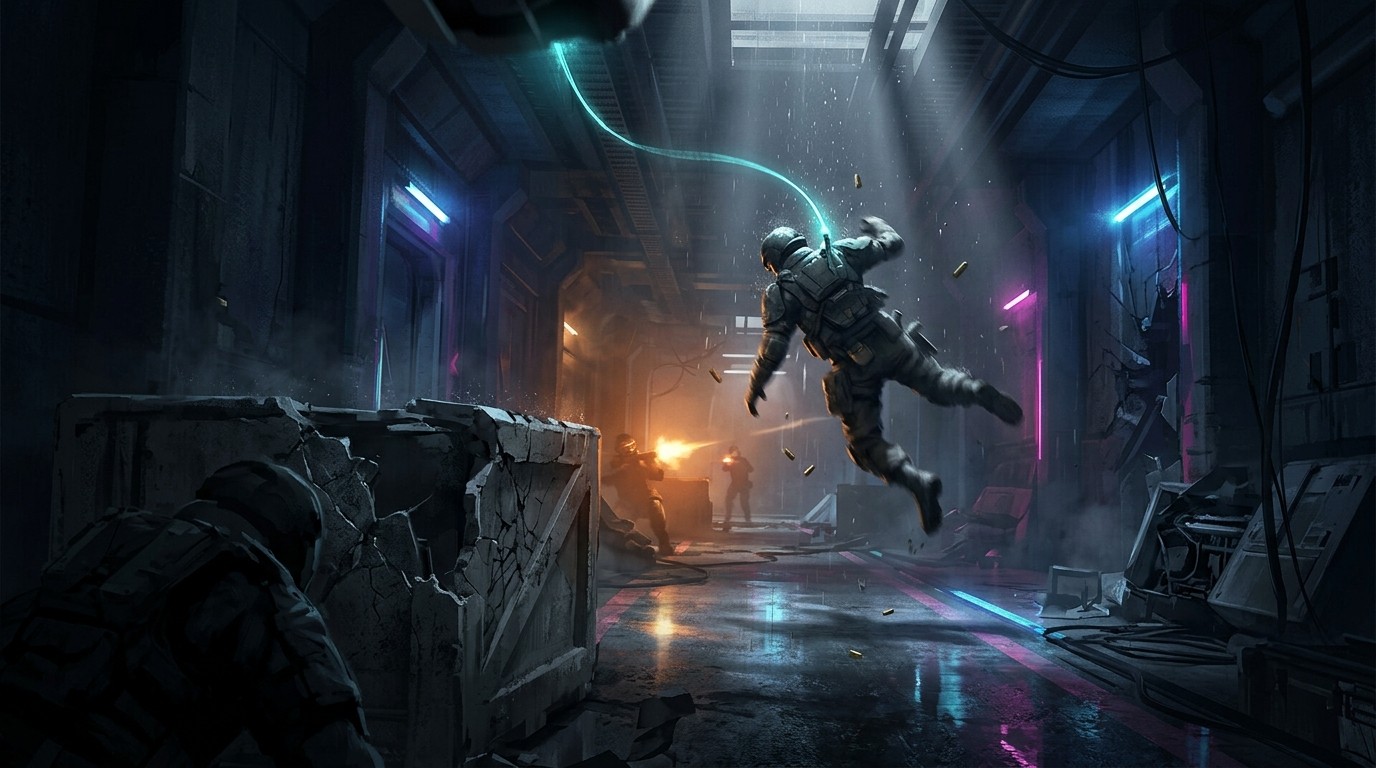
Duck. Two guns come up. Enemies pour through the door and you’re trading fire from behind a waist-high crate, leaning out to pick off straggers, dropping back down as bullets chip the concrete above your head. Then one of them staggers — stunned, wobbling — and you snap out a laser leash, yank him into the air, and the world goes slow. Three shots. Four. An Unreal Tournament–style adjective flashes on screen: Slayer. Health restored, score bumped, and the next wave is already through the door.
That’s Mortal Blitz. It’s Time Crisis with dual-wielded guns, a laser leash, and a VR headset, and it knows exactly what it is.
The Arcade Thing, Done Right
Mortal Blitz started as a Gear VR launch title in late 2015 — one of the earliest commercial VR shooters — before hitting PlayStation VR in early 2017 and Steam mid-year. The game was adapted from a location-based VR arcade setup in Korea, and you can feel those roots in every design decision: short sessions, fast pacing, zero fat.
The loop is simple. You’re Yuhei, an ex-government operative, fighting through five missions of sci-fi corridor shooting. Enemies advance on your position. You duck behind cover — physically, with your real body, no button press — lean out to fire, and duck back. Dual-wield two weapons independently, one in each hand. The movement is node-based teleport: you point at the next cover spot, hold a button, and snap to it. No artificial locomotion, no stick movement, no comfort vignettes needed. You’re stationary, you’re physical, and you’re shooting.
The Groggy System is the hook. Stun an enemy and a laser leash appears — grab them, yank them airborne, and the game cuts to slow motion while you unload. The more shots you land, the better the rank and the more health and score you get. It’s a small mechanic, but it makes every encounter feel like a set piece instead of a shooting gallery. When three enemies stagger at once and you’re juggling them in slow motion, dual-wielded guns barking, it’s the kind of moment VR was built for.
Comfort That Actually Works
The comfort here is excellent, and it’s worth explaining why. There’s no artificial locomotion at all — you teleport between cover positions, and the only movement is your physical body ducking, leaning, and dodging. If you can handle standing in one spot and bending your knees, you can handle Mortal Blitz. No stick-based motion means no nausea from artificial movement. No snap-turn means no vestibular mismatch. The game is about as sickness-safe as a VR shooter gets, and reviews from the launch era consistently report zero motion-sickness problems with the home versions.
You can play seated or standing. Standing is better — the physical duck-and-cover is the whole point — but seated works if your play space is tight. You’ll just miss the visceral satisfaction of actually dropping behind a crate while virtual bullets chip the wall above your head.
The teleport movement is snappy, almost aggressive. You’re not drifting between positions — you’re snapping, like the game is in a hurry to get you to the next firefight. It suits the arcade tone. You never feel like you’re waiting for a slow walk to finish. You’re always in the action or about to be.
What Holds It Back
The campaign is ninety minutes. That’s not an estimate — that’s what most reviewers hit, and it tracks with the five-mission structure. The first mission introduces the systems. The third mission starts repeating environments. By the fifth, you’ve seen every enemy type the game has.
Five enemy types. That’s the roster. Grunts with guns, slightly tougher grunts with guns, drones, a couple of shielded variants, and a boss at the end of each mission. They march in, find a spot to shoot from, and wait there to die. The tactics don’t evolve. The environments — a train, a facility, another facility — blur together. The last mission literally repeats the same teleport-and-shoot pattern for ten minutes before the credits roll.
The story is incomprehensible. Something about a Teratoma Destruction Plan. You’re a government operative. There are villains. None of it matters, and the game knows it — cutscenes are either missing entirely or truncated mid-sentence, as if the developers ran out of time or budget and just stopped. You’ll lose the plot by mission two and stop caring by mission three.
The soundtrack fits the action. The weapon sounds don’t. Guns sound like they’re firing ping-pong balls — a persistent complaint across reviews that doesn’t change with patches. For a game built around the fantasy of dual-wielded gunfire, the audio underdelivers.
Where to Play It
The Steam version is the way to go. Still on sale at $19.99, still works, tracked motion controllers, any SteamVR-compatible headset — era hardware was Rift and Vive, but anything current runs it fine. The install is small, the launch is frictionless, and the offline single-player means you don’t need an internet connection or a backend. It’s one of the cleaner “buy it and play it” VR purchases available.
The PlayStation VR version exists for anyone with legacy PSVR1 hardware — you’ll need the headset, a PS4 or PS5 with the camera adapter, and Move controllers or a DualShock 4. It’s the same game, same comfort, same ninety minutes. It never made it to PSVR2, and it’s not going to.
There was a Gear VR version, the original, but the platform is dead. There was a free-to-play multiplayer spin-off called Combat Arena on PSVR — launched October 2020, node-based PvP with the Aim controller — but the servers went dark sometime in 2024 and nobody noticed. The main game is the one worth playing.
Ninety Minutes of Fun
Here’s what Mortal Blitz gets right: the VR implementation is genuinely good. Teleport locomotion eliminates motion sickness. Physical duck-and-cover gives you real presence. Dual-wielded guns feel natural with tracked controllers. The Groggy System makes kills feel like events instead of chores. For a game that started life on mobile VR in 2015, the home versions hold up better than they have any right to.
What it doesn’t get is depth. Ninety minutes, five enemy types, environments that repeat before the second mission ends. The arcade roots are both the game’s greatest strength and its ceiling — it’s designed for short bursts, and it delivers exactly that. There’s no reason to go back after you’ve beaten it once, unless you want to chase higher scores on harder difficulties. The replay loop is there, but it’s thin.
If you want a comfortable, motion-controlled VR shooter that doesn’t ask for a two-hour commitment and doesn’t make you sick, Mortal Blitz is a solid pick. It’s Time Crisis in your living room — the same dopamine loop, the same quarter-eating energy, translated into a medium that lets you physically duck behind cover. It won’t change how you think about VR. It will give you a satisfying afternoon.
For ninety minutes, that’s enough.