I strapped on the headset expecting a novelty — a 1997 kart racer stretched awkwardly across two lenses. Thirty seconds into the first lap I was craning my neck to watch a red shell arc past my left ear, and I had forgotten the thing is pushing thirty years old. It didn’t come from Nintendo, and it shouldn’t work this well.
Two doors into the kart
There isn’t one Mario Kart 64 VR option. There are two, and they’re both the real deal. Both are built on Harbour Masters’ SpaghettiKart — the decompiled, natively-running PC port of the game — so neither is an emulator faking a screen in a virtual room. They’re renderer forks that draw the world in stereo with proper 6DOF head tracking.
The first is a PCVR build (RaYRoD-TV’s OpenXR work, now handed out through the Multiverse VR Hub). You run it on a VR-capable PC with whatever headset you’ve got — SteamVR, Virtual Desktop, Quest Link, Air Link, it doesn’t care which. The second is a native Quest and PICO standalone port (SgtBilko76’s SpaghettiKart-VR) that renders both eyes directly on the headset, no PC in the loop. Both ask the same thing up front. You need your own legally-owned Mario Kart 64 ROM. Drop it in and the build does the rest.
Neither is an official Nintendo product. These are full VR adaptations with motion controls — you’re in the kart, not watching it from a couch.
In the driver’s seat
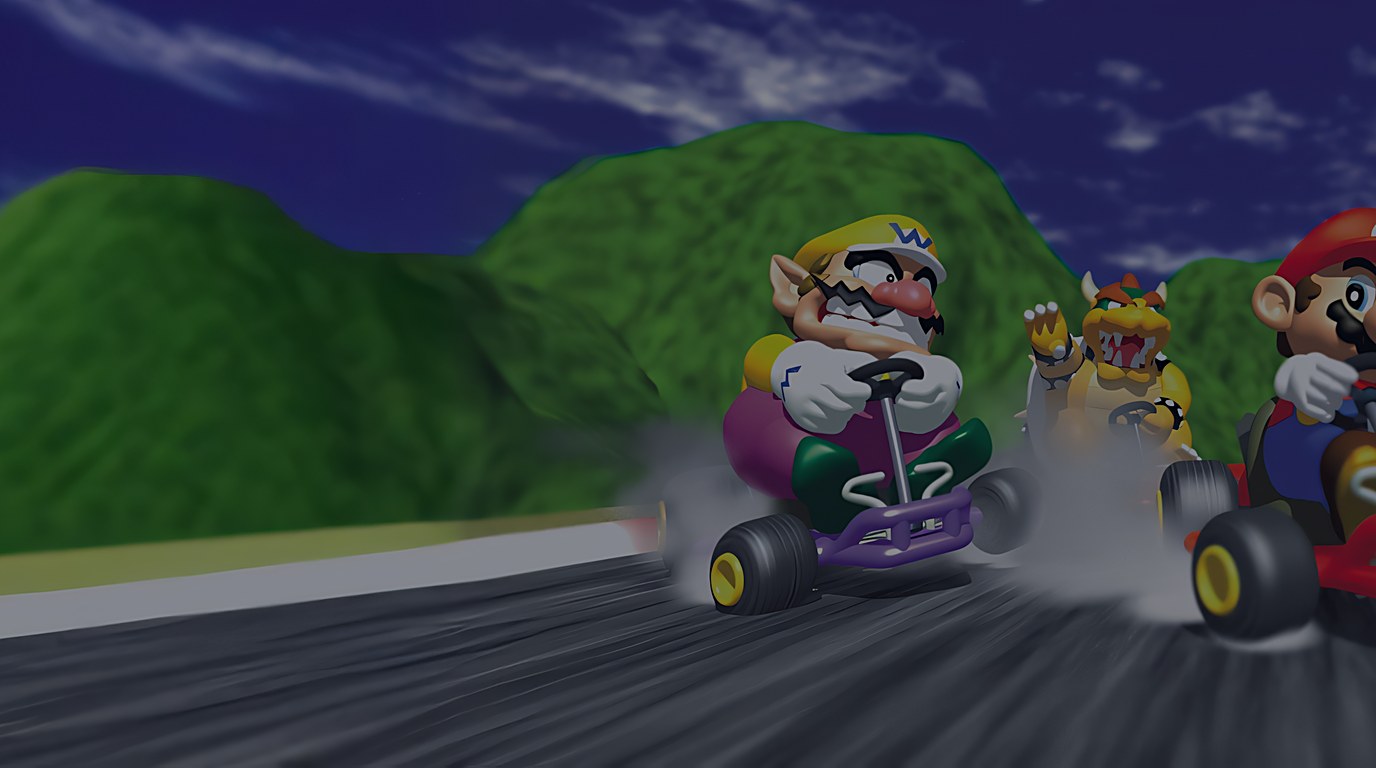
The headline view is first-person: you’re sitting in the kart in stereo 3D with full head tracking, and the world has actual depth around you. The karts, the track edges, the item boxes — they occupy space. On Moo Moo Farm I found myself leaning into the turns without thinking, because the kart visibly dips and the horizon tilts the way it should. You can glance sideways at a rival drafting your bumper or crane around to watch a shell you just fired, and that small freedom changes how the racing reads. It becomes a thing you’re physically sitting inside.
Controls map cleanly onto the N64 pad through your motion controllers. Left stick steers and moves menus, A is gas, right trigger or grip does the hop-and-drift, a held button looks behind, and a right-stick click cycles the view. Your controllers rumble when you take a hit, which sounds minor until a blue shell deletes your lead and your hands jolt at the exact frame it lands. Gamepad works alongside if you’d rather, and there are binding profiles for Quest Touch, Index, Reverb G2, WMR, and Vive. Four view modes — third person, first person, theater, diorama — are switchable on the fly, both on a gamepad and in-headset, so you’re never stuck in a camera you hate.
Why it works in VR
The thing that makes Mario Kart 64 hold up is feel — the drift, the mini-turbo, the item chaos arriving from off-screen — and VR is unusually good at delivering feel. Looking back to check for a red shell isn’t a gimmick; it’s a real read on the race you couldn’t get on a CRT. The hop-and-drift on a trigger makes the most important mechanic in the game physical: you’re initiating the hop, not mashing a face button and hoping. After a few laps the controls stopped being a translation and started being the game.
Depth does real work too. On a flat screen, item boxes and rival karts are sprite-ish suggestions. In the headset they sit in space, so the closing laps — when everyone’s holding something and the pack is bunched — become readable instead of luck. The tracks you’ve memorized for twenty years suddenly have a foreground and a background, and Rainbow Road stops being a flat void with edges you can’t see.
What surprised me most is that this is the whole game. All 16 tracks and battle mode are there, and the port ships the CUSTOM class row — item modes, 200, 300, and 500cc, turbo laps, mirror, plus knockout, balloons, tag, treasure hunt, and infected. You can build a silly party ruleset and run it solo against the AI. Both routes are live and being worked on right now. A kart racer is only worth a headset if the build you install today is the one that keeps getting better.
The PCVR route in particular has gotten easy to live with. The Multiverse VR Hub is a single exe that pulls the official PC-port build, applies the VR patch, and self-updates with checksum verification — the ROM is still on you, but the assembly line isn’t.
Where the rubber meets the retro
The first wall you hit is the visuals. This is an N64 game, and there’s no way around it. Low-poly karts, chunky textures, draw distances that end in fog because they always did. The HD texture pack helps the surfaces but not the geometry, and if crisp, modern VR visuals are your non-negotiable, this will read as a tech demo wearing a classic’s skin. It looks like 1997 because it is 1997, just with depth now.
The second wall is the front door. You need your own ROM, full stop — there’s no store purchase that hands you the game. On PCVR the hub hides most of the rough edges, but the Quest standalone asks more: you run the asset-extraction step on a PC, flip on developer mode, and sideload the APK and asset files yourself. It’s a known sequence, but it’s a longer afternoon than clicking Install. And the Quest build is early — single-player only in the headset (split-screen is disabled in VR), no in-headset settings menu yet (you edit a config file), and the PICO build is untested by the author. PCVR keeps the versus-AI modes; the standalone is you against the field, alone.
Final lap
Mario Kart 64 in VR is a genuinely fun, properly tracked replay of a game you probably already love, and the motion controls make the drift feel like yours for the first time in thirty years. It is not a technical showcase, and you’ll do a little work to get in the door. For VR owners who grew up on this kart and want to finally sit in it, that trade is an easy yes. For everyone else, it’s a brilliant weekend experiment that proves the classic survives the headset — just don’t expect it to look like it was born there.