
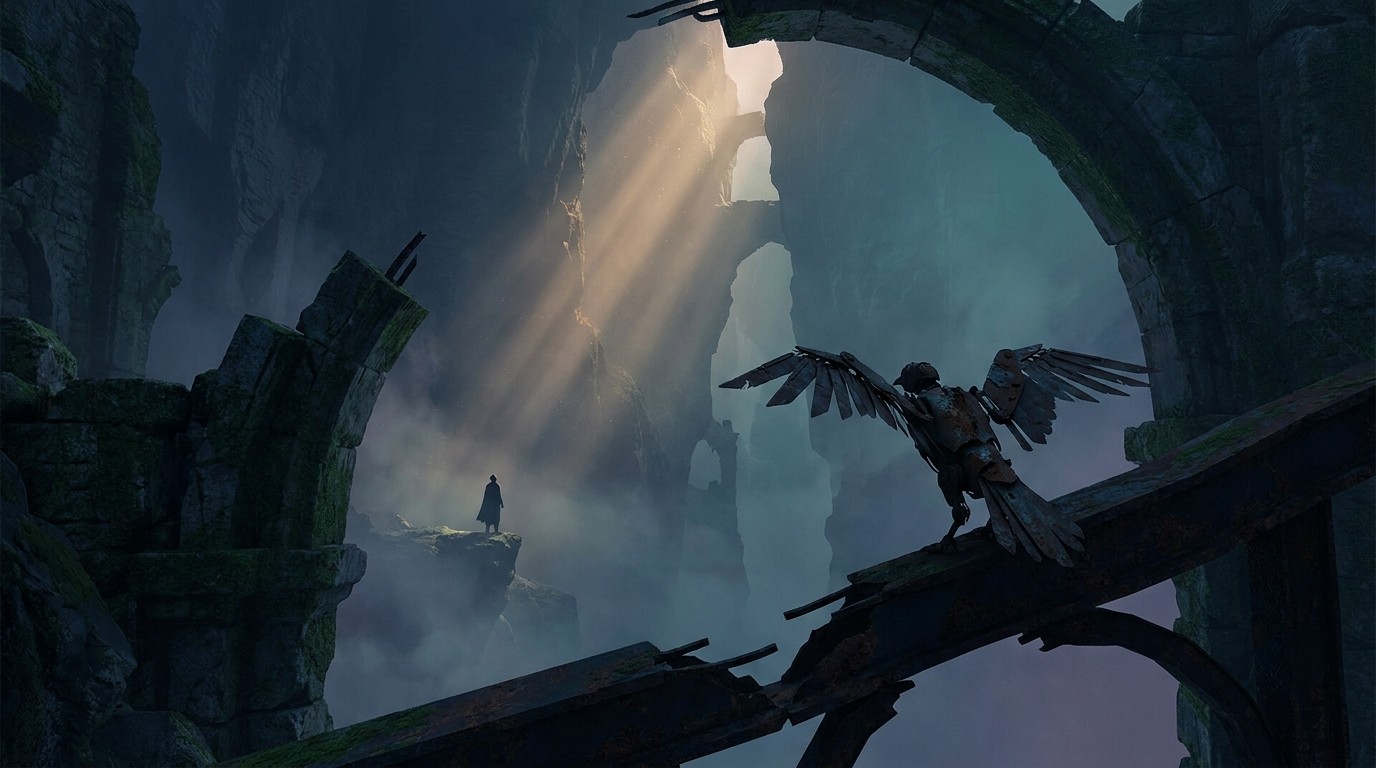
I spent a Sunday afternoon as a mechanical bird, and I’m not embarrassed to say I forgot to check my phone the entire time. Mare doesn’t grab you by the collar. It settles you onto a perch above a fog-swept ruin and asks you to look after a small girl who has no idea you’re there. That’s the whole deal — and it’s one of the most quietly confident VR experiences I’ve put on a headset.
A bird, a girl, and eight chapters of fog
Mare is a native VR puzzle-adventure built from the ground up for the headset. There’s no flat version to repair with mods and no injection driver doing ugly stereoscopic tricks — you buy it on your platform and you’re in. Lonekite Games (formerly Visiontrick Media, out of Tokyo) shipped it on Quest back in January 2021, brought a prettier build to PC VR — Steam, the Rift store, and Viveport — in March 2022, and with the PSVR2 release it now sits on every major VR platform worth naming.
You play a benevolent force embodied as a rusted mechanical bird. Your job is to guide a young companion across eight chapters of crumbling, mist-laced architecture that owes an enormous debt to ICO and The Last Guardian. You hop between perches, fire little bolts of lightning to activate switches and clear her path, and keep watch for the silent shadow things that surface when you look away too long.
Watching from the perches
Here’s the part that caught me off guard: you’re not walking in anyone’s shoes, you’re a bird watching from above. The camera doesn’t drag you through the world on rails or smooth locomotion — you pick a perch, the view fades to the next vantage point, and you survey the puzzle from there. Only the opening level has a brief bit of camera gliding, and even that’s gentle; my stomach never once objected, which is rarer than it should be in this medium.
On Quest and PC VR you fly the bird with the thumbsticks and an auto-hover takes the edge off — you’re not fighting the controls to stay aloft. The puzzles are light. I’ll be straight with you: this is not a brain-burner. Most of the challenge is spatial — figuring out which perch lets your companion climb to the next ledge, or which switch to spark so she’ll move. The real draw is the act of watching, not the act of solving.
The PSVR2 version changes the input in a way I didn’t expect to enjoy as much as I did. Past the expected foveated rendering — it holds a steady 90fps, and the headset buzzes faintly with rain-on-your-face haptics when you fly into a stormcloud — it ships two modes. Classic mode lets you play the entire game with eye tracking alone: you select and trigger puzzle objects just by looking at them. Enhanced mode brings the Sense controllers, adds puzzles, redraws a few stages, and gives you a compass avatar so you always know where your charge wandered off to. I spent most of my time in Enhanced, but Classic is a genuine “I finished a VR game without touching a button” curiosity that works better than it sounds.
The world does the work
The art direction is the headline. Mare renders its world in deliberate low-poly planes and lets scale and weather do the lifting — vistas that run for miles, cloth rippling in wind you can’t feel, a musical score that sits under everything like weather. On PC VR the real-time lighting gives the ruins a weight the standalone Quest build can’t quite match, but even on Quest the composition carries it. I kept stopping the bird mid-flight just to turn and look at a cliff face.
The companion dynamic is the second pillar, and it’s thornier than it looks. You protect this girl, but protection has a cost — sometimes you have to shock a structure to move her along and she screams, and the game does not flinch from how that lands in your ear at point-blank VR distance. It’s a small, uneasy thread in an otherwise serene game, and I respected it for not sanding the edges off.
Where it runs thin
Brevity is the first caveat, and I’m not going to soften it. The main arc runs about two hours. Hunt the hidden artifacts for the secret ending and you might stretch to three or four. For some people that’s a feature — a tight, complete experience you finish in an evening. For others it’s a hard pill at full price, and there’s no filler to pad it.
The puzzles are the other soft spot. They’re pretty, they’re calm, and they are not deep. If you’re coming to Mare for satisfying mechanical challenge, you’ll be bored by the second chapter. It’s a game about atmosphere and companionship with puzzles bolted on as structure, not the other way around — and the order matters.
There’s also a distance to it. Because you’re a bird above the action rather than a body in it, Mare never quite reaches the physical, you-are-there presence of something like Half-Life: Alyx or Lone Echo. You’re overseeing a beautiful diorama, not standing inside the story. That’s the line between a great VR experience and an essential one — and for me, the gorgeous world and the quiet unease of the companion thread land it firmly in great.
Who should put the headset on
If you want a VR game you can hand to a friend who gets motion sick, or one you can sink into after a long week without bracing for combat, Mare is an easy yes. Bring it to PSVR2 first if you have the option — the eye-tracking Classic mode and steady 90fps are the definitive way to play — but the Quest and PC VR builds are the same calm world, just with different ceilings on the lighting. Skip it if you need your VR to challenge you; this one wants you to watch, not to win.