
Sitting cross-legged with a LEGO diorama
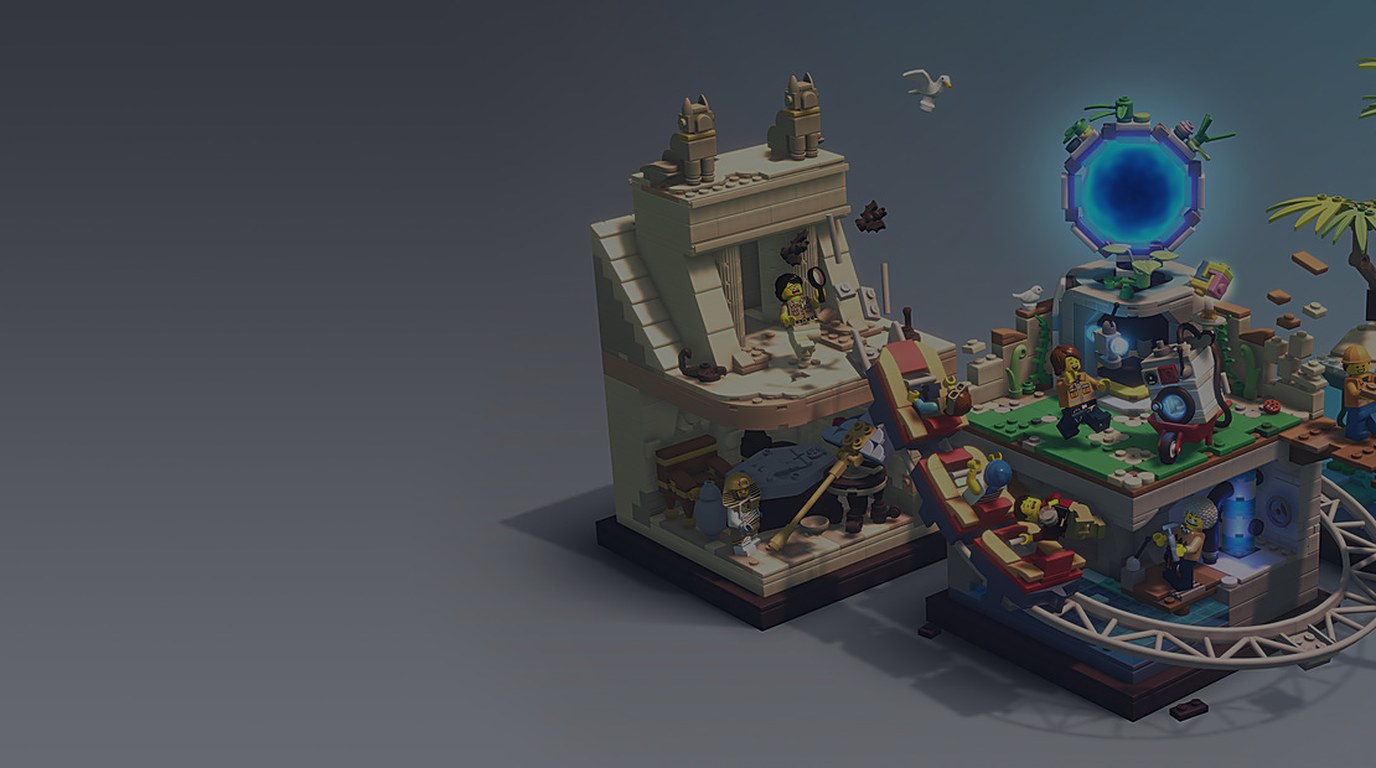
You’re sitting on the floor of your living room, and on the carpet in front of you is a diorama about the size of a coffee table — a jungle outpost, a forest, a handful of themed worlds you travel between. A minifigure the size of your thumb stomps around the edge, and when I want him to cross a gap, I don’t open a menu. I grab a 2x4 plate, line it up against bricks sized exactly like the real pieces, and snap it into a bridge. That’s the whole loop, and it’s the most relaxed I’ve felt in a headset in a long time.
LEGO Bricktales on Quest is a standalone, developer-made build from ClockStone and Thunderful. It’s not the flat game with a VR toggle, and there’s nothing to sideload. It launched December 7, 2023 as a Quest 3 launch-window title, and it remains the only way this game exists in VR: no PCVR version, no PSVR2 build, no Pico release. The Steam flat game lists no VR support at all, so if you don’t own a Quest, this one isn’t coming to you. That’s a reach limit, not a quality knock — but it’s the first thing to know.
Building with tracked hands
This is a Controller-based game in the literal sense the devs use that phrase: you hold the Touch controllers, and your hands are the tool. The minifigure himself you steer with the thumbstick — you’re remote-controlling a little LEGO dude on your living room floor, and it’s difficult to at least marvel once or twice at how natural that split ends up feeling. Your off hand repositions the whole map when a structure drifts out of reach; your working hand does the actual brick work.
What’s missing is the tactility of a real brick click — there’s no haptic snap when a piece locks in. Bricktales makes up for that with smart brick-building design: pieces snap to a clean grid, the camera frames your construction, and the puzzle tells you when a bridge will actually hold weight. It never fakes the feel of plastic, but it never asks you to fight the controls either. After ten minutes I stopped thinking about the controllers and started thinking about load-bearing geometry, which is the exact moment a builder like this earns its headset.
The dioramas are table-scale on purpose. You’re not walking the world first-person; you’re crouched over it like a kid at a kitchen table, rotating the build, testing it, watching your minifigure scramble across what you just made. Five themed worlds give the campaign its variety — a jungle, a desert, a medieval set, a city, a fairytale slice — and each one drops you into bite-size construction puzzles: a ramp for a cart, stairs for a climb, a crane that actually has to lift.
Mixed reality is a great gimmick, not the point
On Quest 3 and Quest Pro the game offers colour passthrough, so the diorama can sit on your actual rug with your real coffee table bleeding into the scene. It’s a pretty great gimmick, considering the little LEGO pieces are all accurately sized to their real-world counterparts - the brick in your hand lines up with the brick on the floor. But it’s just plain passthrough, no spatial anchoring that makes the world react to your room. On the gimmick-to-essential spectrum, Bricktales’ mixed reality leans hard toward gimmick. Quest 2 owners get straight VR and lose nothing that matters; the brick-building is the draw, not the see-through walls.
The VR version is the one to play
Road to VR scored it 8/10 and called puzzle solving “suitably native to VR” despite being a port from flatscreen - high praise for a game that could have felt like a cursor dragging bricks. The Metacritic aggregate for the Quest build sits at 84, the highest any version of this game managed; the flat PC, PS5, Xbox, and Switch releases all landed in the high-60s to mid-70s. Eight separate VR review channels covered the launch, and more than one framed it as the best LEGO game yet. When the headset edition out-reviews every flat edition by a clean margin, the VR build isn’t a novelty bolted on after the fact - it’s the definitive way to play.
The story is a snooze, and that’s fine
The campaign runs about six hours, and the kid-friendly story tying the dioramas together is thin. You collect outfit pieces, wander small open pockets as the minifigure, and solve the construction puzzles that are obviously the real reason the game exists. I wanted to care about the narrative thread. I didn’t, and I don’t think ClockStone expected me to. ## Where it runs out of steam
The biggest miss is the one every builder-genre player feels first: there’s no real sandbox. You can unlock a free-build spot after completing specific construction challenges, but the true “sit down and build whatever you want” mode never shows up, and three years on, no patch has fixed it. For a game built entirely around the joy of snapping bricks together, that absence stings more than the thin story ever did. Once the puzzles are solved, the campaign is over, and there’s nothing left to reshape.
That’s the one structural flaw I keep coming back to. The minifig exploration is light, the story is forgettable, and the dioramas are small enough that you’ve seen every trick by hour four. None of that sinks the experience - it’s a cozy puzzler, not a sprawling adventure - but it does mean the game lives and dies on the strength of its building, and the building is good enough to make you wish there were more of it.
The verdict you actually want
LEGO Bricktales in VR is a charming, well-built puzzler that turns a flat construction game into a hands-on ritual. The Quest build is the best version of the game by a wide margin, it runs like a dream on standalone hardware, and it’s the most comfortable thing you can put on your face this side of a meditation app - no artificial locomotion, snap-turn only, seated or standing, static space. Buy it, download it, play it.
Just go in knowing what it is: a tight, six-hour cozy puzzle game with brilliant brick-by-brick building and no free-build sandbox to fall back on once you’re done. If you want a world to inhabit for fifty hours, this isn’t that game. If you want the most satisfying LEGO construction experience VR has produced, the Quest store already has your answer.