
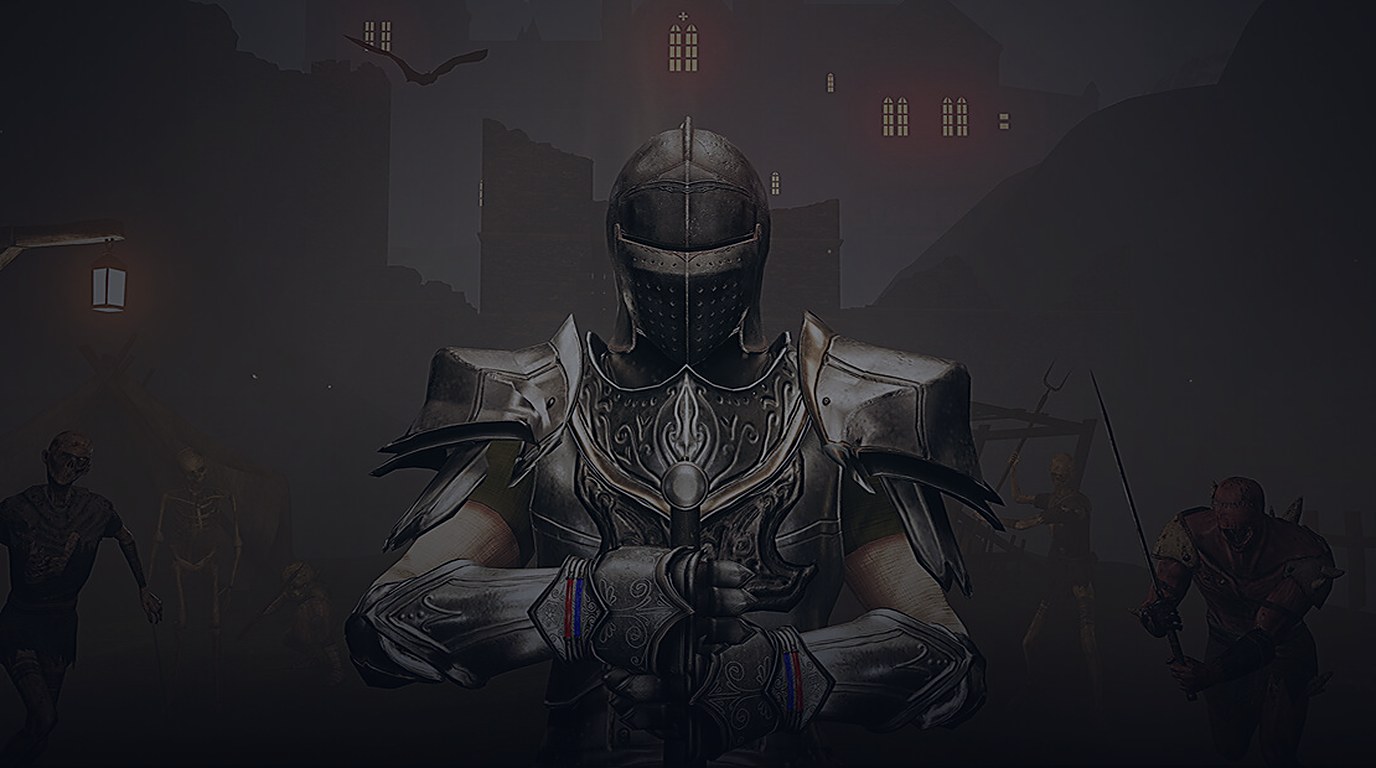
I spent a weekend swinging a two-handed sword at skeletons in my living room, and for the first ten minutes I felt like an idiot flailing at empty air. Then I caught a parry window — stepped in, met the skeleton’s overhead with an upward block — and watched its arm spin off into the dark. Suddenly I got it. Legendary Tales is a VR-native dark fantasy RPG that treats your arms as the weapon, not a mouse cursor with extra steps.
This isn’t a flat game with a VR toggle stapled on. Urban Wolf Games built it for the headset from day one — no injection drivers, no community mods, no emulator acrobatics. You buy it on Steam, the PlayStation Store, or the Quest Store and you’re in. On PC it runs through SteamVR (Index, Vive, Windows Mixed Reality, or Quest via Link), on PS5 it’s a PSVR2 title using the DualSense, and on Quest 3 and 3S it’s a standalone port that needs no PC at all. Full motion controls everywhere: your real controller swings dictate where the blade goes, parries are timed to your motion, and mage builds cast with hand gestures rather than menu clicks.
The pitch is “Dark Souls in VR,” and that’s not just a tagline. The combat is physics-driven in a way most VR RPGs only gesture at. A horizontal slash lands based on the actual arc your controller travels. A parry is a defensive motion you perform, not a button you mash. Co-op runs up to four players online with friendly fire enabled — so the warrior beside you can genuinely take your head off if you swing wild, which happened to me, and I deserved it.
Here’s the thing: the fighting is the entire argument for this game, and it’s a good one. When it clicks — trading blows with a shielded brute while your friend flanks and the friendly fire keeps every swing honest — that’s the VR fantasy a hundred flat-to-VR ports promise and never deliver. The crafting backs it up: you collect materials, forge weapons at a bench, brew potions through hands-on interactions instead of a recipe list. The skill tree is deep enough to support rogue, mage, warrior, or hybrid builds, and there are 15-plus hours of handcrafted dungeons, fully completable solo or co-op.
But I owe you the friction, because it’s real and it shapes the experience.
The movement is glacial. I’m not exaggerating for effect — next to something like Dungeons of Eternity, traversal in Legendary Tales feels like wading through cold syrup. There’s smooth locomotion with a mana-cost dash and no stamina system to make the pace feel deliberate, so the slowness just reads as slow. You’ll spend real minutes walking between fights, and the dungeon hub is linear enough that the world starts to feel like a corridor with monsters spaced down it.
The game is also dark. Not moody-atmospheric dark — under-lit. There’s a brightness slider, and it pulls the worst of it back at the edges but doesn’t fix the core problem: you’ll squint at floor textures wondering if that’s a trap or a shadow. Layer in occasional hitbox oddness — swings that clearly connect but don’t register, or ones that shouldn’t but do — and the polish sits a notch below what a full 1.0 action RPG probably should have.
None of that kills the melee. The swordplay is still the best argument for VR gaming I’ve handled in a while; there’s real weight to landing a clean hit, and the co-op friendly fire means every swing carries stakes. (It’s active arm work with smooth movement — if you can handle a standard VR action game, this won’t lay you out.) The depth is genuine too. This isn’t a tech demo with a sword bolted to it; it’s a real RPG whose systems reward a second run on a different build, and a third if the crafting rabbit hole gets its hooks in you.
Platform choice affects what you get. PCVR is the most mature build and has the “Dawn of History” expansion. PSVR2 launched alongside the full PC release and puts the DualSense haptics to good use — you feel the adaptive trigger resistance on a drawn bow. The Quest 3/3S standalone version is the newest and, per the developer, runs system updates not yet on the other platforms, so if you live on standalone Quest you’re on the leading edge here rather than the compromise tier. Quest 2 isn’t supported, which is worth knowing before you buy.
So who’s this actually for? If you’ve been waiting for a VR game that makes melee feel like you’re holding the weapon instead of waggling a stick, this is close to the best thing on the shelf. Bring patience for the pacing and a tolerance for dim dungeons, and the combat will carry the whole ride. If you need tight, fast action or a world that rewards exploration over fighting, the slowness will wear you down fast.
Legendary Tales is worth playing, with real caveats. The swordplay is genuinely excellent and the systems run deep, but glacial movement and murky visuals keep it from the dark-fantasy classic it’s reaching for. Play it for the combat, tolerate it for the rest, and bring a co-op partner who won’t accidentally parry your head off.