
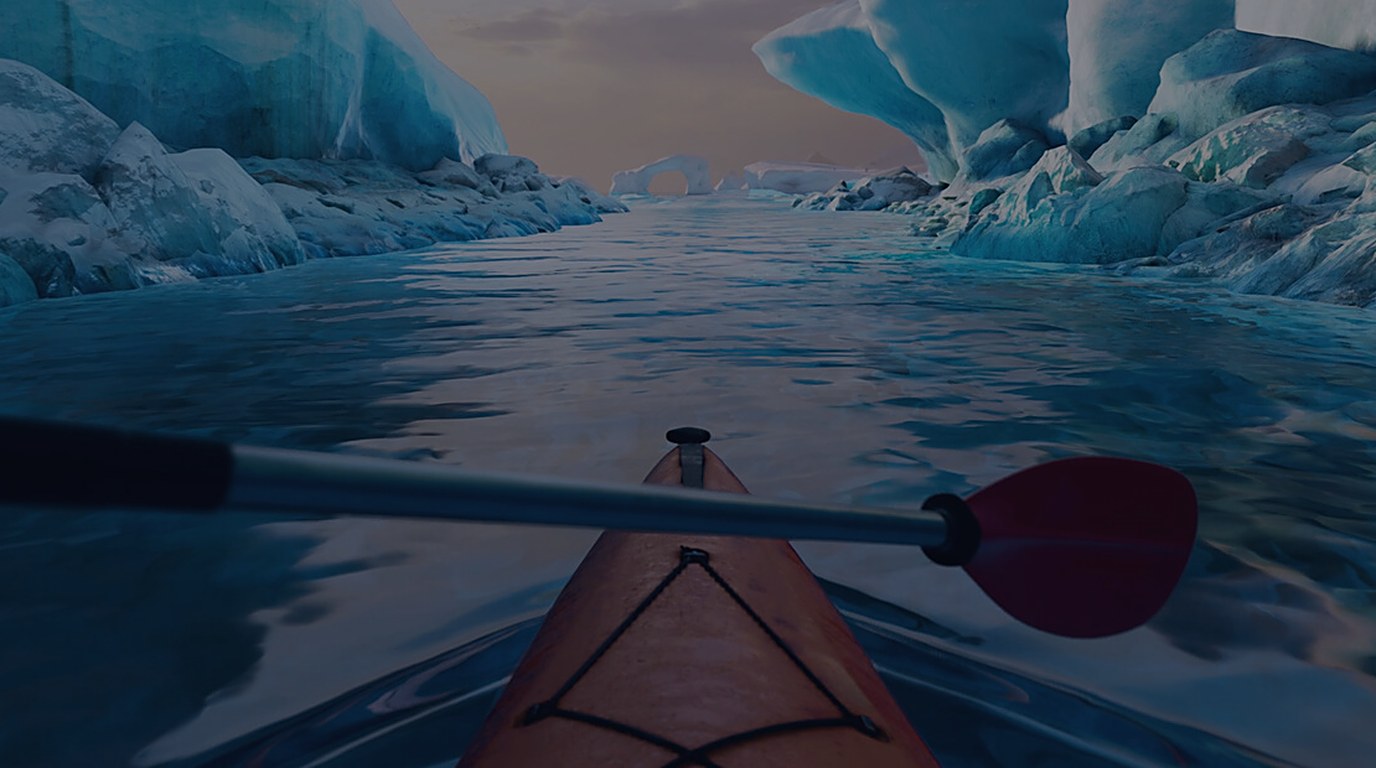
I’ve paddled a lot of virtual water in my time in the headset, and most of it looks like a screensaver with current. Then I launched Kayak VR: Mirage, pushed off from an Antarctic shoreline, and sat there for a full minute just taking in the size of the ice behind me. The scale is wrong in the best way — meaning it’s right, and my brain believed it. That’s the whole pitch in one frozen moment: this is what a kayak actually feels like, not what a trailer tells you it feels like.
What this is
Kayak VR: Mirage isn’t a flat game with a VR mode bolted on. There’s no monitor version. It was built from the ground up for VR by Better Than Life, a small Dutch studio, and it shows in the decisions that matter — full six-degrees-of-freedom head tracking, native stereo rendering, and motion-controller paddling that is the game, not a control scheme you can swap out. You buy it on Steam for PCVR or grab it on the PlayStation Store for PSVR2, install it like any other title, and you’re on the water in under a minute. No mods, no injectors, no profile hunting. It just is VR.
It landed on Steam in July 2022, and showed up as a PSVR2 launch title in February 2023 with Sense controller haptics and adaptive triggers feeding back through every stroke. Both versions are the same core experience: a kayak, real-world waterways, and you.
How it actually plays
You hold a controller in each hand and they become the paddle. Left blade, right blade, and the rhythm is yours to find. The physics are the quiet star here — lean into a forward stroke and the boat responds with weight, the wake trails behind you, and the spray behaves like spray. I spent my first session just paddling in circles off the coast of Costa Rica because the act of moving through the water felt earned rather than scripted. It’s a seated experience with vignette options for turning and collisions, and I never felt the need to bail.
There are two reasons to be out there. Free-roam is pure sightseeing: glide through Antarctica, Norway, Australia, and Costa Rica, and soak in environments that rank among the most convincing I’ve seen rendered in VR. The checkpoint racing and time-trial mode adds a goal — hit the gates, beat the clock, chase online leaderboards — and it’s where the paddling skill actually gets tested. Multiplayer exists too, if you want company on the water. Performance is the other pleasant surprise: this is one of the best-optimized VR titles I’ve run, holding a clean frame rate even on modest rigs, which is rare for something this pretty.
What’s genuinely good
Start with the visuals, because everyone does, and for once the hype is earned. The photorealism isn’t just texture resolution — it’s scale and light. A glacier feels like a glacier. A fjord feels like it could swallow you. That correct sense of size is the thing flat screens can never hand you, and it’s the reason this game gets used to show newcomers what VR is even for. If you’ve ever had to explain why someone should care about a headset, this is the thing you put on their face.
The motion-control paddling deserves equal billing. It’s not waggle-to-move; it’s a real simulated stroke, and the dual-controller implementation means your arms are doing the work your brain expects. On PSVR2, the adaptive triggers and haptics add a texture to each pull that makes the separation between “playing a game” and “paddling a boat” thinner than I expected from a small studio.
And the calm. Not every VR title needs to be a shooter or survival horror. Kayak VR is a place to be, and the absence of threat is the point. After an hour of racing gates and an hour of just drifting, I closed the session genuinely relaxed, which is not a sentence I write often about VR.
What doesn’t work
Here’s the honest catch: there isn’t much game under the water. You paddle, you race checkpoints, you look at pretty things. That loop is the entire package. There’s no progression system with teeth, no narrative pulling you forward, no mechanical depth that rewards mastery beyond shaving seconds off a leaderboard time. For a certain kind of player that’s perfect. For someone expecting a systems-heavy simulation, the shallowness will show within an evening.
The content, while beautiful, is also finite. Four launch locales plus a paid Soča Valley expansion that adds whitewater rapids — it’s a tight, polished slice rather than a sprawling world. You’ll see everything it offers, and then the question becomes whether the vibe is enough to bring you back. For me, the answer is “sometimes,” and that’s the difference between a beautiful showcase and a game I’d call essential.
Who this is really for
If you want a headset-justifying moment to show friends, or a genuinely peaceful place to spend an hour after work, Kayak VR: Mirage delivers something few titles bother to attempt. Skip it if you need deep systems or a long campaign — but don’t mistake its calm for emptiness. It’s the rare VR title that does one thing beautifully and doesn’t pretend to be more.