
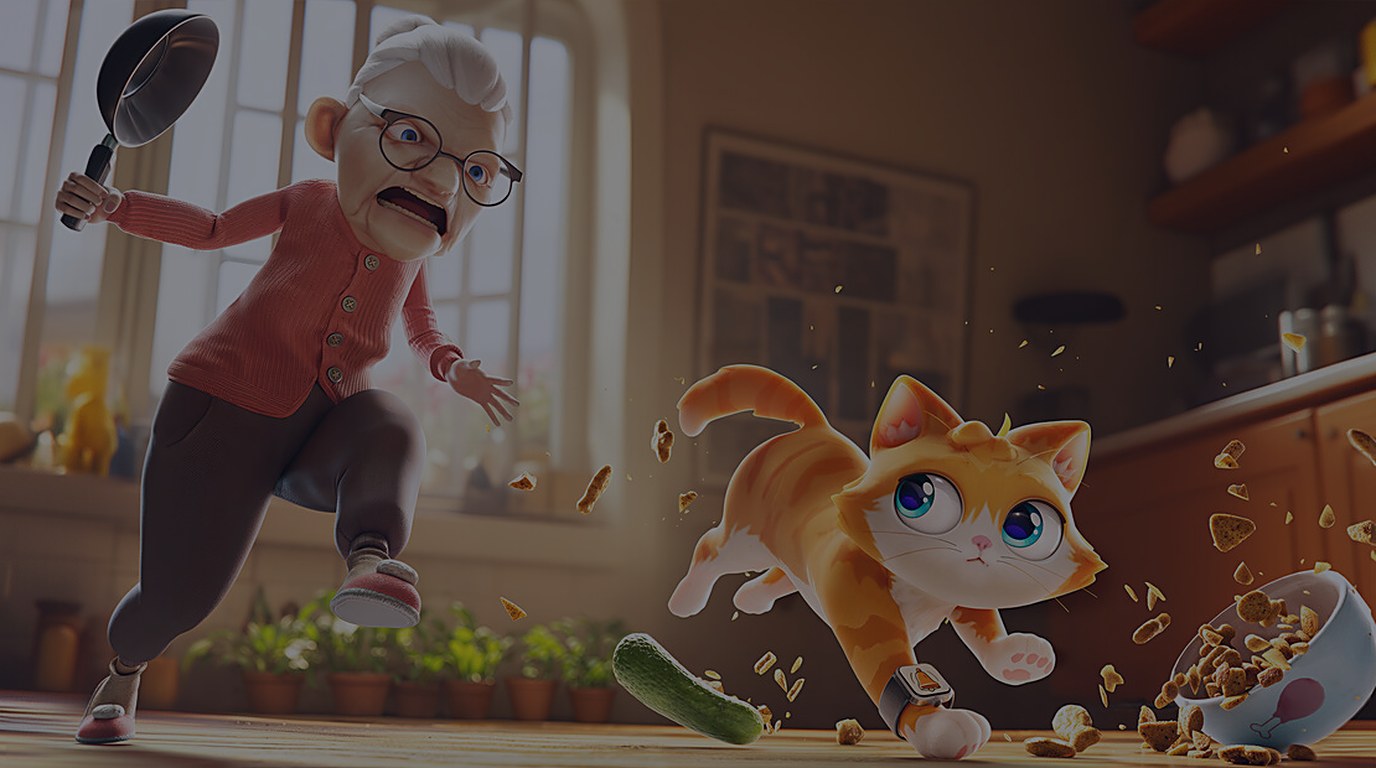
The first thing you do in I Am Cat is knock a cup off a counter. Not because the game tells you to — because you are a cat, and the cup is there, and your paw is right there, and the physics engine clearly thinks this is the funniest thing that has ever happened. It is. I knocked that cup off, watched it bounce, and felt something I don’t feel in most VR games: I was not playing a character, I was being a goddamn animal.
That’s the whole pitch, and New Folder Games actually delivers it. This is a native VR sandbox — no flat version, no mod, no injection trickery — where you live as a cat in Granny’s house. You explore, you cause physics-based havoc, you complete little cat quests, you play mini-games, and you evade Granny when she’s had enough of your nonsense. It landed on Quest App Lab as Early Access, and it’s also on SteamVR, so however you run VR, the cat is available. Setup is the kind of thing you tell your non-gamer relatives to do: open the store, hit install, put the headset on.
Being a cat is the whole game — and it works
Here’s what surprised me. The paws aren’t a gimmick you forget after ten minutes. You reach with each controller, bat at objects, grab and throw, cook, and chase. The house is loaded with stuff that reacts, so the simplest act — shoving a plate off a table with your forehead — becomes a tiny physics comedy you direct. That’s the core loop: find something, wreck it, see what happens, repeat. The motion controls are the reason it lands. If this were a gamepad roam with a reticle, it would be a tech demo. Because your hands are paws, it’s a toy you actually want to pick up again.
The house gives you room to be stupid. Football, basketball, catch-the-mouse — small games that sound thin but play better than they should because the act of being a cat doing them is the joke. Hide-and-seek with Granny adds a sliver of stakes: she’s the authority figure you’re defying, and the stealth of creeping behind furniture on four legs has more tension than the premise implies. None of it is deep. I’m not going to pretend there’s a narrative arc that’ll sit with you. But the structure keeps the chaos from feeling empty, which is the trap most physics sandboxes fall into.
Why it’s clicking with everyone
I don’t usually weigh view counts as criticism, but when comedy VR channels are pulling millions of views just from being terrible cats, that tells you something simple: people come back. This isn’t a one-and-done novelty you show a friend once. It’s a toy that generates its own stories — the clip of you “eating Grandma” or turning off gravity is the kind of thing you recreate, not watch. That repeat-play signal is real, and for a sandbox it’s the difference between a gimmick and a game.
It’s also one of the more family-friendly things on the platform. The tone is silly, not scary, and there’s no barrier to entry beyond “can you move your hands.” That’s a genuine asset on Quest, where a lot of the catalog assumes you’ve already survived a hundred VR shooters.
The catches
Let me be honest about where it thins out. The light structure is a feature and a limitation: you’ll never be lost, but you’ll also never be gripped. If you want a game with stakes, narrative momentum, or systems that deepen, this isn’t it. It’s a chaos box. Some sessions I put it down feeling like I’d had a great ten minutes; others I felt like I’d mined the joke.
The controls, for all that they sell the fantasy, aren’t precise. Paws slide, grabs miss, and the quadruped body doesn’t always go where your brain expects. That imprecision is part of the comedy, but it can also read as jank when you’re trying to do something specific. Like every four-legged VR game, the cat’s smooth gallop is the one thing that’ll bunch your stomach if you’re prone to VR nausea — worth a test before you let a kid or a motion-sensitive friend take the first run. It runs efficiently even on standalone Quest, so performance is not the thing that’ll bite you; your inner ear might be.
It’s Early Access, so expect the occasional rough edge — placeholder feel in spots, content that’ll clearly grow. That’s the deal right now, not a defect.
Who this is for
If you want a VR experience that makes people laugh in the room with you, or you’ve got a headset and a kid and want something that isn’t a gun, this is an easy yes. If you need your VR to be a serious game with a serious world, you’ll bounce off the shallowness fast. I keep coming back to it the way I keep a good stress toy around — not because it changed my life, but because being a cat for twenty minutes is a better break than most things on the store.