
The dog, the diorama, and the marching horde
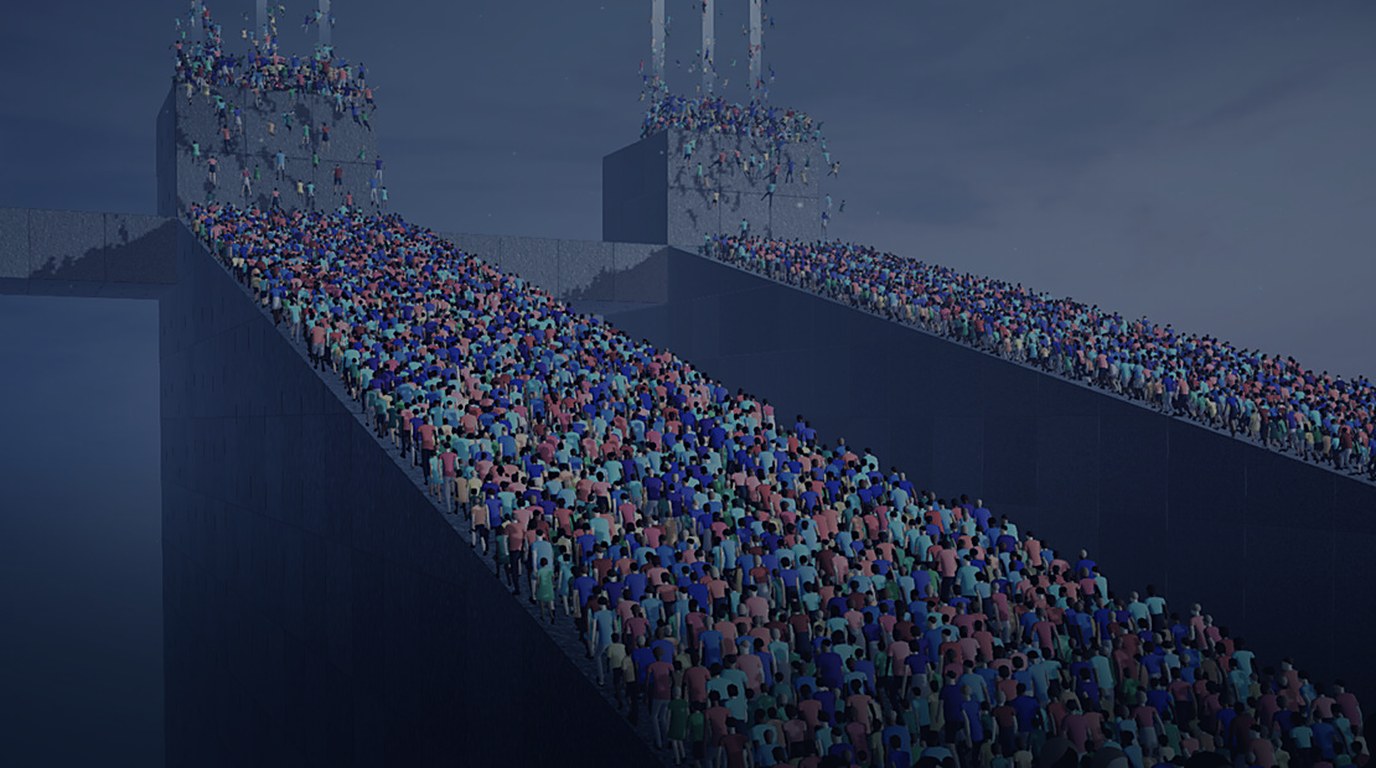
I put the headset on, launched Humanity, and within ten seconds I was a Shiba Inu standing over a glowing cube-grid world, watching a column of tiny humans march toward a glowing exit. You don’t control the people directly, you issue movement commands — turn left, flow right, jump, float, climb — and watch the swarm obey. It’s Lemmings rebuilt as a calm architecture puzzle, and the VR mode doesn’t change the game. It changes where you’re standing while you solve it.
Humanity is a tha ltd. puzzle game published by Enhance, the Tetsuya Mizuguchi studio, and it shipped on May 16, 2023 with an optional VR Mode baked into the same build on PSVR2, PSVR and PCVR. You didn’t buy a separate SKU. You bought Humanity, and the headset was one toggle away.
What the VR mode actually is
This is official, developer-built VR — not a mod, not an injection driver, not a community profile. The same copy of the game runs flat on your monitor or in your headset, and you can flip between them mid-save without losing progress. That’s the cleanest possible route to VR: no loader, no config file, no per-game profile to chase.
It covers the entire Story Mode campaign — 90-plus levels across themed collections, with the Goldies collectibles — plus the library of user-created community stages you can download in-game. The one real gap: the Stage Creator, the built-in level editor, is flat-only. If you want to build, the game drops you to a 2D view; you can’t sculpt stages from inside VR. For a game about routing crowds across a cube grid, that’s a genuine missed opportunity, but it’s a creation tool, not the game itself — the playing is fully in VR.
The option later expanded to Meta Quest standalone on March 14, 2024, so Quest 2, Quest 3 and Quest Pro owners get the same VR campaign with no PC and no Link cable. On every platform the VR mode is the complete game, not a trimmed port.
Peering into the cube grid
Here’s what actually happens when you play. The level sits in front of you like a tabletop diorama — a cube-based isometric grid you view from a fixed, table-scale distance. There’s no player locomotion; your body stays put and your head does the moving. You lean in to read a junction, pull back to see the whole flow, and twist the camera with your controllers to find the angle that makes the solution click.
The camera orbits and zooms via the thumbstick and face buttons on your motion controllers — Sense controllers on PSVR2, Index or Rift S controllers on PC, Touch controllers on Quest. It works, and because the grid is fully 3D, being able to physically crane your neck around a structure beats squinting at a flat screen. But it’s stick-and-button camera control, not the grab-and-drag manipulation that makes something like Little Cities feel native to VR. You’re steering a camera, not handling the world.
Why the headset earns its place
The puzzle design is the real draw, and VR serves it. Humanity’s levels are about reading spatial flow — which ramp funnels the crowd where you want, where a single misplaced command cascades into a hundred tiny bodies walking off an edge. On a monitor that’s a 2D read of a 3D space. In the headset the grid has actual depth, so depth-based solutions stop being guesses. I’d catch a path I’d missed flat because I could finally see the level’s layers instead of inferring them.
You’re a dog looking down on a swarm of thousands, and that god’s-eye vantage reads completely differently in stereoscopic 3D — the crowd has volume, the grid has weight, the exit glows in a way that pulls your eye. Outlets that covered the mode split on whether it justifies itself, but both sides agreed on the essentials: it runs well, it’s fully playable start to finish, and the puzzles translate cleanly into an environment you’re looking around inside rather than at.
The honest catches
The sharpest critique of the VR mode wasn’t about bugs — it was about ambition. Eurogamer’s Ian Higton called it a box-ticking exercise rather than a tailor-made way to inhabit the world, and there’s truth in that. The game never uses your body beyond your head and your hands on the sticks. For a diorama puzzle that’s defensible, but it means the VR is a viewing upgrade, not a reinvention. You won’t come out of a session feeling like you physically did something — you’ll come out having solved clever puzzles while peering into a satisfying little world.
Comfort is a non-issue for most. The design is inherently low-motion: fixed third-person view, no player locomotion, nothing whipping the camera around. One control gap worth naming came up on the PSVR2 version — there’s no direct vertical camera elevation; you can orbit and zoom but not raise or lower the view along the structure. It’s a minor irritation on tall stages, not a blocker.
The Stage Creator being flat-only is the other real caveat, and it shapes who this is for. If your plan was to build and share levels, VR doesn’t cover that half of the game. Play them in VR all you want — just don’t expect to author them there.
The platforms, briefly
If you’ve got a PCVR headset, that’s the most flexible build: switch between flat and VR at will. PSVR2 holds up well too — it pushes 120Hz with reprojection that’s basically invisible in a game where you barely move your head. The standalone Quest release means wireless players aren’t left out.
The verdict, as I see it
Humanity is one of the best puzzle games I played that year, and the VR mode is the best way I found to actually see it. The catch is that it’s the best viewing way, not a different game — the headset hands you depth, scale, and a diorama you can lean into, but it never asks your body to do anything the monitor couldn’t. That’s an easy recommendation for anyone who already loves a good spatial puzzle and owns a headset: put it on, lean over the grid, and let the swarm march. If you only wanted the campaign and couldn’t care less about stereoscopic depth, the flat version loses you nothing meaningful. And if your interest in Humanity was building stages, do that part on a screen — the VR is for playing, not authoring.