
I spent a solid ten minutes in Human Fall Flat VR trying to climb a ladder, and I never made it. Not because the game is broken — because my left arm, mapped to my actual left controller, spasmed at the worst possible moment and yeeted me across a gap I was only trying to step over. I laughed until my chest hurt. That, more than any score, is the whole pitch.
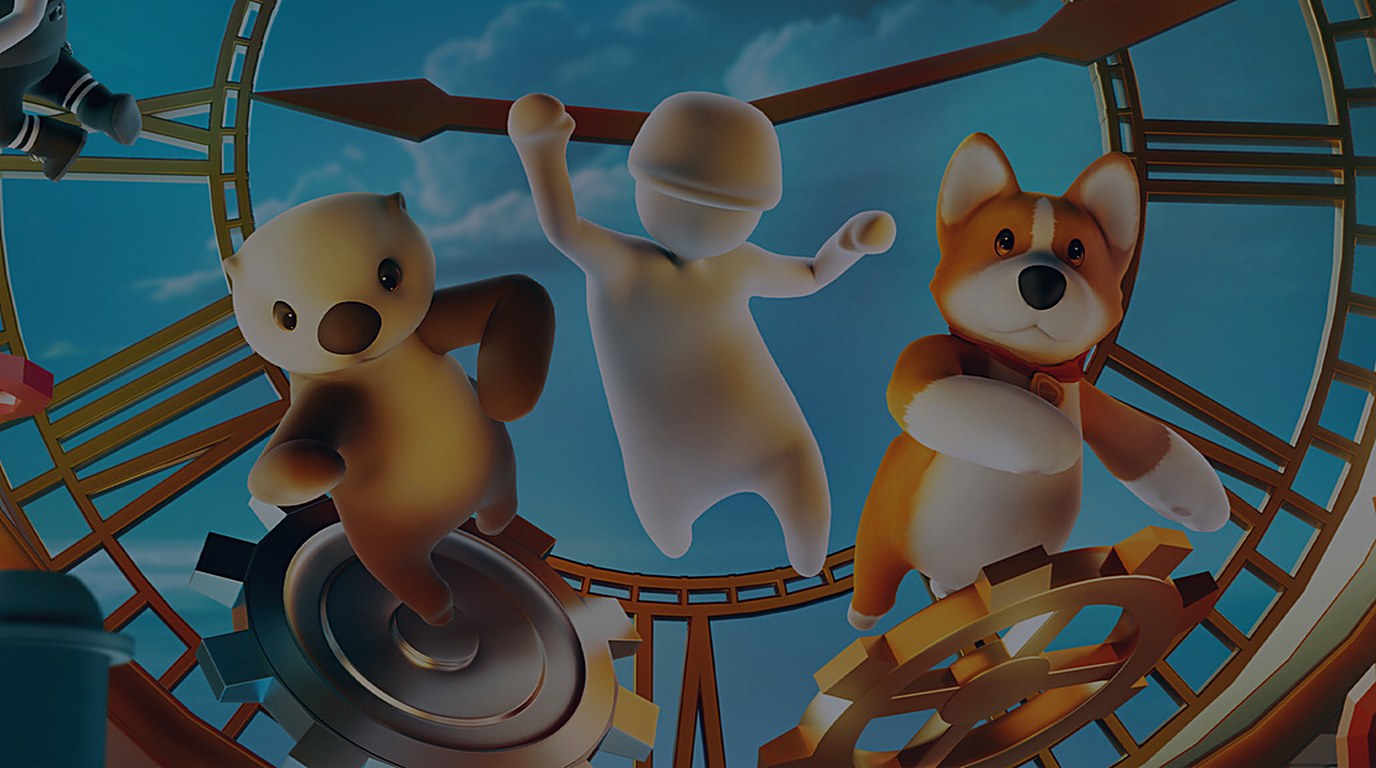
Human Fall Flat is the eight-year-old physics sandbox where you play a wobbly jelly man who cannot be trusted with his own limbs. The VR version, out now, isn’t a patch bolted onto the flat game. It’s a separate purchase, a ground-up rebuild from SneakyBox and No Brakes Games that landed on Quest, SteamVR, and PS VR2 at once. You buy it, you install it, you’re in. No setup tax, no dependency chain, no twelve-step guide. For a VR port, that’s worth saying on its own.
The signature call is third-person. The camera sits behind and above your guy, watching the disaster unfold, instead of cramming you inside his skull. That sounds like a step down if you came up on first-person VR, but it’s the right instinct. Human Fall Flat was never about inhabiting a space — it’s about watching a body betray itself, and the headset keeps you close enough to conduct the puppetry without drowning in it.
Your arms are mapped to your controllers. You reach out, you miss, you flail, and when you pull the triggers you grab whatever your hands have fumbled into. UploadVR called it playing like a digital puppeteer, and that’s the exact feel: you’re not pressing a button to grab, you’re yanking a marionette string and hoping it’s attached to the right thing. Two dedicated buttons do the rest of the comedy. One leans your guy forward so he topples into a push. The other makes him go completely limp, which is the single funniest input I’ve pressed in VR this year — a slow-motion trust fall off a ledge, limbs splayed, is its own reward.
There’s real physicality here. Swinging across a gap means actually swinging your arms. Hauling a crate means actually hauling. The flat game asked you to mime these with a stick; the headset puts your shoulders in the joke. The comedy isn’t described to you, it’s performed by you, and that’s the part that survives contact with actual play. It runs clean on every platform it shipped on, and the comfort options are a proper tunable set, so the motion sickness a few players hit during the heaviest swinging stays a manageable note rather than a wall.
What actually works
The headline is four-player online co-op. You and three friends drop into the same wibbly levels and immediately start sabotaging each other’s solutions, which is the entire point of the flat game and translates almost untouched. Someone grabs the wrong ledge on purpose. Someone goes limp at the worst moment. The third-person camera means you can actually see your friends failing next to you, which a first-person view would hide behind your own hands. That efficiency is the real point: the barrier to a couch co-op session is everyone owns a headset, and then you’re off.
Content is the full original campaign plus a wide selection of Extra Dreams built by community creators. If you played the flat game to death, the community levels are where the VR rebuild earns its keep — fresh puzzles, same unreliable body. Solo works too; the game was always a sandbox you could pick at alone, and nothing about the VR rebuild breaks that.
Where it wobbles
Here’s the honest catch, and it’s not comfort. The puzzles were designed for a version of this game where the body was an obstacle you steered with a stick. In VR, where your own arms are the obstacle, some solutions that felt clever flat now feel like they were tuned for a different control scheme. A few levels want a precision the puppet simply won’t give you, and you solve them by accident while fighting your own grip more than the puzzle. That’s not a dealbreaker — the chaos is the charm — but it’s the ceiling. The rebuild is a faithful translation, not a redesign, so the occasional level that assumes stick-precision will frustrate before it delights.
The other wobble is the thing you already know if you’ve played any Human Fall Flat: there’s no story pulling you through. It’s a sandbox of disjointed dream levels, each a self-contained gag. You show up, you fall, you solve or you don’t, you move on. That’s the genre, not a flaw, but don’t come looking for a world to inhabit. The headset makes you the joke; it doesn’t put you somewhere.
How it got here
The official port didn’t drop from nowhere. The VR version the fans were already building in the garage. Raicuparta — the modder behind the Outer Wilds and Firewatch VR fan projects — has gone on record saying he started an unreleased Human Fall Flat VR mod and shared early footage before the studio picked up the idea. That lineage is why the rebuild feels like it understands the comedy instead of bolting VR onto a flat game it half-remembers. This is a studio that watched the community try to solve the problem and then solved it properly.
One footnote worth knowing before you buy: there’s an experimental first-person mode on the Steam version, pulled from a beta branch. It’s a work-in-progress prototype, single-player only, and the studio has flagged it may never graduate past that phase. Don’t buy the VR version because you want first-person co-op — that mode is a curiosity, not a feature, and the third-person puppeteering is the real game anyway. If first-person is your hill, wait and watch; if you just want to fall over with friends in a headset, you’re already holding the finished thing.
The bottom line
Human Fall Flat VR is the rare port that’s genuinely better in the headset than on a monitor, not just different. The arm-mapped controls turn a game about unreliable bodies into something you perform rather than watch, the co-op is intact and louder for it, and it runs clean on every platform it shipped on with a setup burden of zero. The third-person view is a design choice that serves the joke, not a compromise you’ll resent.
It’s an easy yes for anyone who already loved the flat game, and a strong maybe for co-op fans who’ve never touched it — grab three friends and prepare to sabotage each other. Just don’t come hunting for a world to live in. For a physics comedy, the headset doesn’t just show you the joke, it makes you the joke. That’s worth the price of entry on its own.