
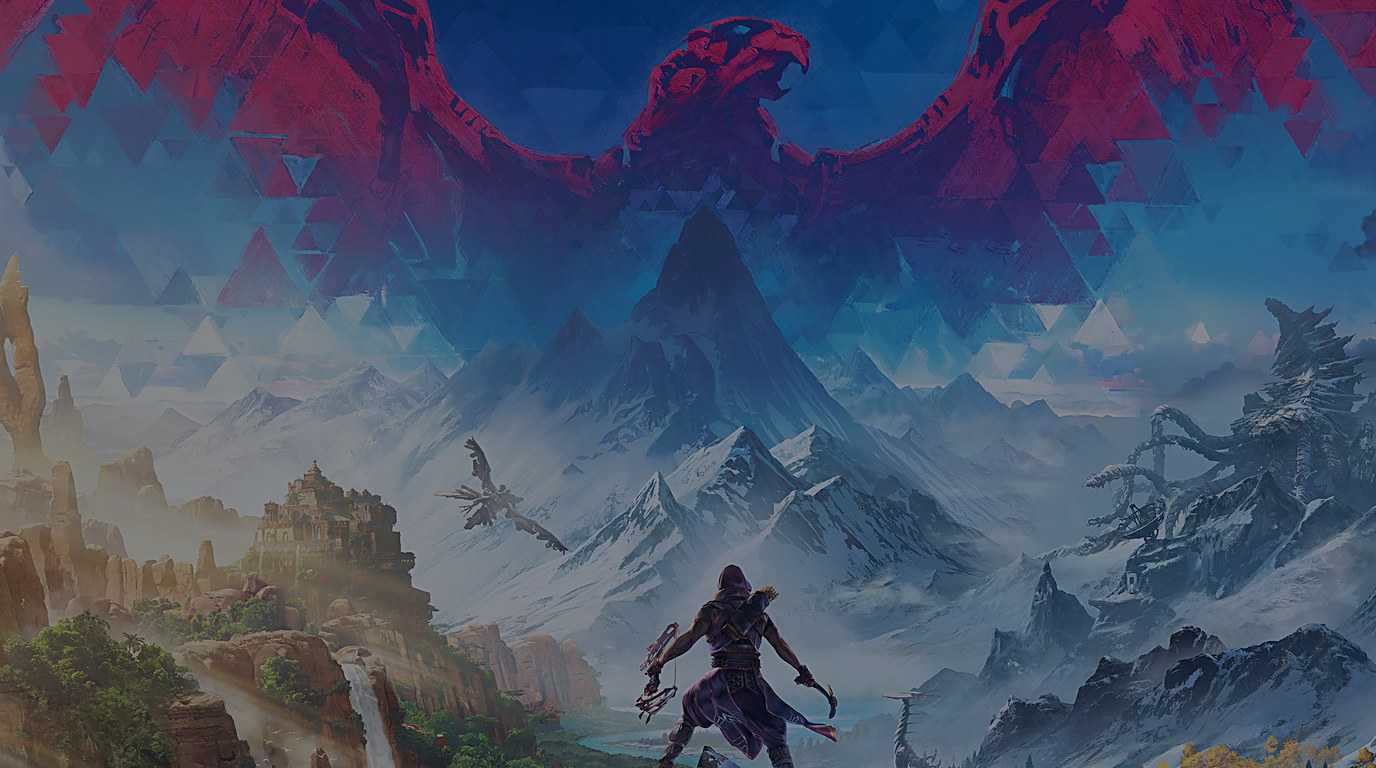
The Mountain Owns You From the First Grip
I grabbed a handhold, pulled, reached for the next one, and the cliff dropped away below me into a haze of pine and machine smoke. For a second I forgot I was standing in my living room. That’s the trick Call of the Mountain pulls off in its opening minutes: it doesn’t announce itself as a tech demo, it just puts your hands on rock and dares you to look down.
Horizon has always been a game about scale — the dead cities, the thundering robots, the sense that something enormous happened and you’re picking through the bones. On a flat screen that scale is a postcard. In the headset, with your own arms doing the climbing, it’s a place.
A Native VR Title, Full Stop
This is not a port and there is no flat version hiding underneath it. Call of the Mountain was built from zero for PlayStation VR2 on PS5, co-developed by Guerrilla — the studio that made the Horizon world — and Firesprite, who handled the VR execution. You play Ryas, a disgraced former Shadow Carja soldier and master climber sent to investigate a signal that’s enraging the machines. Aloy shows up in a supporting role, but this is Ryas’ story.
Because it’s native, there’s no setup saga. You own a PS5 and a PSVR2, you buy the game, you play. No dependencies, no injector, no config file to edit at midnight. That’s the right call for a launch title — the barrier to your first climb should be “press start,” not “read a forum thread.”
The game runs in Unreal Engine 4, tuned to use the PSVR2’s eye-tracked foveated rendering and the Sense controllers’ haptic feedback. When you draw a bow, the resistance is in your hand. When a machine roars past, the headset vibrates. It’s the kind of integration that only exists when the VR hardware and the game are built in the same breath.
Your Hands Are the Whole Game
The signature mechanic is climbing, and it’s pure motion control. You physically reach, grip, and pull with both Sense controllers. There are multiple movement schemes built in for different comfort tolerances, including options that keep you from full-body vertigo on the long vertical stretches. I kept it on the most physical setting because that’s the point: the climb is the experience, not a loading screen between fights.
When you’re not on a wall, you’re hunting. The bow combat is the same reach-draw-release loop you’d expect from a Horizon game, but here the draw is your real arm. You nock an arrow, pull the string, and loose it at a Grazer or a Snapmaw. It feels earned in a way the flat games never quite landed.
The set pieces are where it pays off. One sequence drops you onto a moving raft while a Tremortusk bears down, and you’re reloading, swatting watchers, and trying not to fall overboard all at once. Another puts you face to face with a Thunderjaw and you spend the fight scrambling between cover and landing arrows in its disc launcher. These are the moments the game was built around, and they deliver.
What Lands
Start with the world. Firesprite and Guerrilla rendered the Forbidden West hinterland with a density that reads completely differently in stereo. The lens flare off the OLED panel, the machine fur catching light, the way a valley opens up when you crest a ridge. It is the best-looking thing I have put on a PSVR2 headset, and I say that having spent real hours in the launch library. This won two awards for a reason: Best VR Game at the Golden Joystick Awards and the Immersive Reality Technical Achievement award at the D.I.C.E. Awards.
The physicality is the other win. Climbing a cliff by actually climbing it is a better game than pressing a button to climb. The bow feels like a bow. The haptics make machine hits register in your palm. For a VR enthusiast who has spent years strapping machines to their face and hoping the developer bothered, this is a studio that bothered.
Where the Cliff Gets Thin
The campaign is short — you’ll finish the story in somewhere around seven hours, and that’s if you slow down to admire the view, which you should. More than that, the structure is a rail. You go where the game points you, the climbing is gorgeous but mechanically repetitive (reach, pull, reach, pull, swing, repeat), and the bow combat, while satisfying, leans on a small roster of enemy types. After the Thunderjaw spectacle, the back half starts to feel like the same climb with a different backdrop.
Critics landed in the same place: generally favorable, with the visuals praised and the linearity and climbing repetition flagged as the real reservations. That’s a fair read. The game is a showcase first and a deep action-adventure second. If you came expecting the systemic openness of Forbidden West, you’ll feel the walls close in.
There’s also the platform question. This is a PSVR2 exclusive. No PC build, no Quest port, no path to play it without Sony’s headset and console. That’s not a quality judgment — the experience in the headset is what it is, and it’s strong — but it does mean the audience is the audience that already bought into PSVR2. I’d love to see more people get at it, but the version that exists is the version worth talking about.
The Verdict From the Ridge
Call of the Mountain is the Horizon concept finally meeting the hardware it deserves. The world is gorgeous, the climbing is the most physical I’ve done in VR, and the machine hunts are the kind of set pieces I’ll tell friends about. It’s short, it’s linear, and the climbing rhythm wears thin by the end — those are real caveats. But for a PSVR2 owner, this is the reason the headset earns a corner of your living room. If you’ve got the hardware, climb it. If you don’t, this is one of the games that makes the case for getting it.