
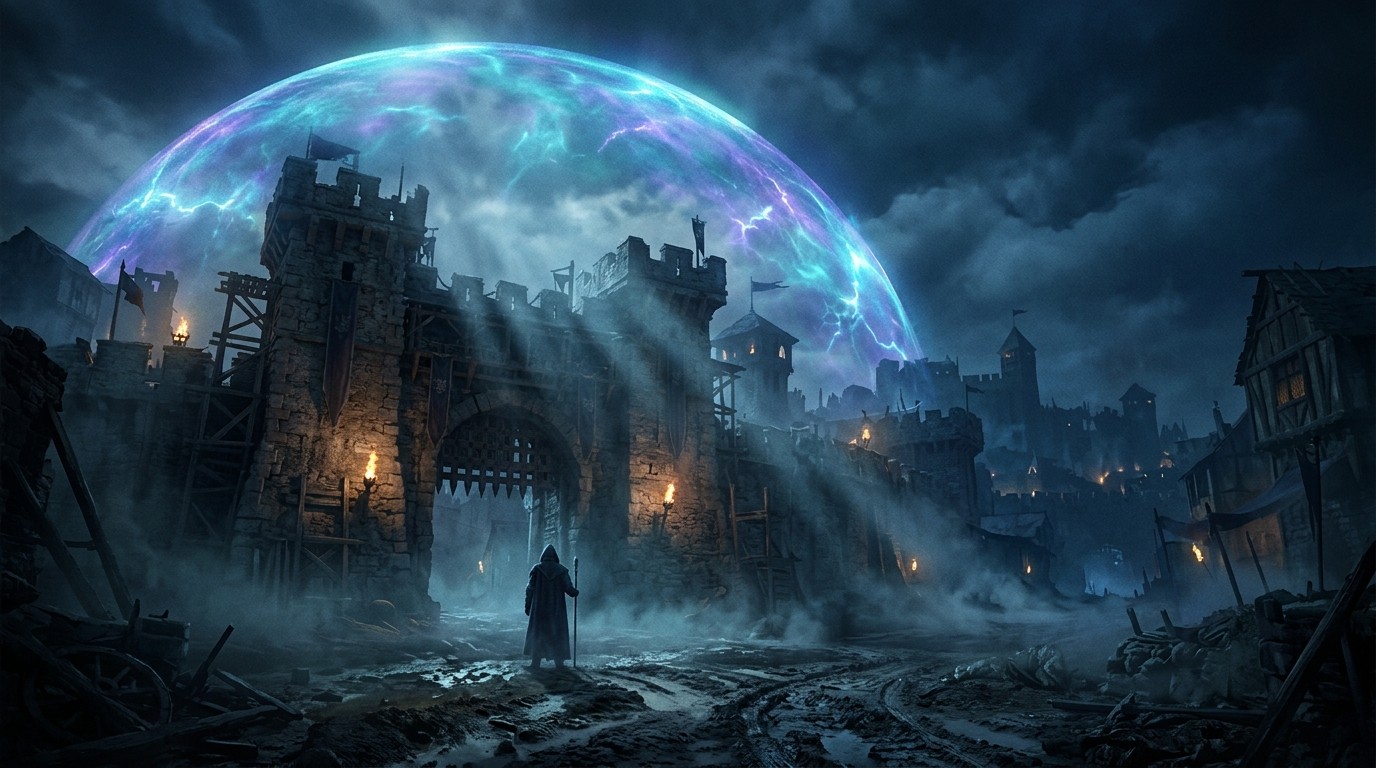
Standing at the foot of the Old Camp gate in VR changes something. In flat Gothic, the Barrier is a skybox and a loading screen away from the next cave. In a headset, that glowing dome is above your actual head, the mud is under your boots, and the guy demanding protection money is close enough to count the polygons on his teeth. After more than two decades, the colony is finally becoming a place you can step inside.
The catch: there is no official VR. THQ Nordic has never shipped headset support for either the 2001 original or the 2026 remake. So every option is community-built, and none of them is a finished product. If you want the classic game, your best path is Gothic-UnZENity, a native Unity rebuild that reads the original game’s assets at runtime. If you want the remake, your only path is UEVR, Praydog’s Unreal Engine VR injector. There is also a VorpX profile for the original, but the person who wrote it literally tells you not to use Full VR.
The Real Option for the Original: Gothic-UnZENity
This is the project that made me stop scrolling and start paying attention. Gothic-UnZENity does not manually port levels or textures into Unity. It uses the ZenKit parser to load the original Gothic data files directly, so the world you walk through is the real Old Camp, the real Swamp Camp, the real Sleeper Temple — just rendered inside a modern engine with proper 6DOF tracking and motion controls.
What that means in practice is: you can explore the entire map, pick things up with your hands, climb ladders rung by rung, and feel like you are physically standing in one of the most atmospheric RPG worlds ever built. The team has been open about what is still missing — sword combat and spellcasting were not fully implemented when I was looking at recent builds — but the foundation is unusually solid for a volunteer project. They also clearly care about comfort: smooth locomotion is available, teleport is available, and ladder climbing has a comfort fallback. For an old, camera-relative RPG being rebuilt for VR, that thoughtfulness matters.
The setup is not drag-and-drop. You need a copy of Gothic 1, you need to download the alpha build, and you need to point the application at your install. It is not expert-only territory, but it is also not a Steam Workshop one-click. Treat it like an early-access mod, because that is exactly what it is.
The Older Attempt: GothicVRProject
Before Gothic-UnZENity, the same community effort lived under the GothicVRProject name. It was the solo proof-of-concept that grew into a team, built a functioning Unity prototype, and then split. The Unity branch released one alpha in February 2025 and immediately marked itself discontinued. The remaining team pivoted toward building VR functionality for the Unreal Engine 5 Gothic Remaster.
That branch is not publicly playable yet, so it is not a practical option today. But it is worth knowing about because it explains why there are two separate projects with confusingly similar names. Gothic-UnZENity is the one you can actually download.
The Real Option for the Remake: UEVR
The 2026 Gothic 1 Remake runs on Unreal Engine 5.4, which means Praydog’s UEVR can inject 6DOF VR into it the day it launches. Community reports say it works out of the box, and footage confirms the remake’s dense, painterly colony looks genuinely impressive in a headset. This is currently the only way to experience the remake in VR.
It is, however, an injector, not a port. The UI is still a flat-screen menu floating in space. Comfort options are whatever UEVR and your headset runtime give you, which is to say: not much by default. The camera is a mix of first-person presence and third-person legacy logic, because the remake itself is a third-person action RPG. Combat and climbing that were designed for a gamepad do not magically become motion-controlled just because you are wearing a headset.
Performance is also a real concern. UE5.4 with Nanite in VR is not gentle hardware. You will want a high-end PC if you want stable 90Hz without reprojection. A mid-range rig can run it, but expect to trade supersampling and crowd density for comfort.
The Not-Really-Option: VorpX
There is a VorpX profile for the original 2001 Gothic. It uses DGVoodoo2 to wrap the old DirectX renderer and feeds the result into VorpX as G3D/Z3D geometry 3D. The author of the profile themselves notes that “Full VR is not recommended.” That tells you everything. This is a way to look at a 3D-ified version of the flat game inside a headset, not a way to live in the colony. I would skip it unless you are specifically curious about how the old game looks with depth.
What Actually Works Right Now
If you own the original Gothic and want the best possible VR version of it, Gothic-UnZENity is the project to watch. It is not finished, but what is there already has more genuine VR design — hand interaction, comfort locomotion, ladder climbing — than most fan projects ever reach. The fact that it loads the real game files instead of hand-rebuilding everything also means texture packs and script mods from your Gothic install should mostly carry over. That is a big deal for a community as mod-happy as this one.
If you bought the 2026 remake and want to see the colony in VR today, UEVR is your path. It is rougher, more demanding, and less comfortable, but it exists and it functions. Just go in with the right expectations: you are injecting VR into a flat third-person RPG, not playing a native VR remake.
The real headline is that Gothic has become a genuine multi-route VR story. Two different games, two different paths, neither perfect, both playable in a headset. For a series that spent twenty years locked to a monitor, that is a hell of a thing to see.