
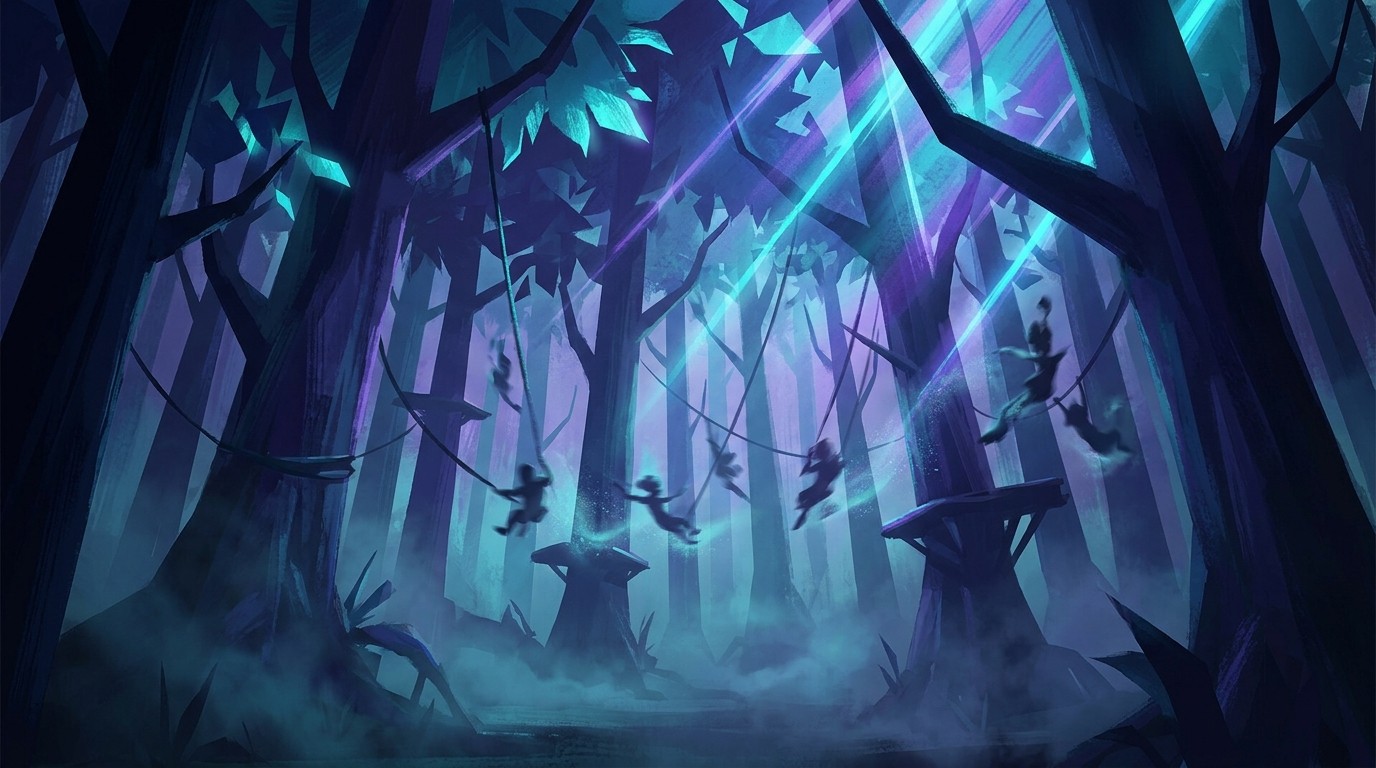
The first time you play Gorilla Tag, you will fall on your face. Not in the game — in real life, because you leaned into a wall-run that your arms were absolutely not strong enough to sell. There is no controller stick movement here. There are no legs. You are a torso with two very enthusiastic arms, and the only way anywhere is to slap your hands against a surface, push off, and pray your momentum carries you to the next tree. It is the stupidest, most physical, most genuinely joyful thing I have done in a headset this year.
Here’s the thing: Gorilla Tag should not work. It’s a low-poly arena where you and a handful of other apes chase each other in tag, infection, and a slingshot paintball mode. The textures are flat, the maps are simple, and there is no story, no progression, no reason to be there except the movement. And the movement is everything. You don’t steer a character — you become an animal that flings itself around with pure upper-body panic. Within ten minutes I went from faceplanting against a stump to launching myself across a canyon on a half-decent baseball slide of momentum. The skill ceiling is ridiculous, and reaching for it is the entire game.
Two ways in, one monkey
On Quest it’s free and sitting in App Lab (or sideloadable if you were early). You download it, you’re in. On Steam it’s early access at $19.99 for the PCVR crowd — same game, oddly paid versus free on Quest, but the Steam side is where the modding lives, and it supports full body tracking on an Index if you want to look like a complete ape from the waist down. Both pools cross-play, so you’re never hunting for a lobby. Quest is the beginner path: zero configuration, spawn in a tree hub, walk out into the chaos. PCVR is moderate setup if you’re already running SteamVR, and it’s the route you want if custom maps and cosmetic mods are your thing.
The game has no menu to speak of. You materialize in a tree, drop into a lobby, and the voice chat is already on — proximity-based, so the kid three feet from you in virtual space is already yelling about being “it.” That’s the second pillar: it’s a social toy, not a game with a chat box bolted on.
What actually makes it good
The locomotion is the headline and it earns it. Pushing off surfaces, squeezing to climb, flailing to build speed — it reads as absurd and plays as a workout. UploadVR handed it Best Competitive Multiplayer this year, and I get why. No other VR title makes me sweat and laugh this hard for free. The modes are thin but they don’t need to be deep: infection (one lava monke, everyone scatters) is pure panic, hunt gives you a personal target, paintbrawl is team slingshot warfare. The maps — forest, cave, canyon, city — are readable low-poly spaces that keep your eyes on the movement, not the draw distance. Performance is efficient; this runs clean on a standalone Quest.
Cosmetics run on Shiny Rocks, earnable free at 100 a day or bought, and the shop rotates. Nothing gates play. You can be a naked ape forever and lose nothing but style.
The catches, stated plainly
Comfort is the honest one. The movement is fast, chaotic, and entirely arm-driven, with no comfort options — no vignette, no snap turn, no alternative. If smooth VR locomotion already makes you queasy, this will find out. TechRadar called the movement potentially nauseating, and they’re not wrong; I’d steady my swings before I learned to trust them. It is manageable once you adapt, but it is a real wall for sensitive players, not a footnote.
The other catch is the crowd. Voice chat is on by default and the playerbase skews young — this is a schoolyard with headsets, not a curated lobby. It’s funny as hell and occasionally annoying. Cross-play means you’re never alone, but it also means you’re never filtering who you’re alone with.
Later, on other headsets
It eventually landed on PSVR2 as a free port, which is the right call for a game thisPhysical — though at launch it didn’t cross-play with the Quest crowd, so those lobbies are smaller and isolated. The low-poly look doesn’t show off the headset’s muscle, but the game never needed pretty.
Bottom line
Gorilla Tag is the rare free VR title that justifies the headset through physical comedy alone. You will sweat, you will faceplant, you will absolutely hear a seven-year-old call you out by proximity voice. If fast, arm-driven movement and a loud young community don’t put you off, it’s an easy yes. If motion sickness hits you easily, respect the intensity before you swing.