
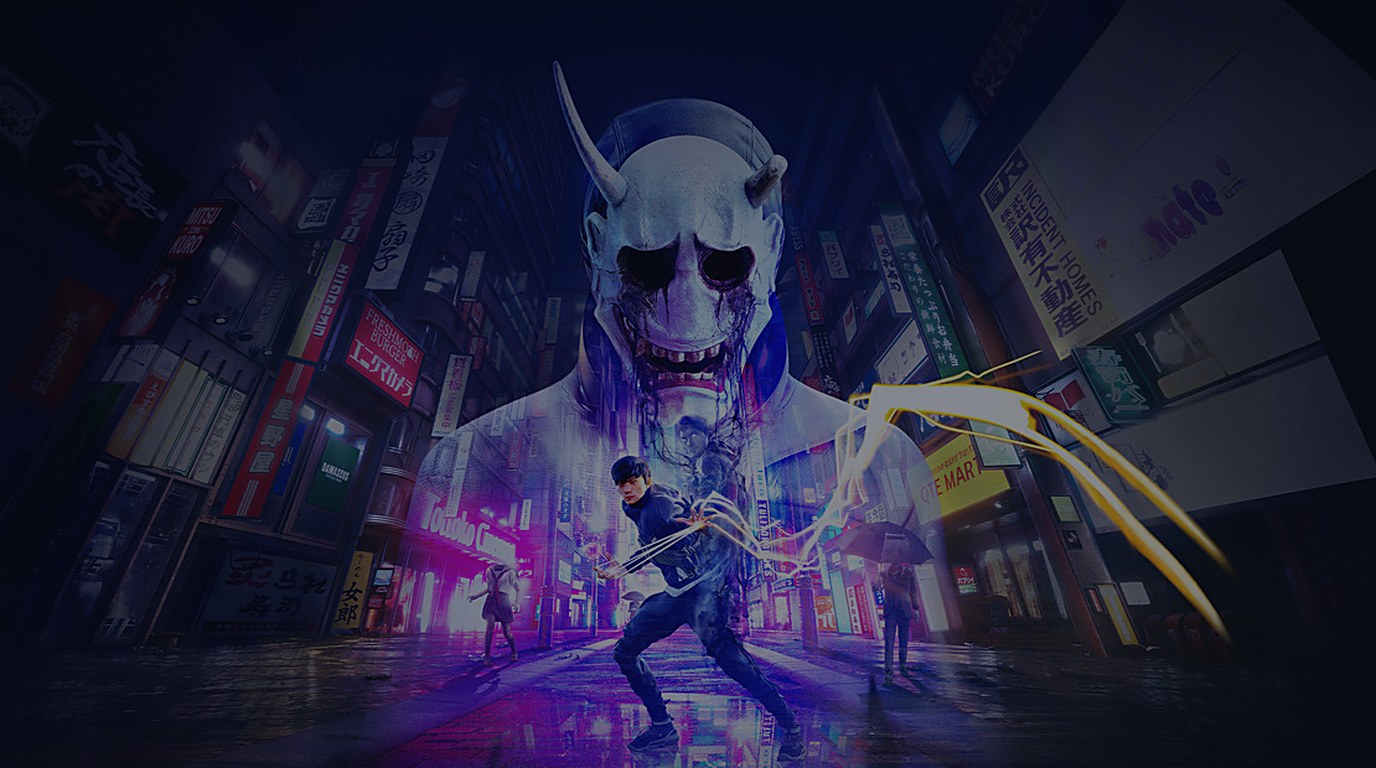
I spent a rainy Sunday night in a headset, standing at the center of a deserted Shibuya crossing, watching a visitor spirit drift through the haze with its arms outstretched. Ghostwire: Tokyo’s empty, supernatural Tokyo is the kind of place that was practically begging for VR — and thanks to the community, you can actually stand in it.
There’s no official VR mode for Ghostwire. None. Every way to play it in a headset is community-built, and there are three of them, each a different technical approach. The one you want is Luke Ross’s R.E.A.L. VR — a framework conversion that’s been quietly maintained since 2023 and gives you proper 6DOF head tracking. The other framework option is an open-source UEVR profile that landed in August 2024; it’s free, it works, and it rides on praydog’s injection. Then there’s a VorpX profile from launch week that’s been dead in the water since spring 2022 — broken positional tracking, fog rendering in one eye, abandoned by its creator. Skip it. The real choice is R.E.A.L. VR or UEVR, and both are PCVR-only.
Three ways in, one worth using
R.E.A.L. VR is the mature path. It’s the one with game-specific fixes in its release history and an overlay you tune to taste. Setup is moderate: drop the package into the game directory, run the game, configure the overlay. Not click-and-play, but not a weekend project either. UEVR is the lighter lift — install the injector, grab the profile, inject at launch — and because it’s free and open-source, it’s the easier entry point if you just want to see Tokyo in 3D tonight. The VorpX attempt doesn’t belong in the conversation; it was never finished and the core tracking is broken.
What you’re actually holding
Here’s what you get: a first-person game rendered in stereoscopic 3D with full head tracking. You look around a fog-choked, paper-doll-haunted city and the scale lands — the crossing feels wide, the narrow alleys feel close, the spirits feel like they’re in the room with you. What you don’t get is your body. Combat is gamepad-driven. Those hand gestures Akito makes to weave elemental spells — the kuji-kiri signs, the wrist-flick casting — are animated by the game, not by your hands. You’re pressing buttons and watching the character cast. It looks like motion control from a trailer; in the headset it’s a controller.
One honest catch: Ghostwire was never authored for VR comfort, so its fast camera swings and vertical traversal can be rough, and there’s no vignette or snap-turn to lean on.
Performance is the other real tax. This is a demanding UE4 game — Tokyo’s volumetrics, reflections, and dense particle effects will bury a mid-range PC in VR. You’ll want a high-end rig, and you’ll disable ray tracing immediately. Even then, expect to drop resolution and effects to hold framerate during the busier spirit fights, and UEVR stacks its own overhead on top of the native render.
The city is the whole point
The reason to do this is the place. Ghostwire’s Tokyo — emptied by a supernatural veil, lit by red torii gates and drifting visitors — is one of the most atmospheric spaces in modern gaming, and first-person head tracking turns “looking at a screenshot” into “standing in it.” Climbing a skyscraper and looking out over a fog-shrouded Shibuya at night is the moment the whole effort pays off. The investigation loop — cleansing torii, following spirit threads, uncovering what happened to the city — reads completely differently when you’re physically turning your head to scan a rooftop instead of nudging a mouse. That’s the transformation: not new mechanics, but a world that finally has volume. The story underneath (a man and a ghost sharing a body, hunting the figure who emptied the city) gives you a reason to keep walking, and the quiet, eerie streets are the part that sticks.
Where it hits a wall
The gamepad leash is the ceiling. You move with a stick, you cast with face buttons, and the spell gestures that should feel like magic feel like a cutscene you’re triggering. There’s no motion-control option on the mature path, and while the UEVR profile has scattered reports of partial 3DOF support, it’s unverified and not something I’d build expectations around. So the combat — which is the loudest, most frequent thing you do — never stops feeling like you’re playing the flat game with a headset bolted on. The atmosphere is native; the interaction isn’t.
Then there’s the friction tax. Version compatibility matters — game updates have broken VR support before, so you’re at the mercy of both Tango’s patches and Ross’s follow-up fixes. Note for context: there’s no official VR mode because the studio was shut down, so don’t expect a first-party fix to appear. And the VorpX path is a graveyard — if a guide points you there, keep walking.
This is a “put the headset on for the place, not the play” experience. If you’ve got a capable PC and you want to be inside one of the best-realized haunted cities in games, Ghostwire in VR delivers a genuine sense of presence the flat version can’t match — and R.E.A.L. VR or UEVR will get you there without drama once it’s set up. If you need motion controls, comfort options, or a flawless native port, this isn’t your game, and it never will be. But for an atmospheric evening in a dead Tokyo, the framework injection is more than good enough.