
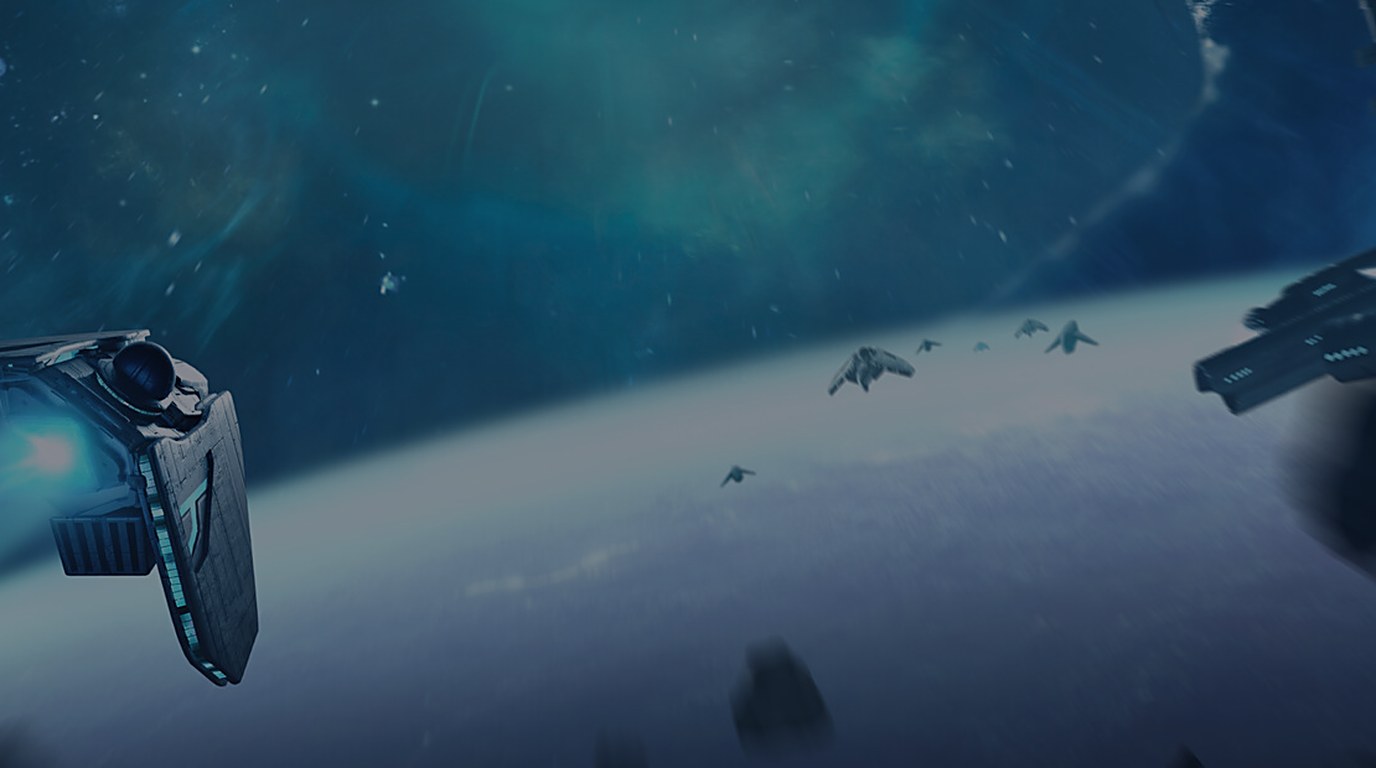
Most VR space games want your face pressed against the canopy, hands on the stick, living inside the cockpit. Ghost Signal does the opposite, and it’s a better game for it. Fast Travel Games built this thing as a third-person “diorama” — your starship, the Aurora, sits in the middle of a floating battlefield you view from above and behind, like a commander leaning over a holographic war table. You run the whole fight from outside the ship, with your hands.
There is no flat-screen Ghost Signal. This is a VR-native spin-off of Paradox’s grand-strategy beast Stellaris, but don’t let the license fool you — there’s no galaxy map, no bureaucracy, none of the spreadsheets that make Stellaris what it is. What’s left is the flavor: weird space monsters, shield-and-hull attrition, the quiet dread of dropping into an unknown sector. And it’s one of the most compulsively playable roguelites I’ve worn a headset for.
A roguelite that sits you in the captain’s chair
Each run drops you into a randomized sector map — a chain of nodes you pick between, risk-reward style, choosing whether to dive into a fight, grab loot, or bank a quiet repair stop. You captain the Aurora from a third-person seat. Enemies have two health bars: blue shields up top, red hull underneath. You can’t just hold fire and win. You’re swapping between the Aurora’s three primary weapons to strip shields first, then punch through the hull, while enemies close distance and throw their own patterns at you.
It sounds simple, and it is. What makes it work is how little friction sits between you and the decision. The diorama framing means you always see the whole skirmish — no camera fighting, no losing track of a bomber sneaking around your six because the viewpoint’s buried in a canyon. You’re the admiral with the god-view, and the tension comes from the routes you picked.
A full successful run runs about 35 to 40 minutes, and the structure is the sticky part: three major boss fights punctuate the climb, there’s a story mode if you want narrative scaffolding, and Daily Challenges with global and local leaderboards give you a reason to come back tomorrow. There’s even asynchronous multiplayer — you scavenge other players’ deserted ships — which sounds like a gimmick and mostly is, but it’s a nice texture on the loop.
Flying the Aurora with your hands
This is where Ghost Signal earns the “VR” part instead of just wearing it. Your dominant hand holds your weapon selection — the three weapons literally live on the back of whichever hand you picked (left or right, your call). Your off hand is the flight control: angle or move it to set the Aurora’s direction, like a throttle you steer with your wrist. It reads as gimmicky on paper and feels natural in about ten minutes. You’re reaching out, slapping a new gun onto your firing hand, then banking the ship with the other. It’s tactile in a way a thumbstick-menu loadout never is.
Comfort-wise this is about as safe as VR gets: seated, third-person, and built to keep nausea down, with a vignette toggle for camera rotation if you want it and adjustable controller vibration.
If you want to get weird with it, the Quest build supports hand tracking — palm-up for menus, closed fist to drag yourself around the diorama, open palm to scan, pinch to shoot. I tried it. It’s a neat option and it works, but in a frantic boss fight the controllers are simply faster and more reliable. Stick with the sticks.
The visuals punch above the hardware
I played the Quest 2 build first, and I keep coming back to UploadVR’s line that this is some of the best-looking work they’d seen on that headset. The diorama style helps — instead of trying to render an endless open space, every arena is a self-contained little stage with real depth, lighting, and personality. The later enemies get genuinely strange: bio-mechanical space creatures that feel like they wandered out of a Stellaris anomaly report. It’s trippy without being noisy.
The PSVR2 and PCVR versions, which landed later in the year, bump the visuals up and fold in all the content updates plus PlayStation trophy support and a free demo on PSVR2. If you’ve got a PCVR or PSVR2 setup, those are the prettier ways to play; the Quest build is the scrappier, more portable one and still looks great for what it is. No version feels compromised.
Where it starts to repeat
The tactics thin out. New enemy types do show up deeper into a run, but they tend to reuse the same playbook — shield up, close, fire a pattern, repeat. After a dozen runs you’ve seen most of what the combat wants to throw at you. The randomization is in the route and the loot, not in the fights themselves. That’s the classic roguelite ceiling, and Ghost Signal hits it the way most roguelites do: the loop stays fun longer than the individual encounters stay surprising.
There’s also a friction point I hit every time I came back to it after a break. The flight scheme is a combination of face-button presses and thumbstick direction that my brain simply refused to store. It’s not hard, just not obvious enough to survive a week away from the headset. First five minutes back, I’m always fumbling the turn input. You relearn it fast; you just shouldn’t have to.
The launch Quest build had no mid-run suspend. Quit out and you’d either lose the run or nurse the headset in sleep mode and pray the battery held. The later PSVR2 and PCVR builds added a proper save-resume so you can drop a run and pick it up — a real quality-of-life fix if you’re playing on those platforms.
The verdict I’d actually give a friend
I keep calling it a roguelite you’ll say “just one more run” to, because that’s exactly what happened to me — and to the reviewers who flagged the same compulsion. Ghost Signal isn’t trying to be the deepest game on your headset. It’s trying to be the one you can pick up for half an hour, fly a ship around with your hands, and set down without a commitment hangover. It nails that.
What it delivers is polish, presence, and a commander fantasy that actually uses VR. The hand-based weapon swapping and wrist-steered flight are the kind of tactile small-win that makes you smile the third time you do it, not the first. The diorama view keeps every fight readable. The runs are tight. The Daily Challenges and leaderboards give the loop a reason to survive past the novelty.
The repetition is real and I won’t talk you out of it — if you need every encounter to invent a new mechanic, this will wear thin faster than a systems-heavy roguelite. But for the VR owner who wants a calm, confident, pickup-and-play space game that respects their time and their stomach, this is an easy recommendation. It’s one of the stronger native VR roguelites of its year, and it’s the rare Stellaris-adjacent game that understands you came for the monsters, not the management.