
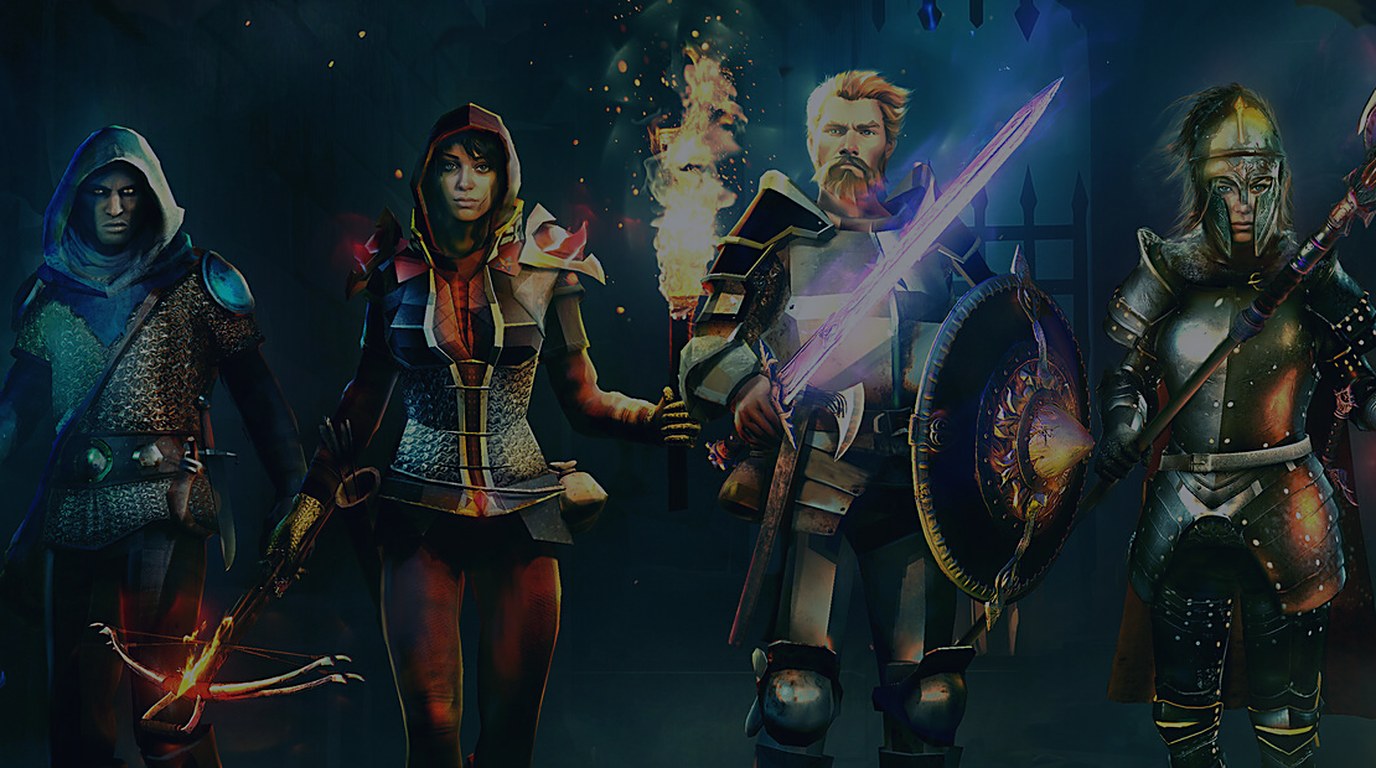
I spent a run in Dungeons of Eternity the way it’s meant to be played: back against a cold stone wall, a sword in my right hand and a throwing axe in my left, watching a skeleton wind up a swing I could actually read because the weapon physics don’t cheat. When I knocked its blade aside and drove mine through its ribs, the body didn’t pop out of existence with a particle puff. It folded. That single motion is the whole pitch.
What you’re buying
Dungeons of Eternity is VR-native. Othergate built it for the headset from the first line of code, and there is no flat version you’re missing out on. You buy it on the Quest store or on Steam and you’re inside the game. No mod manager, no bindings file, no “does it work in VR yet” anxiety hanging over the purchase. The studio is Othergate, founded in 2021 by people who shipped VR at Oculus before that, with Herobound and Dead and Buried on their résumé, and you can feel that history in how the combat lands.
Swing first, ask later
Combat is the reason this game exists, and it runs on physics rather than hitboxes. You swing a sword and the arc, the speed, and the angle of contact decide the outcome. There is no auto-connect. A mace to the side of a skull does what a mace to the side of a skull should, and axes stick where you throw them before the magnetic-grab return flies them back to your hand so you’re never left defenseless. Bows, crossbows, and magic staffs cover the ranged side, and shields let you actually block instead of dodge-rolling through every encounter.
The inventory is part of the fight. Waist holsters and back slots mean you’re reaching behind you and to your hip, swapping a sword for a spear in the middle of a melee. Any two one-handed weapons can be dual-wielded, so a sword-and-axe loadout is a genuine choice. There are no character classes here. Your build is your weapons plus the stat upgrades you pour into your Exosuit, which is a cleaner fantasy-role system than half the genre’s class trees.
The dungeon that rebuilds itself
The dungeons are stitched together from hundreds of hand-built chambers, crypts, ruined castles, and caverns, and the game has well past thirty of them to pull from by now. No two runs assemble the same way. You drop into a Dungeon Raid, clear the rooms, grab what’s worth grabbing, and extract, or you take on Soul Harvest and stand against waves, or Crystal Hunt and defend a point. Sandbox arena and an experimental four-player PvP Deathmatch showed up in later updates, and the co-op headcount climbed from three players at launch to four. The randomization is the engine that keeps the loop from going stale, and after a hundred runs I was still hitting room combinations I hadn’t seen.
Loot, levels, and the Outpost
Progression lives in your Exosuit and your level, which capped at fifty at launch and climbed to sixty. You earn upgrades by surviving, and the loot you haul back changes how the next run plays rather than just inflating a number. The hub, called the Outpost, feels like a place. There’s a physical map table, a workbench, a teleporter to ready up with your group, and spherical mini-map projectors floating in the air. Road to VR handed the game its 2023 UI design award largely on the strength of these stations, and it’s earned. Othergate shipped more than it launched with, and kept shipping: longswords, spears, a sickle, Nightmare difficulty, four-player co-op, and the PCVR port all landed after the doors opened.
Built for a group
This is a co-op game first. It supports one to four players, and the downed-recovery mechanic means a fallen teammate isn’t an instant wipe, which matters when you’re dragging a friend who’s never held a sword in VR before. Solo is fully supported and has been playable offline since late 2023, though the cloud saves still want an internet connection at some point. Cross-play runs through room codes and cross-save links your Quest and Steam accounts, so the group you raid with doesn’t have to own the same hardware. bHaptics support and a LIV creator kit mean the game plays nice with the broader VR ecosystem, not just the headset on your face.
Where it shows its seams
Start with the story, because there isn’t much of one. It takes a back seat to the fighting, and that’s the honest shape of it: you’re here to swing, not to follow a plot. The launch version was thinner than what’s there now. More than one reviewer walked in cold at release, shrugged, and then revised their verdict upward after the updates landed, which tells you the day-one build and the current one are different games in weight if not in name. Solo play thins out after a dozen runs once the randomization stops feeling fresh and the lack of a world to inhabit starts to show. The studio earned the rating it has, but you’re buying the matured version, not the day-one one.
Reach is the other limit. The game lives on Quest and PCVR. There’s no PSVR2 or Pico build, and that’s a purchasing fact. If your headset isn’t one of those two, this isn’t your game yet.
The long game
UploadVR gave it their Essential rating and named it Best Multiplayer VR Game of 2023, and the creator coverage hasn’t stopped since, which is the signal I actually trust: people keep coming back to it across updates. That’s the real test for a game built on randomized rooms. The combat is physical in a way flat dungeon crawlers can’t touch, the loot loop gives every run a reason, and the group you drag in becomes the point.
If you own a Quest or a PCVR headset and you’ve got at least one friend willing to sword-fight with you, this is one of the best co-op action games built for VR, plain and simple. Play it solo if you must, but know the seams show faster alone. Bring a group, put a weapon in each hand, and let the dungeon surprise you. It will.