
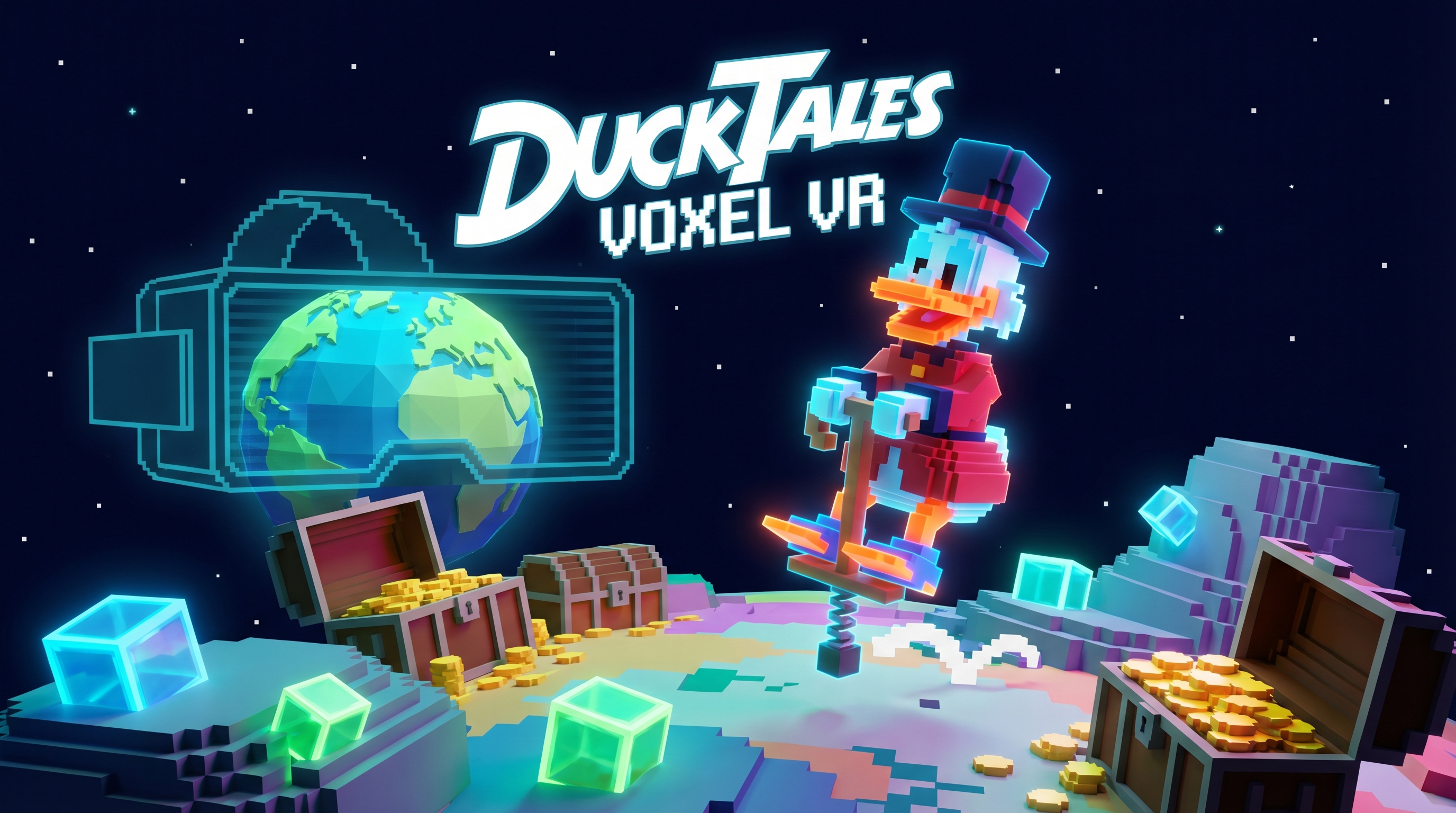
Duck Tales in VR: The Pogo-Cane Adventure Goes Dimensional
Duck Tales didn’t just define licensed game excellence—it proved that a Disney property could inspire genuine mechanical depth. When Capcom released Scrooge McDuck’s treasure-hunting quest in 1989, they created something that still resonates: the pogo cane, non-linear level selection, and the Moon Theme that still lives in players’ heads decades later.
Experiencing Duck Tales in VR through 3dSen VR transforms those 8-bit landscapes into genuine spatial environments. The voxel-based 2D-to-3D conversion adds depth that makes the Amazon, Transylvania, and the Moon feel more like real places—and for a game built on exploration and discovery, that added dimension matters.
VR Routes Comparison
| Route | Platform | Experience Type | Setup Difficulty | Cost | Best For |
|---|---|---|---|---|---|
| 3dSen VR | PCVR | Voxel diorama | Easy | $14.99 | Classic NES Duck Tales in 3D |
| 3dSen VR MR | Quest | Mixed reality diorama | Easy | $14.99 | Playing in your actual room |
| EmuVR | PCVR | Virtual retro bedroom | Medium | Free | Authentic CRT nostalgia |
What VR Routes Exist
3dSen VR — Voxel Transformation
3dSen VR is a specialized NES emulator that converts classic 2D games into explorable 3D voxel environments. For Duck Tales, this algorithmic transformation fundamentally changes how you perceive the game’s varied landscapes.
The conversion process:
- Treasure chests and gems become genuine 3D objects with depth
- Pogo cane bounces trace through actual Z-space
- Platforms and ledges gain tangible spatial relationships
- Boss arenas become enclosed chambers rather than flat planes
- Background layers separate convincingly from foreground action
The game’s pogo mechanics, enemy patterns, and treasure-hunting flow remain identical to the NES original—only the visual presentation changes.
3dSen VR Mixed Reality — Treasure Diorama in Your Space
On Meta Quest, 3dSen VR offers a mixed reality mode using passthrough cameras. Duck Tales’ voxel diorama appears floating in your real environment—whether that’s placing Scrooge’s adventure on your coffee table or letting the Moon stage tower in your living room.
The MR mode is particularly effective for Duck Tales because:
- The bright, colorful palette pops against real environments
- The compact level design works well as a tabletop diorama
- You can position yourself around stages for optimal viewing angles
- The varied environments create striking visual variety in your space
EmuVR — Authentic Retro Bedroom
EmuVR takes a preservationist approach—recreating the complete retro gaming experience rather than transforming the game. You enter a virtual 80s bedroom, physically insert the Duck Tales cartridge into a NES, and play on an authentic CRT television with accurate scanlines and phosphor glow.
For Duck Tales specifically, the CRT simulation enhances the experience:
- The warm glow softens the vibrant color palette
- Scanline patterns integrate the pixel art beautifully
- The Moon Theme’s visual accompaniment feels appropriately retro
- The virtual CRT accurately displays the game as originally intended
This is 2D gameplay on a virtual screen—but the ritual and authenticity have their own appeal.
How It Plays
The Voxel Treasure Hunt
Loading Duck Tales in 3dSen VR immediately showcases the transformation. The opening cutscene and level select screen gain genuine depth—you can see into the environments, and those treasure chests feel more tangible.
The conversion handles Duck Tales’ specific visual elements well:
Environments:
- The Amazon’s jungle foliage has proper thickness and layering
- Transylvania’s haunted mansion gains architectural depth
- The African Mines’ cavernous spaces feel genuinely underground
- The Himalayas’ icy peaks gain spatial presence
- The Moon’s alien landscape becomes an actual place
Gameplay Elements:
- Treasure chests and gems exist in 3D space
- Platforms and ledges have genuine depth relationships
- Enemies (Beagle Boys, ghosts, aliens) occupy real space
- Boss encounters gain dimensional presence
Scrooge and Animation:
- Scrooge’s sprite maintains its charm in voxel form
- The iconic pogo-cane bounce animation translates well
- Walking and climbing animations preserve their character
- The idle animation (counting money) gains charm in 3D
Controls and Input
3dSen VR is not a motion-controlled reinterpretation—you play with a gamepad exactly as on the NES. The VR layer is purely visual.
What VR adds:
- Spatial awareness: Distance to platforms becomes more intuitive
- Environmental immersion: You’re inside the levels rather than viewing them
- Cinematic framing: Free camera for screenshots and examination
- Presence: The varied world feels more tangible
What VR doesn’t change:
- Input lag, timing windows, and hitboxes remain identical
- The pogo-cane physics are preserved exactly
- Enemy AI patterns and spawn points unchanged
- Level layouts and secrets untouched
Comfort and Performance
Duck Tales in 3dSen VR runs perfectly across all platforms:
PCVR: Handles the NES emulation and voxel conversion with minimal resources. Works on any VR-capable PC from the last decade.
Quest (Native): The standalone Quest version runs Duck Tales flawlessly. The voxel transformation is computed efficiently, and frame rates are rock solid.
Quest (MR Mode): Passthrough mode introduces minor overhead but remains smooth. The colorful Duck Tales palette contrasts beautifully with real-world environments.
Comfort Rating: Comfortable. The camera remains fixed during gameplay with smooth transitions between screens. No artificial locomotion or intense camera movements.
The Profile System
3dSen VR uses game-specific profiles—hand-tuned configurations that tell the engine how each game’s sprites should convert to 3D. Duck Tales benefits from dedicated profile work:
- Proper layer separation for foreground/background
- Correct voxel colors and materials
- Optimized camera positioning for platforming visibility
- Fine-tuned depth values that preserve the pogo-cane precision
What This VR Option Actually Is
3dSen VR — Emulation with Dimension
3dSen VR is a commercial NES emulator (approximately $14.99) that specializes in real-time 2D-to-3D voxel conversion. It’s not a VR-native remake of Duck Tales—it’s the original NES ROM running in an emulator that happens to render the output as explorable 3D voxels.
What it provides:
- Full NES Duck Tales compatibility (USA, Europe, Japan versions)
- Real-time voxel conversion with adjustable depth
- Multiple viewing angles (fixed for gameplay, free for exploration)
- Mixed Reality mode on Quest
- Gamepad-based controls (no motion controls)
What it doesn’t provide:
- Motion-controlled pogo-cane gameplay
- Remastered graphics or textures
- Modern quality-of-life features (save states are available)
- Native VR interaction systems
EmuVR — Preservation Through Presence
EmuVR (free) takes a different approach. Rather than transforming the game visually, it transforms the context—you’re physically present in a virtual 80s bedroom, inserting cartridges, adjusting CRT settings, and playing on an authentic television.
For Duck Tales, EmuVR provides:
- The exact original NES presentation
- Authentic CRT scanlines and phosphor glow
- Physical cartridge-handling ritual
- Retro bedroom atmosphere
What it doesn’t provide:
- Any visual transformation of the game itself
- 3D depth or spatial presence in the gameplay
- Modern enhancements of any kind
How It Plays
The Pogo-Cane Precision
Duck Tales lives or dies on its signature mechanic: Scrooge’s cane pogo. Holding the button mid-jump causes Scrooge to bounce continuously, allowing him to cross hazards, reach high platforms, and defeat enemies by bouncing on their heads.
Each VR option handles this core mechanic:
3dSen VR:
- Fixed camera angle ensures depth perception matches classic gameplay
- The Z-depth actually helps with distance judgment to platforms
- Optional viewing modes let you adjust perspective for comfort
- The diorama framing keeps action framed and focused
- The pogo bounce animation gains charm in 3D space
Mixed Reality:
- You can physically walk around the diorama to find optimal viewing angles
- Tabletop placement keeps the entire level visible at comfortable distance
- Real-world lighting helps with depth perception
EmuVR:
- Pure 2D representation—play exactly as original
- CRT simulation may actually help with timing (visual rhythm of scanlines)
- No 3D complications to affect muscle memory
Non-Linear Level Selection
Duck Tales lets players choose their order of stages (Amazon, Transylvania, African Mines, Himalayas, Moon), with the Moon typically saved for last. Each environment has distinct visual character:
The Amazon:
- Vine-swinging sections gain depth in voxel conversion
- River hazards become more tangible
- Treasure chests feel more rewarding when spatially present
Transylvania:
- The haunted mansion benefits most from 3D transformation
- Ghosts and haunted furniture gain presence
- Hidden passages feel more mysterious
African Mines:
- Underground caverns gain genuine spatial depth
- Mine cart sections (if present in specific version) become more dynamic
- Darkness and torch lighting gain atmosphere
The Himalayas:
- Ice physics and slippery platforms remain precise
- Snowy peaks gain vertical presence
- The yeti encounter feels more imposing
The Moon:
- Perhaps the most visually striking conversion
- Low gravity sections become more atmospheric
- The alien landscape gains genuine otherworldliness
- The Moon Theme plays over a genuinely dimensional scene
Boss Encounters
Duck Tales’ bosses—the Amazon’s gorilla, Transylvania’s Dracula Duck, the Moon’s alien king—each present unique challenges. The 3D transformation affects them:
3dSen VR:
- Boss arenas become enclosed chambers with depth
- The gorilla’s charging attacks gain spatial presence
- Dracula Duck’s transformations feel more theatrical
- Projectiles and attacks move through 3D space
The Boss Experience:
- Larger sprites translate well to 3D voxels
- Health bars and gameplay elements remain 2D overlays
- The framing keeps boss action centered and visible
- Optional camera zoom for detailed examination
Platform Differences
PCVR vs. Quest
PCVR Advantages:
- Higher resolution rendering if you have a capable GPU
- Potential for supersampling if hardware allows
- Easier ROM file management via desktop file system
- Access to Steam Workshop features
Quest Standalone Advantages:
- No PC required—completely wireless
- Native Mixed Reality support (PCVR requires additional setup)
- More convenient for quick sessions
- Better integration with Quest system features
Recommendation: Both versions work excellently. Choose based on your hardware setup and preference for wired vs. wireless play.
What Works Well
Visual Atmosphere: The voxel conversion enhances Duck Tales’ colorful aesthetic without changing its character. The varied environments—jungles, mansions, mines, mountains, moon—each gain genuine depth and presence.
Signature Mechanics Intact: Everything that matters—the pogo-cane timing, the hidden treasures, the non-linear progression—remains untouched. This is still Duck Tales, just viewed differently.
Performance: Runs flawlessly across all platforms. The voxel conversion doesn’t strain hardware.
Profile Quality: Duck Tales has a well-tuned 3dSen profile—depth values are calibrated for optimal platforming visibility.
Mixed Reality Potential: Duck Tales’ bright colors and varied environments make it one of the more visually striking games in passthrough mode.
The Music: The Moon Theme (and the entire soundtrack) plays exactly as you remember, now accompanying a visually dimensional adventure.
What Doesn’t Work
No Motion Controls: This isn’t a VR-native Duck Tales with pogo-cane motion controls. You can’t physically bounce Scrooge—you press buttons on a gamepad.
Fixed Camera Gameplay: While you can examine levels from different angles, actual gameplay happens from a fixed perspective. Free camera is for viewing, not playing.
Visual Depth vs. Mechanics: The 3D transformation is purely visual. Don’t expect your pogo cane to have actual depth range changing based on viewing angle.
No 3D Audio: Sound remains in stereo—there’s no spatial audio implementation for enemy positioning or environmental ambience.
ROM Requirement: You must provide your own Duck Tales ROM. 3dSen VR is an emulator frontend, not a game distribution platform.
Limited Modern Features: While 3dSen VR offers some enhancements (save states, rewind, fast forward), this is fundamentally the 1989 NES game with all its period-appropriate limitations.
Who This Is For
3dSen VR is perfect for:
- Duck Tales fans who’ve memorized every treasure location and want to see it differently
- Retro platformer enthusiasts seeking the definitive modern presentation
- VR headset owners looking for experiences that justify the hardware
- Players curious about 2D-to-3D transformation technology
- Anyone who wants the Moon Theme to hit even harder
3dSen VR Mixed Reality is perfect for:
- Quest owners who want to integrate VR into real spaces
- Users sensitive to full VR immersion (MR reduces motion sickness)
- Anyone who loves the “magical diorama” aesthetic
- Parents sharing classic games with children in a novel format
EmuVR is perfect for:
- Historical preservationists who want to experience games as originally presented
- Collectors lacking physical space for CRT setups
- Players who prefer authenticity over transformation
Not for:
- Players seeking motion-controlled pogo-cane gameplay
- Those wanting modernized graphics beyond the voxel conversion
- Users unwilling to source their own ROMs
- Players who need modern conveniences (though save states exist)
- Anyone expecting a full remake rather than an enhanced emulation
The Verdict
Tier: A
Game Quality: A Duck Tales is NES platforming at its finest. The pogo-cane mechanic remains satisfyingly precise, the non-linear structure feels fresh even decades later, and the Moon Theme is genuinely iconic. Capcom’s licensed game craftsmanship shines through every pixel.
VR Implementation Quality: A- The voxel transformation respects Duck Tales’ aesthetic while adding meaningful depth. Colorful environments gain genuine presence, treasure chests feel more tangible, and the varied world becomes more immersive. The profile is well-tuned for gameplay visibility. Some may wish for motion controls, but as an enhanced emulator, this is exemplary.
EmuVR Implementation Quality: B+ Excellent CRT simulation and authentic retro setup, but for Duck Tales specifically, the 3D transformation of 3dSen VR offers more novelty. EmuVR is about the ritual—worthwhile if that’s what you value.
Overall Tier: A
Duck Tales in 3dSen VR represents what flat-to-VR conversions should aspire to: enhance without compromise. The colorful environments gain genuine dimension, the pogo-platforming remains precise, and the visual presentation feels like rediscovering a classic through new eyes.
For fans of NES platformers—particularly those who appreciate Duck Tales’ signature mechanics and varied level design—3dSen VR offers the definitive way to replay Scrooge McDuck’s adventure. The voxel conversion doesn’t try to modernize beyond what serves the experience; it simply adds the dimension that hardware limitations prevented in 1989.
Scrooge’s treasure hunt has never felt more tangible. The Moon Theme has never played over a more dimensional landscape. And for the price of a few coffees, you can experience one of platform gaming’s most beloved licensed titles in what may be its most compelling presentation.
Life is like a hurricane—and in 3dSen VR, that hurricane has depth.