
I didn’t expect Dr. Mario to make sense in a headset. It’s a 1990 falling-block puzzler: pills, viruses, a tiny board. There’s no world to explore, no first-person perspective to sell, no action that maps to your body. The whole appeal is clean, fast, two-dimensional decision-making. So when I started looking for VR paths, I assumed the honest answer was “don’t bother.”
Then I tried it in 3dSenVR.
It turns out the answer isn’t “don’t bother” — it’s “bother, but only if you use the one path that actually converts it.”
Two very different ways to pill-drop in a headset
The important thing to know up front: Nintendo has never made a VR version of Dr. Mario. Every option is third-party. That splits cleanly into two experiences.
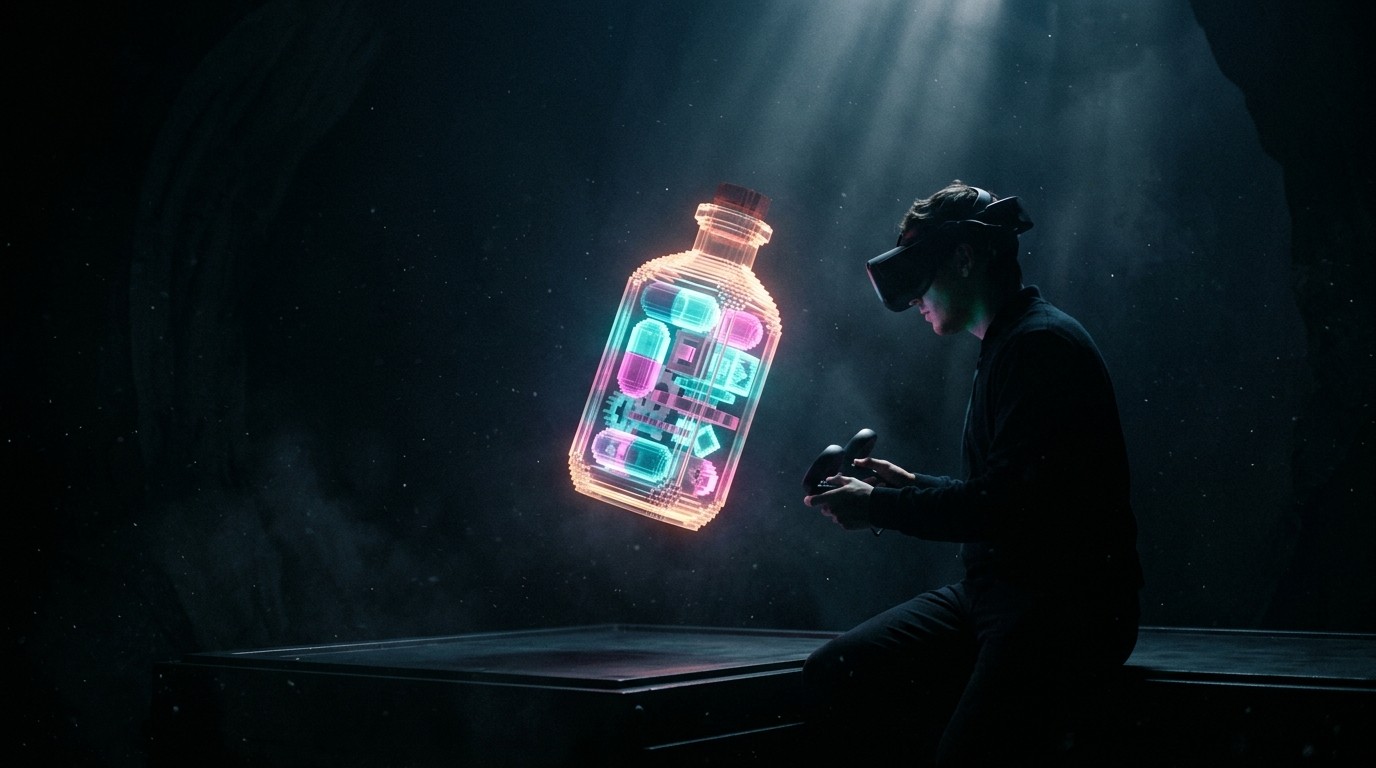
3dSenVR is the one that matters. It isn’t a virtual screen with a ROM taped to it; it’s a dedicated NES emulator that reconstructs 2D games into 3D voxel dioramas in real time. Dr. Mario has a native profile. The board becomes a physical object floating in front of you, the pills and viruses stack with visible depth, and the whole thing feels less like “playing a retro game in VR” and more like leaning over a toy puzzle box.
EmuVR is the other side of the coin. It puts you in a 1990s bedroom, turns your ROM collection into cartridges and discs, and lets you play on a virtual CRT. Dr. Mario runs beautifully in it — but it’s still the flat 2D game on a virtual screen. The nostalgia is thick and the room presence is real; the puzzle itself is not meaningfully different from playing on your monitor. That’s fine, but it’s a different category of experience.
The rest of the landscape is basically dead ends. VorpX can’t inject into a ROM. UEVR doesn’t apply because Dr. Mario has no Unreal Engine release. Dolphin VR is for GameCube/Wii (and the 3D-rendered Dr. Mario 64 if you want to go there, but that’s a different game from 2001, not the 1990 classic). You can sideload a bare RetroArch NES core on standalone Quest and play on a flat virtual screen, but at that point you’re getting neither the 3dSenVR depth nor the EmuVR bedroom.
What 3dSenVR actually feels like
The hook is immediate: you load Dr. Mario and the board is no longer flat. The bottle outline, the virus clusters, the falling capsules — all of it has thickness, shadows, and parallax. You can lean in and look around it. The colors pop more than they have any right to, because the voxel style adds a tangible toy-block quality that the original sprites only implied.
Controls are simple. You can use a gamepad or map motion controllers; for a puzzle game this sedentary, a gamepad is honestly preferable. There’s no room-scale nonsense, no artificial locomotion, no motion-sickness risk beyond whatever the headset already gives you just by existing. I played seated, head forward, hands on a controller, dropping pills for forty-five minutes. It felt like the most natural version of “retro puzzle game in VR” I’ve found — because it doesn’t pretend the game was designed for motion controls. It just gives the classic design a spatial stage.
Performance is easy. This is an NES emulator at its core; a mid-range PC pushes it without effort. The 3D reconstruction is lightweight compared to any modern VR title, so framedrops and reprojection are essentially a non-issue if your SteamVR/OpenXR setup is healthy.
The experience isn’t perfect. The 2P mode has a reported HUD glitch where virus counts don’t display cleanly. You have to supply your own ROM. And at $24.99 for 3dSenVR, you’re paying for the engine and its library of profiles, not just Dr. Mario. Whether that’s worth it depends on how many NES games you want to revisit this way.
EmuVR: the nostalgia play
If 3dSenVR is “the game remade as a 3D object,” EmuVR is “you, in your childhood bedroom, with a CRT.” The Dr. Mario cartridge appears on the shelf. You pick it up, blow on it (not required, but the gesture is there in spirit), slot it into a virtual NES, and turn on the TV. The music starts. You’re playing the exact flat game, unchanged, on a simulated tube television.
It’s free, which is nice. The setup is heavier than 3dSenVR because EmuVR is really a wrapper around RetroArch: install EmuVR, point it at your ROM folders, make sure the right libretro core is configured, and then learn the room controls. Expect a session of tinkering before you’re comfortably seated with a controller in the virtual bedroom.
Comfort is also high here. Seated, no motion, stable horizon. The appeal is emotional, not mechanical. If you want to feel what it was like to play Dr. Mario on a Saturday morning in 1990, EmuVR is the closest thing I’ve found. If you want Dr. Mario to actually do something it couldn’t do on a flat screen, it doesn’t.
Skip the others
I looked at the usual suspects so you don’t have to. VorpX has nothing to hook into for a thirty-five-year-old console ROM. UEVR only targets Unreal Engine PC games. Dolphin VR doesn’t cover the 1990 NES release at all. And the various Mario fan-made VR projects floating around itch.io and SideQuest are Super Mario Bros.-style platformers, not Dr. Mario.
The standalone Quest angle is a common question, and the short answer is: not meaningfully. You can run a bare RetroArch NES emulator on Quest and view it on a virtual screen, but you lose both the 3dSenVR depth conversion and the EmuVR room simulation. It’s the worst of both worlds unless you have no PCVR option at all.
Who this is really for
Dr. Mario in VR is never going to be the reason you bought a headset. It’s a novelty — but a good one, specifically for people who already love the game or love the idea of classic NES puzzlers reimagined as physical objects. 3dSenVR makes it a genuinely better spatial experience; EmuVR makes it a more emotional one. Pick whichever payoff matters to you, or skip both and keep playing on a flat screen, where Dr. Mario is still excellent.
For my money, 3dSenVR is the only path that justifies putting the headset on. It’s a B-tier VR experience overall: the game itself is great, the conversion is clever and comfortable, and it never pretends to be more than it is. That’s enough.