
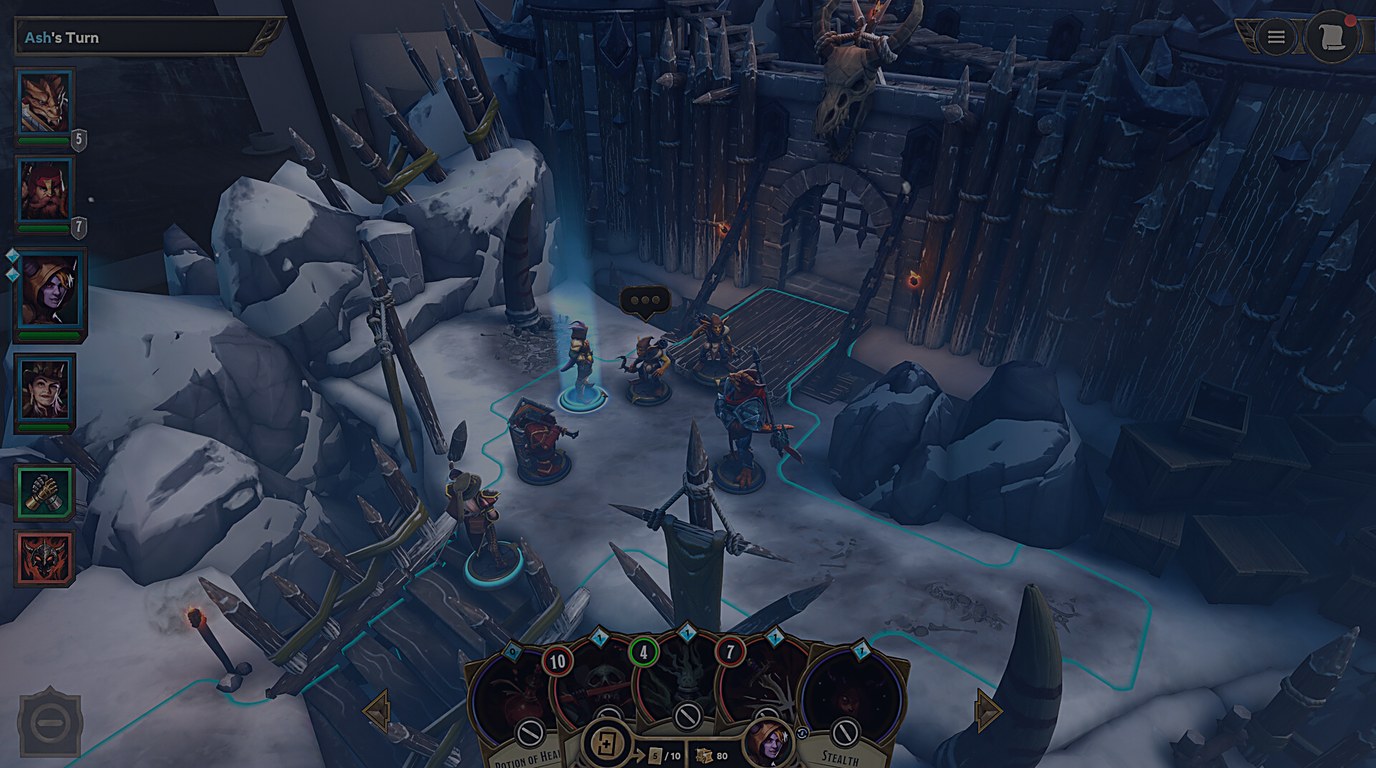
I leaned over the table, grabbed a miniature off the board, and slid it three squares into a pool of goblin-red light. The goblins didn’t move — they were waiting for my turn. In a flat game that’s a mouse click and a camera pan. In Battlemarked it’s me, hunched over a stone tavern floor, physically pushing my rogue into position while my friend’s wizard leans in from the other side of the same table in another state.
The board game you climb inside
Demeo x Dungeons & Dragons: Battlemarked is what happens when Resolution Games — the Swedish studio that already proved a VR headset can be a gaming table with Demeo — gets the actual D&D license. This isn’t a flat game with a VR patch bolted on after the fact. It shipped as a native VR title on day one, the same November 2025 launch, on Quest, PSVR2, Steam PCVR, and Pico. You buy it from the store, you install it, you’re in. There is no mod, no injector, no framework profile, no “does it work in VR” question — the VR version is the product.
What you’re buying is a diorama-scale, turn-based tactical RPG. Think of a physical D&D board session shrunk to fit on a coffee table you’re standing over, then populated with licensed monsters, classes, and spell lists. Up to four players take turns moving miniatures, drawing action cards, and resolving combat on a grid. The camera is a board you look down at, not a first-person body you walk around in. That single design decision is why this is Native VR and not a Half-Life: Alyx — and why it’s also the thing that decides whether you’ll love it.
Casting a spell is still a card flip
The controls are motion controllers doing exactly what your hands would do at a real table. You reach in, pick up a piece, place it. You draw from your hand of action cards and flick one onto the board to cast or attack. Resolution ships this with tracked controllers and full hand presence — there is no gamepad-only fallback for the VR build, which is the correct call for a game whose entire vocabulary is “pick up the thing and move it.” It’s a Comfortable, seated experience by nature: no artificial locomotion, no vomiting-inducing sprint, just you and the board. If your VR legs are shaky, this is one of the gentlest things you can put on the headset.
Where the D&D license actually pays off
The Demeo lineage is obvious the second you sit down — same grid, same card-driven actions, same readable diorama. What Battlemarked adds is the weight of the license. The three campaigns ship with named D&D monsters and classes that carry a familiarity a generic tabletop clone never gets. When my wizard’s fireball card resolves into a cone of damage across the goblin cluster, it reads as D&D in a way no house-ruled knockoff could fake. It’s the closest thing to “I’m running a real session” the headset has managed, and for a franchise whose entire identity is the shared table, that’s the point.
The structure is three campaigns of turn-based missions, played single-player or co-op. The pacing is the opposite of an action game: you spend real minutes reading the board, positioning, and deciding which card to burn. For the right player that’s the entire appeal. For someone who bought a headset to swing a sword, it’s going to feel like homework with better lighting.
The catch is the genre, not the tech
Who this isn’t for matters, because the tech will not save it. Battlemarked is a slow, deliberate, turn-based tactics game. There is no wow moment of scale, no set-piece spectacle, no reason to gasp at the world the way you would inside Skyrim’s peaks or Alyx’s vaults. The diorama is charming and the miniatures are characterful, but you are looking at a board, not inhabiting a place. For an S-tier VR experience what usually pushes it over the line is a world worth living in — and a tactical tabletop, however polished, is a puzzle you admire, not a home you move into.
That’s the real reason this lands at A and not S. The VR implementation is essentially flawless for what it is: native, comfortable, cross-play across everything, zero setup. But the experience doesn’t transform your body or your sense of place the way the headset’s best do. It transforms a board game into a shared room, which is the point.
The other honest note is depth-versus-patience. If you came up through Demeo and wanted “the Demeo 2 we asked for,” this is that game with the official license and three campaigns. If you didn’t, the card system can feel thin against deeper tactics games, and the campaign structure is familiar rather than surprising. Neither is a flaw in the build; both are boundaries on who should pick it up.
Bottom line
Battlemarked is the strongest argument yet that VR’s killer use for tabletop gaming isn’t novelty — it’s presence at the table. Resolution Games shipped a native, comfortable, cross-platform tactical RPG that lets your headset-owning self and your console-owning friends share one board without anyone installing a mod or learning a new ecosystem. It won’t blow your mind the way a spectacle game will, and it asks for patience the way any tactics game does. But if you’ve ever wanted to run a D&D session from inside the headset, this is the one to put on — and it’s the version of Demeo the franchise has been building toward since 2021.